Advances in Engineering Advances in Engineering features breaking research judged by Advances in Engineering advisory team to be of key importance in the Engineering field. Papers are selected from over 10,000 published each week from most peer reviewed journals.

Significance
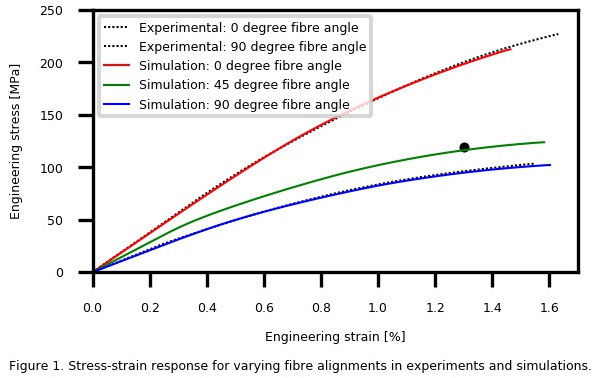
Desirable attributes, such as: corrosion resistance, high specific strength and geometrical freedom make injection moulded glass fibre reinforced plastics popular among designers. These outstanding properties help minimize the environmental impact, cost and weight of load bearing components. The primary drawback they suffer is that they tend to show both non-linear and strong anisotropic material behaviour, which render their in-use behaviour unpredictable. Injection moulding simulations are able to provide second order orientation tensors which describe the local fibre orientation, however they are not commonly combined with structural simulations. In addition, due to the complex mechanisms behind the mechanical behaviour of fibre reinforced polymers, material parameters governing plasticity and damage need to be determined by optimizing the simulation response towards experimental stress-strain curves for known geometries and fibre orientations.
Recently, Jönköping University researchers in Sweden: Johan Jansson (PhD candidate), Engineer Tim Gustafsson, Dr. Kent Salomonsson, Dr. Jakob Olofsson, Dr. Joel Johansson in collaboration with Engineer Peter Appelsved at Kongsberg Automotive and Mikeal Palm at Husqvarna Group developed a new method that would enable accurate prediction of the anisotropic and non-linear behaviour of glass fibre reinforced plastics using finite element methods. They developed and implemented a material model so as to remedy the need of multiple material definitions, and to control the local plastic behaviour as a function of the fibre orientation. Their work is currently published in the research journal, Composite Structures.
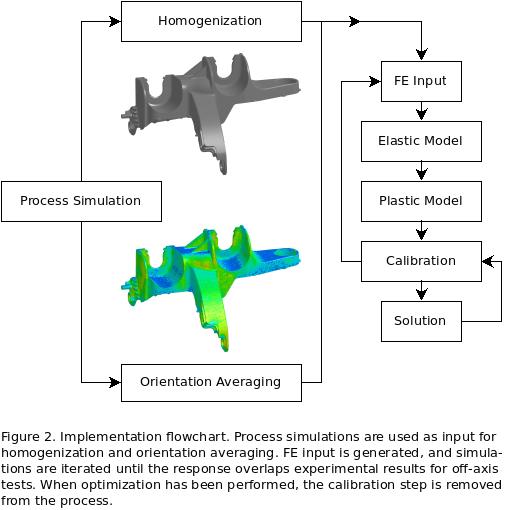
In brief, the research method employed entailed giving analytically the elastic behaviour of each element, by an orientation averaged and extended Mori-Tanaka homogenization scheme, applicable to materials of higher fibre volume fractions by considering the fibre-fibre interactions. Additionally, the researchers described the plastic behaviour phenomenologically by a hardening functional, given in terms of hardening polynomials which were defined by experimental stress-strain data and parameter optimization using simulations. All in all, fourth order tensors were used in combination with traditional methods to provide more accurate material properties.
The authors observed that it was possible to capture the stress-strain behaviour of the tensile tests with good accuracy by optimizing the material model. More so, they noted that the developed calibration process resulted in material specific hardening polynomials, which could be used to model other geometries using the same material. The elastic and plastic material behaviour were also seen to vary locally as a function of the fibre orientation.
In summary, Swedish scientists successfully presented a methodology that uses different material properties in every material point with one material definition. They emphasize that by using more advanced material models, potential weight reductions in industrial components is made possible. Altogether, the presented material model can support design engineers in making more informed decisions, allowing them to create smarter products without the need of excessive safety factors, leading to reduced component weight and environmental impact.
“By developing tools which make it easier for design engineers to consider the influence of the manufacturing process in subsequent structural simulations, we hope to increase the potential for weight reduction and performance optimization in industrially manufactured components. The general methodology does not only apply to injection moulded components, but really to any process which yields local property variations in the manufactured component, such as casting, forging, etc.” Said Johan Jansson in a statement to Advances in Engineering.







Reference
J. Jansson, T. Gustafsson, K. Salomonsson, J. Olofsson, J. Johansson, P. Appelsved, M. Palm. An anisotropic non-linear material model for glass fibre reinforced plastics. Composite Structures, volume 195 (2018) page 93–98.
Go To Composite Structures