 Advances in Engineering Advances in Engineering features breaking research judged by Advances in Engineering advisory team to be of key importance in the Engineering field. Papers are selected from over 10,000 published each week from most peer reviewed journals.

Significance
Presently, fossil fuels have been ranked among the highest contributors to environmental pollution and global warming through the emission of greenhouse gases. Among the available fossil energy sources, coal has been widely used to provide energy for various applications. Therefore, to promote utilization of coal with regard to current global regulations on pollution, development of more efficient and clean technologies for exploitation and utilization of coal is highly desirable. As such, researchers have been looking for alternatives for efficiently converting coal into fuels without polluting the environment and have identified supercritical water gasification as a promising solution. Furthermore, supercritical water fluidized bed has also been identified as the most suitable reactor for the coal conversion process. Unfortunately, the limitations of the design process involved in developing supercritical water fluidized bed have negatively affected the overall gasification process.
Recent studies have shown that the problem could be solved through investigation of the fluidization properties and their effects on the development of the supercritical water fluidized bed reactors. Alternatively, a lot of emphasize has been given to the transition of the fluidized bed including the initial velocity, the pressure drops of the bed and expansion. This, however, has not provided adequate information for understanding the fluidization properties of the supercritical water fluidized bed attributed to the neglection of the bubble hydrodynamics due to the limitations of the available measuring systems.
To this note, Xi’an Jiaotong University researchers: Dr. Jikai Huang, Professor Youjun Lu and Dr. Hao Wang developed a dual-capacitance probe measuring technology to enable the experimental study of the bubble hydrodynamics in supercritical water fluidized beds. Specifically, the probe was used to measure the rising velocity, frequency and the bubble size in the supercritical water fluidized bed. Their research work is currently published in the research journal, Industrial & Engineering Chemistry Research.
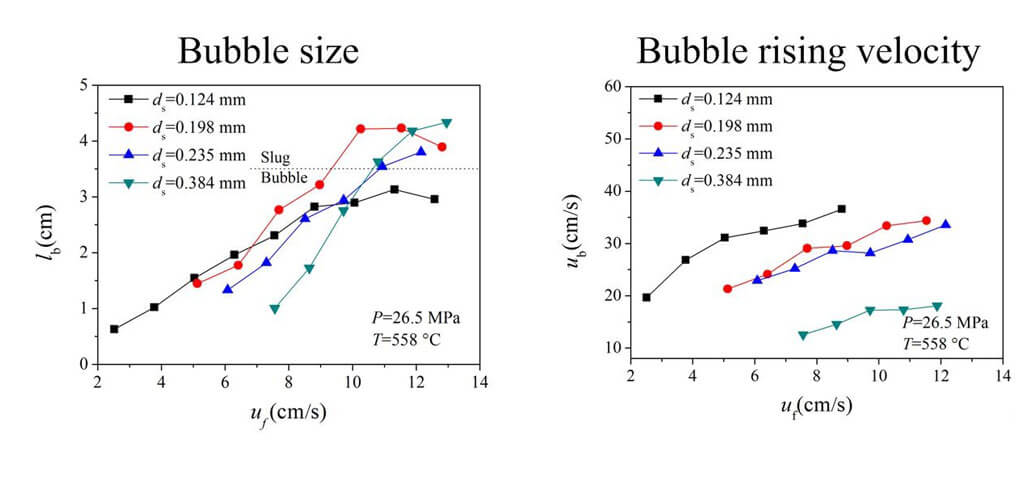
In brief, the authors commenced their experimental work by preparing four different particle sample groups with different mean diameters. Next, the particles were fluidized using supercritical water in a temperature range of 410°C- 570°C and pressure rage of 20-27MPa. In particular, they examined the influence of the various operating parameters on the bubble parameters like size and frequency.
It was necessary to take into consideration the bubble hydrodynamics rules. The authors observed that the bubble size was linearly proportional to the superficial velocity and inversely proportional to the system pressure, temperature, and diameter of the particle. In addition, it was worth noting that fluidizing smaller particles resulted in a faster rise in the bubbles with the same size as compared to those in bigger particles.
In summary, Xi’an Jiaotong University researchers were the pioneers in the study of fluidization of particles in supercritical water, and successfully investigated bubble hydrodynamics based on fluidization of particles. To actualize their study, correlations of the bubble rising velocity and bubble diameter were proposed with minimal relative error. Altogether, the study provides essential information that will further advance the design and development of efficient reactors for future use in the research on fluidization and bubble hydrodynamics under extreme operating conditions.


Reference
Huang, J., Lu, Y., & Wang, H. (2019). Fluidization of Particles in Supercritical Water: A Comprehensive Study on Bubble Hydrodynamics. Industrial & Engineering Chemistry Research, 58(5), 2036-2051.
Go To Industrial & Engineering Chemistry Reaserch