 Advances in Engineering Advances in Engineering features breaking research judged by Advances in Engineering advisory team to be of key importance in the Engineering field. Papers are selected from over 10,000 published each week from most peer reviewed journals.

Significance
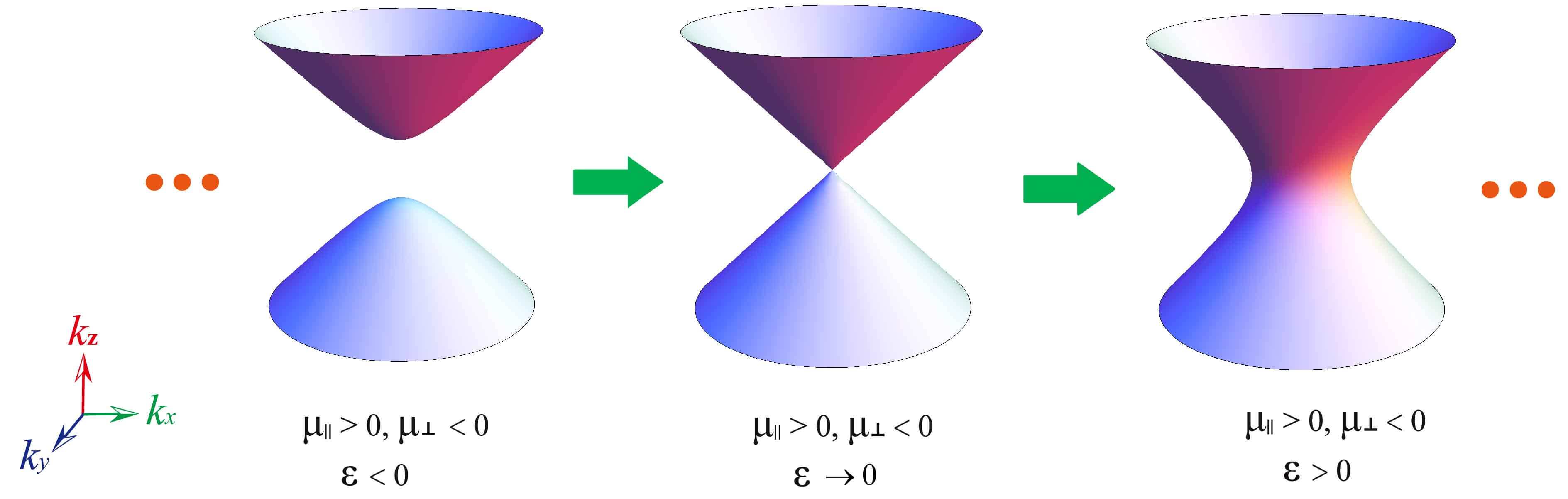
Amongst the established fundamental facts of optical metamaterials, one stands out. They possess different photonic dispersions characteristics that enable emission of light in various ways. In a recently published literature, it has been shown that the transition of iso-frequency contour between elliptical and hyperbolic dispersion can result in unexpected optical phenomena including optical switching effect, enhanced transmission, and collimation. For instance, during the transition from metal-type hyperbolic metamaterial to a dielectric type, the transition medium also corresponds to an anisotropic epsilon-near-zero medium which also have numerous advantages such as enhancing thermal emission. Specifically, a topological transition involving two-dimensional electric hyperbolic metamaterials comprises of in-plane anisotropic permittivity with opposite signs and vertical permittivity with fixed signs. Unfortunately, the aforementioned topological transition techniques are unsuitable for controlling the vertical electromagnetic parameters of the medium. To this note, researchers have been looking for alternatives and have identified linear-crossing metamaterial consisting of two intersecting linear dispersions as a promising solution.
Recently, Tongji University researchers: Zhiwei Guo, Dr. Haitao Jiang, Kejia Zhu, Dr. Yong Sun, Dr. Yunhui Li, and Professor Hong Chen from the School of Physics Science and Engineering proposed a new topological transition between two hyperbolic metamaterials. Fundamentally, they investigated the linear crossing metamaterial of the transition point. Furthermore, they examined the feasibility of using the anisotropic metamaterials in a different application like switching and splitting. Their study is currently published in the research journal, Physical Review Applied.
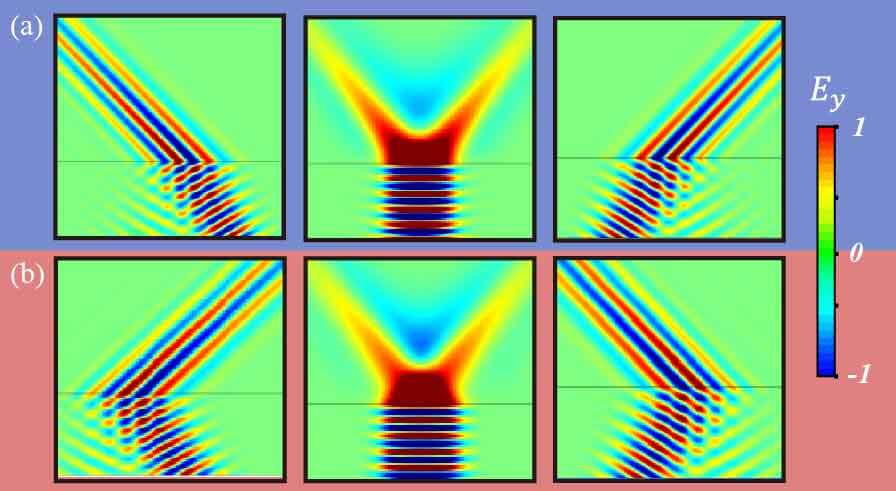
Briefly, the research work entailed: first, design and fabrication of the linear-crossing metamaterial using two-dimensional transmission lines comprising of lumps elements. The lumped elements were loaded in different directions to achieve linear-crossing metamaterial with either negative or positive refractions. Consequently, linear-crossing metamaterial was used to realize various properties including super-resolution, directional propagation, splitting and slab focusing. Secondly, the authors demonstrated experimentally the super-resolution with partial cloaking controlled by the directional propagation and negative refraction in the linear-crossing metamaterial.
The authors observed that contrary to the aforementioned topological transitions based on controlling the in-plane anisotropic electromagnetic parameters, the newly proposed technique exhibited focusing and super-resolution with partial cloaking in the linear-crossing metamaterial-based transmission lines. This was attributed to the two intersecting lines otherwise known as the linear-crossing metamaterial that corresponded to the iso-frequency contour in the transition.
In summary, Zhiwei Guo and colleagues successfully developed a topological transition and thereafter demonstrated focusing and super-resolution with partial cloaking. To validate their study, they tuned the vertical electromagnetic parameters of the anisotropic medium. It was worth noting that the findings did not only present anew anisotropic metamaterials exhibiting unique properties but also showed great possibilities for use in numerous applications like the splitting, focusing and switching.
Altogether, their work addressed challenges witnessed in the previously topological transitions and thus according to the authors, linear-crossing metamaterial will form the basis for future work aimed at improving understanding of the interaction between light and matter. For instance, it will advance applications like controlling light propagation.

Reference
Guo, Z., Jiang, H., Zhu, K., Sun, Y., Li, Y., & Chen, H. (2018). Focusing and Super-Resolution with Partial Cloaking Based on Linear-Crossing Metamaterials. Physical Review Applied, 10(6).
Go To Physical Review Applied