Advances in Engineering Advances in Engineering features breaking research judged by Advances in Engineering advisory team to be of key importance in the Engineering field. Papers are selected from over 10,000 published each week from most peer reviewed journals.

Significance Statement
Freeze-drying is known to produce the highest quality of products among all current drying techniques. However, it is one of the most energy-consuming unit operations. Improving process economic by increasing energy utilization has been a hot topic of research. To save drying time and increase productivity, a novel idea was proposed for freeze-drying of liquid materials by creating an initially unsaturated structure frozen with prebuilt pores. Experimental results show that freeze-drying can be significantly enhanced with the initially unsaturated frozen material and substantial drying time can be saved compared with conventional freeze-drying. Drying time for the initially unsaturated frozen sample (S0 = 0.28 or 0.69 of initial porosity) can be at best 32% shorter than that required for the initially saturated one (S0 = 1.00 or zero porosity). This unique technique would impose an impact on the traditional freeze-drying technology and develop an unprecedented freeze-drying process of liquid materials.

Journal Reference
AICHE Journal, Volume 61, Issue 6, 2015, Pages: 2048–2057,
Wei Wang1,2, Dapeng Hu1, Yanqiu Pan3, Yanqiang Zhao3, Guohua Chen2,4,5
[expand title=”Show Affiliations”]- School of Chemical Machinery, State Key Laboratory of Fine Chemicals, Dalian University of Technology, China
- College of Life Science, Dalian Nationalities University, China
- School of Chemical Engineering, State Key Laboratory of Fine Chemicals, Dalian University of Technology, Dalian, China
- of Chemical and Biomolecular Engineering, The Hong Kong University of Science and Technology, Hong Kong, China
- School of Environmental and Biological Science and Technology, Dalian University of Technology, Dalian, China
Abstract
To save drying time and increase productivity, a novel idea was proposed for freeze-drying of liquid materials by creating an initially unsaturated frozen structure. An experimental investigation was carried out aiming at verifying the idea using a multifunctional freeze-drying apparatus. Mannitol was selected as the primary solute in aqueous solution. Liquid nitrogen ice-cream making method was used to prepare the frozen materials with different initial porosities. Results show that freeze-drying can be significantly enhanced with the initially unsaturated frozen material, and substantial drying time can be saved compared with conventional freeze-drying of the initially saturated one. Drying time was found to decrease with the decrease in the initial saturation. The drying time for the initially unsaturated frozen sample (S0 = 0.28 or 0.69 of initial porosity) can be at best 32% shorter than that required for the saturated one (S0 = 1.00 or zero porosity). This unique technique is easy to implement and improves the freeze-drying performance of liquid materials.
© 2015 American Institute of Chemical Engineers AIChE J, 61: 2048–2057, 2015
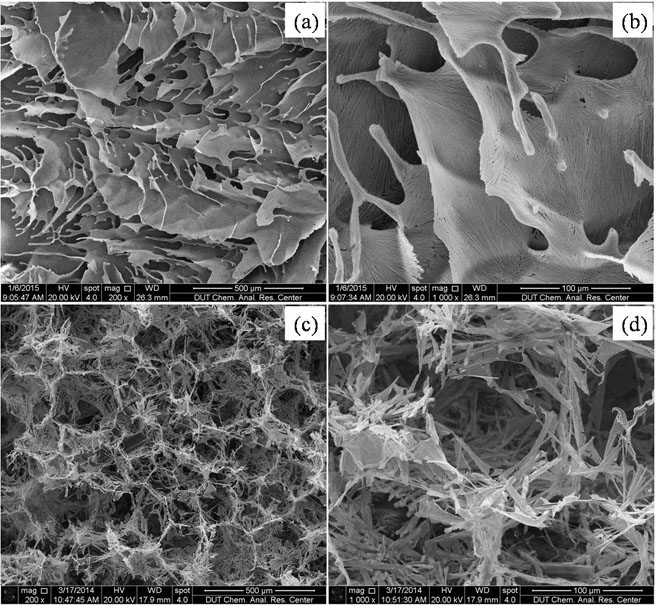
Go To AICHE JournalFigure Legend: SEM images of dried products with two freezing methods at different magnifications; (a) and (b) for the initially saturated sample (S0 = 1.00); (c) and (d) for the initially unsaturated one (S0 = 0.28).