 Advances in Engineering Advances in Engineering features breaking research judged by Advances in Engineering advisory team to be of key importance in the Engineering field. Papers are selected from over 10,000 published each week from most peer reviewed journals.

Significance
Recent advancements in the field of renewable energy have led to the development of more efficient hydrogen production technologies. In particular, proton exchange membrane water electrolysis is a technology that has recently caught the attention of industry and academia. Such technology generates hydrogen by electrochemically dissociating water and is innately capable of operating intermittently, making it an ideal technology for coupling with renewable electricity production.
Currently, the design of these systems takes into consideration the choice of cost-effective materials that can drive down the system costs as well as the operating conditions required to efficiently generate hydrogen. Parameters such as pressure, water flow, current density and temperature have a large influence in determining the efficiency of water electrolysis; however, these operating conditions have not been fully explored thus attracting significant attention of researchers.
Recent findings have shown that the two-phase flow of the evolved gases (hydrogen and oxygen) and the inlet water (which is required both as coolant and as reagent) is a crucial phenomenon that needs to be understood to drive the optimization of the design and operating conditions of membrane-based water electrolyzers. Unfortunately, this problem has not yet been fully investigated; therefore, the development and validation of a multiphase mass transport model is highly desirable.
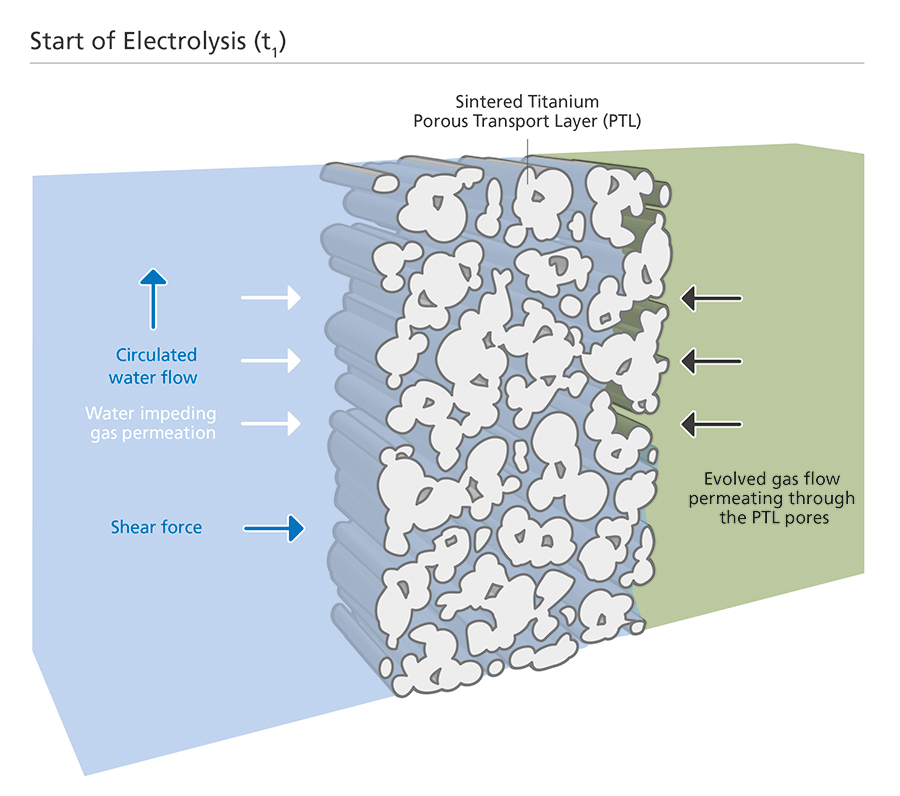
To this note, Julio Garcia-Navarro and Mathias Schulze, together with Professor Andreas Friedrich at the Institute of Engineering Thermodynamics of the German Aerospace Center (DLR) investigated the role of mass transport in proton exchange membrane water electrolyzers. Specifically, they conducted experiments through the porous transport layer of an electrolyzer, which is one of the most critical components of the system regarding mass transport. Their experiments took into consideration the interaction between gas and liquid in microscopic pores and how the pressure drop is affected by water flow. Their research work is currently published in the research journal, ACS Sustainable Chemistry & Engineering.
In brief, the research team cross-examined the measured mass transport losses in proton exchange membrane electrolyzers by developing an energy balance model that takes into account the capillary pressure of the pores of the porous transport layer via the van Genuchten-Mualem capillary pressure model together with the Carman-Kozeny equation. With the developed energy balance equation, they assessed pressure loss associated with the friction between the gas exiting and the water entering the electrolyzer. Furthermore, water was pumped to force the gas over the porous transport layer, simulating the actual conditions during gas evolution in the electrolyzer. This enabled the determination of pressure drops and calculation of energy losses, and their dependence on the water flow. Eventually, the permeability of the gas through the pores was determined through a design energy balance on the system.
From their experiments, the authors ascertained that single-phase permeability was the main mass transport mechanism in proton exchange membrane electrolyzers. Single-phase permeability is a less energy-demanding flow mechanism as compared to two-phase flows in microscopic pores, which is the withstanding mass transport theory found in the literature. This was attributed to the induced shear stress on the gas exerted by the water flow in the boundaries of the microscopic channels in the porous transport layer. In addition, they noted a correlation between the tortuosity of the pores and pressure loss with regard to water flow.
In summary, the authors successfully demonstrated the effects of water flow and porous transport layer on the performance of proton exchange membrane water electrolyzers. In general, the study provided vital information that will advance further studies aimed at improving cell design. For instance, it will enable the optimization of porous transport layers by providing a theoretical framework to understand the effects of material properties such as porosity as well as operating parameters such as water flow.





Reference
Garcia-Navarro, J., Schulze, M., & Friedrich, K. A. (2019). Understanding the role of water flow and the porous transport layer on the performance of Proton Exchange Membrane Water Electrolyzers. ACS Sustainable Chemistry & Engineering, 7(1), 1600-1610.
Go To ACS Sustainable Chemistry & Engineering