Advances in Engineering Advances in Engineering features breaking research judged by Advances in Engineering advisory team to be of key importance in the Engineering field. Papers are selected from over 10,000 published each week from most peer reviewed journals.

Significance Statement
Spontaneous imbibition of wetting liquids in porous media, a ubiquitous natural phenomenon, is of practical importance in a wide variety of technological applications. Spontaneous imbibition of water into the matrix blocks due to capillary forces is regarded as a crucially important driving mechanism for enhancing oil recovery from naturally fractured water-wet reservoirs. Understanding the dynamics of spontaneous capillary imbibition in porous media is essential for their characterization and for the development of new imbibition processes. This is why great interest and attention has been focused on this subject, from a theoretical perspective to engineering applied science, for more than a century since the first introduction of the classical Lucas–Washburn equation.
Considering streamline tortuosity and the possibility of non-circular cross-sectional pore shapes, this work modifies the classical Hagen-Poiseuille and Laplace-Young equations, and develops an explicit analytical model for spontaneous imbibition in homogenous porous media with gravity included, which is deduced theoretically to be more closely matched to reality and more sufficiently general than other available imbibition formulations.
Figure Legend
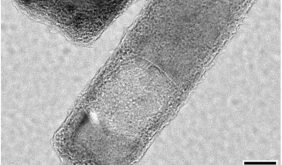
The modification and development of capillary bundle model used in the derivation of more generalized spontaneous imbibition model.

Figure Legend 2
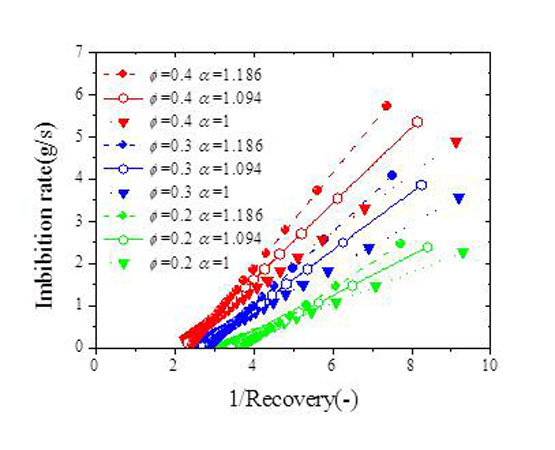
The spontaneous imbibition rate versus the reciprocal of the gas recovery at different porosity with the geometry correction factor considered based on presented model.
Langmuir, 2014, 30 (18), pp 5142–5151.
Jianchao Cai*1, 2, Edmund Perfect2, Chu-Lin Cheng2 , Xiangyun Hu1
- Institute of Geophysics and Geomatics, Key Laboratory of Tectonics and Petroleum Resources of Ministry of Education, China University of Geosciences, Wuhan 430074, P.R. China and
- Department of Earth and Planetary Sciences, University of Tennessee, Knoxville, Tennessee 37996, United States.
Abstract
Spontaneous imbibition of wetting liquids in porous media is a ubiquitous natural phenomenon which has received much attention in a wide variety of fields over several decades. Many traditional and recently presented capillary-driven flow models are derived based on Hagen–Poiseuille (H–P) flow in cylindrical capillaries. However, some limitations of these models have motivated modifications by taking into account different geometrical factors. In this work, a more generalized spontaneous imbibition model is developed by considering the different sizes and shapes of pores, the tortuosity of imbibition streamlines in random porous media, and the initial wetting-phase saturation. The interrelationships of accumulated imbibition weight, imbibition rate and gas recovery and the properties of the porous media, wetting liquids, and their interactions are derived analytically. A theoretical analysis and comparison denote that the presented equations can generalize several traditional and newly developed models from the literature. The proposed model was evaluated using previously published data for spontaneous imbibition measured in various natural and engineered materials including different rock types, fibrous materials, and silica glass. The test results show that the generalized model can be used to characterize the spontaneous imbibition behavior of many different porous media and that pore shape cannot always be assumed to be cylindrical.
Additional Information
This work was supported by the National Natural Science Foundation of China (41102080), the Fundamental Research Funds for the Central Universities (CUG130404; CUG130103), and Key Laboratory of Tectonics and Petroleum Resources of Ministry of Education (TPR-2013-18), China University of Geosciences (Wuhan).