 Advances in Engineering Advances in Engineering features breaking research judged by Advances in Engineering advisory team to be of key importance in the Engineering field. Papers are selected from over 10,000 published each week from most peer reviewed journals.

Significance
Critical heat flux (CHF) limits areas of any heat-flux controlled boiling or evaporation application by the maximum heat flux. The first relationship for calculating the CHF at pool boiling is given by Kutateladze in 1948 by dimensional analysis based on the hypothesis of hydrodynamic nature boiling crisis. Presently, five approaches for the analysis of CHF mechanisms have been mainly considered, namely: bubble interference, hydrodynamic instability, macrolayer dryout, hot/dry spot, and interfacial lift-off. Previous studies have shown that none of the known calculation dependences (except Yagov model connecting crisis with irreversible growth dry spots area), cannot describe the experimental data on boiling crises at low reduced pressures, where the effect of pressure on CHF is very weak. Unfortunately, at low reduced pressures the mechanism of heat transfer through the liquid layer limited in height is changing. The upper boundary of the liquid layer starts playing an important role for the heat sink at low pressures. The convective motions of liquid carry hot liquid onto the free surface, where it evaporates. The effect of liquid evaporation from the upper boundary in the limiting case leads to inevitably of the Landau instability.
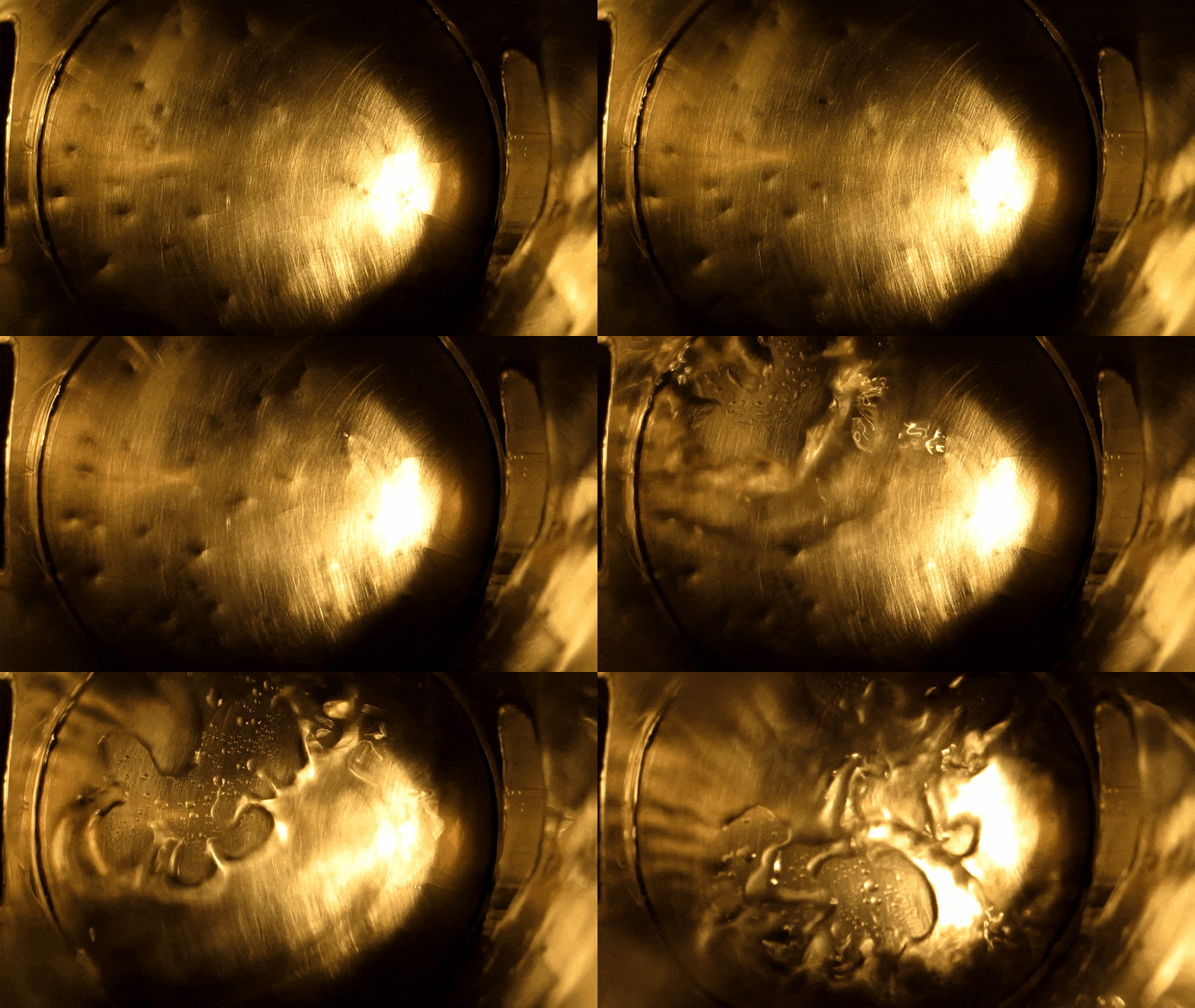
Recently, research carried out by professors V.I. Zhukov and A.N. Pavlenko from the Novosibirsk State Technical University and Kutateladze Institute of Thermophysics in Novosibirsk in Russia, respectively, investigated the heat transfer and high–speed video recording of evaporation and boiling processes in horizontal liquid films of n-dodecane for the wide ranges of layer height and pressure. They purposed to define the boundaries of the various regions characterizing existences of various structures in thin layers of liquid depending on the process regime parameters. Their work is currently published in the research journal, International Journal of Heat and Mass Transfer.
The two researchers commenced their experimental procedure by designing a working chamber as a thermosyphon whose surface was to be used as a heating surface. Next, they characterized evaporation regimes at low reduced pressures by formation of dry spots and structures with the shape of ‘‘funnels” (depressions with a hemispherical bottom on the layer surface) and ‘‘craters” in the layers. Eventually, maps of hydrodynamic regimes of evaporation and boiling for different heights of the liquid layer were plotted.
Zhukov and Pavlenko observed that at low reduced pressures in the liquid layers with the height less than the Laplace constant, dry spots were formed in the layer. Additionally, after a comparison of the calculations by the Kutateladze formula with experimental data, it was seen that at heat fluxes below the calculated ones, the ‘‘funnels” and ‘‘craters” were observed in the layer higher than the Laplace constant and for the heat fluxes higher than the calculated ones, only ‘‘craters” were observed in the layers. An increase in pressure resulted in all cases to occurrence of nucleate boiling.
The Zhukov-Pavlenko study has presented a systematic investigation of the various heat transfer regimes and critical phenomena at evaporation and boiling in the thin horizontal liquid layers with a wide range of pressures and layer heights. Zhukov-Pavlenko results depict that the upper value of CHF in the low pressures region is principally confined in the limiting case by Landau instability. Again, a cross examination of the experimental data indicates that within certain pressure range, the critical heat fluxes is slightly dependent on pressure. Altogether, the slope of the curve of heat flux dependence on the temperature head depends on the layer height at both evaporation and nucleate boiling.


Reference
V.I. Zhukov, A.N. Pavlenko Heat transfer and critical phenomena during evaporation and boiling in a thin horizontal liquid layer at low pressures. International Journal of Heat and Mass Transfer, volume 117 (2018) pages 978–990.
Go To International Journal of Heat and Mass Transfer