Advances in Engineering Advances in Engineering features breaking research judged by Advances in Engineering advisory team to be of key importance in the Engineering field. Papers are selected from over 10,000 published each week from most peer reviewed journals.

Significance
Boiling is commonly used in various domestic and industrial operations to facilitate various processes. Generally, boiling involves various stages including nucleate boiling, transition boiling and film boiling. However, the various stages exhibit totally different boiling characteristics, therefore, their boundaries are equally important for modeling and understanding the heat transfer. Boiling is separated from a single phase by the onset of nucleate boiling which typically depends on the wettability, surface topography and local thermal-hydraulic parameters. Unfortunately, methods for predicting the boiling incipience have not been fully explored.
Among the available methods used to predict boiling processes, the nucleation theory based on the trapped gases is associated with numerous limitations as far as boiling at low superheat on nano-smooth surfaces is concerned. More recently, nucleation model based on Gibbs free energy has been utilized since it is available for boiling on heated surface and also it has the capability of analyzing the influence of pulse heating, external electric field and microstructures. Unfortunately, the model cannot be effectively applied for prediction of the onset of nucleate boiling due to their complicated nature. Therefore, researchers have been looking for effective alternatives and have identified derivation of the criterion of onset of nucleate boiling from a theoretical analysis as well as better understanding of the Gibbs free energy-based nucleation model and the influence of the thermohydraulic parameters.
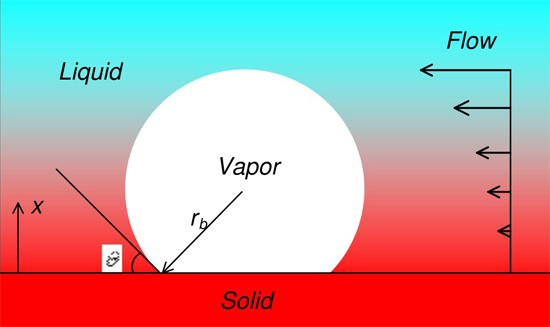
Dr. Hongsheng Yuan and Professor Sichao Tan in collaboration with their colleagues developed a nucleation model based on Gibbs free energy in conjunction to the nucleation model based on the chemical potential. They utilized two types of bubble nucleation to describe the model, one with the preferred nucleation site on the heated surface and the other without. They further investigated the effect of surface wettability and obtained the analytical solution including nucleation size boundary and heat flux at the onset of nucleate boiling. Eventually, they compared the experimental and theoretical data to validate the feasibility of the developed model. They purposed to improve on the nucleation model by eliminating the various assumptions like the saturation temperature. Their research work is published in the journal, International Journal of Heat and Mass Transfer.
The authors found that elimination of the previously used assumptions allowed obtaining of the range of active nucleation bubble radius which is relatively larger than that obtained in the Davis & Anderson’s model. On the other hand, the active nucleation range increases with increasing contact angle and the critical radius decreases with increasing contact angle. Furthermore, some differences were noted between the models especially in high superheat region. Influence of flow condition was also analyzed and the authors observed bubble nucleation transition from type 1 to type 2 with a corresponding increase in the heat transfer coefficient, fluid subcooling and pressure.
According to the authors, the experimental results showed the great similarity of the theoretical data. For instance, the trend of theoretical values of heat flux and superheat with pressure and heat transfer coefficient is in good agreement with experimental results. Thus, due to its added simplicity through the elimination of the initially used assumptions, the developed Gibbs free energy method will advance different application in prediction of the bubble nucleation.


Reference
Yuan, H., Tan, S., Du, W., Ding, S., & Guo, C. (2018). Heterogeneous bubble nucleation model on heated surface based on free energy analysis. International Journal of Heat and Mass Transfer, 122, 1198-1209.
Go To International Journal of Heat and Mass Transfer