 Advances in Engineering Advances in Engineering features breaking research judged by Advances in Engineering advisory team to be of key importance in the Engineering field. Papers are selected from over 10,000 published each week from most peer reviewed journals.

Significance
Photons are used to carry quantum information necessary for secure communication and data exchange. The implementation of quantum information protocols beyond proof-of-principle calls for the development of an accessible technology that take into account the physical regime of quantum light: low light intensity, sensitivity to loss and noise, and different device design.
Losses have been identified to pose a challenge to the operation of quantum optic devices. However, Classical devices do not suffer from this issue as the losses can be mitigated by amplification.. Unfortunately, quantum states cannot be deterministically amplified owing to the non-cloning theorem. Reducing losses is therefore critical, considering that some applications like the quantum information processing and Bell’s inequality tests are intolerant to losses.
Developing easy-to-handle as well as reliable components having low loss, low noise, and preferred quantum features, is the principle challenge facing the exploitation of quantum optic sources. High performance is normally eroded when quantum devices are integrated and packaged.. For this reason, a good number of photon sources still depend on the precise alignment of the external components, restricting their implementation outside the lab.
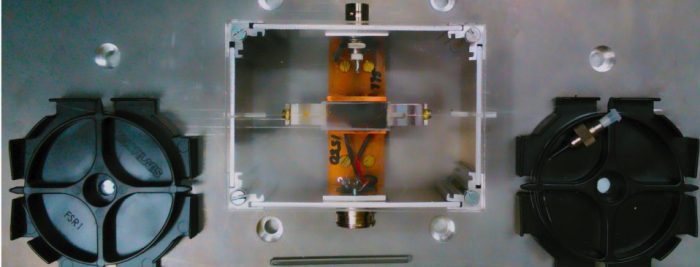
Christine Silberhorn and colleagues at Paderborn University in Germany presented a plug-and-play source of telecom-wavelength heralded single photons, which integrated both: desirable quantum features necessary for long-distance transmission and an alignment-free packaging that allowed for the out-of-lab implementation. This was a quantum source that needed no user intervention and produced photons with high heralding efficiency Limited only by the inherent losses of the fiber-optical components used. . Their research work is published in peer-reviewed journal, Physical Review Applied.
The authors provided an insight, by characterizing their device, into which processes could be analyzed classically to forecast the quantum performance, which quantum characteristics were inaccessible with classical measurements, and instances where the classical characterization should have determined the optical properties, but failed. In order to eliminate the need of bulk elements, the authors adopted a hybrid platform implementing the high nonlinearity and low loss of periodically poled titanium-indiffused lithium niobate waveguides in order to produce photon pairs with high brightness, and telecommunication elements for photon filtering and routing.
The device adopted for the study presented a high stability and ease of use, and quantum performances that surpassed the packaged devices manufactured to date. The device recorded low losses, capacity to generate picosecond photons in the telecom regime, and high heralding efficiencies. The device provided for a complete flexibility to generate a large range of parametric downconversion wavelengths and operation at non-degeneracy and could be incorporated with different filters for user-specific applications.
According to the authors, a completely integrated device could be realized if the source was implemented by pumping with semiconductor lasers as opposed to a pulsed system. The quantum features along with the plug-and-play arrangement of the source represented an improvement in the realization of quantum-based technology for implementation encompassing experimental verification of several communication protocols.


Reference
Nicola Montaut, Linda Sansoni, Evan Meyer-Scott, Raimund Ricken, Viktor Quiring, Harald Herrmann, and Christine Silberhorn. High-Efficiency Plug-and-Play Source of Heralded Single Photons. Physical Review Applied, issue 8 (2017) 024021.
Go To Physical Review Applied