 Advances in Engineering Advances in Engineering features breaking research judged by Advances in Engineering advisory team to be of key importance in the Engineering field. Papers are selected from over 10,000 published each week from most peer reviewed journals.

Significance
Potential applications in attosecond science and high harmonic generation are among the driving forces propagating the development of high-energy and few-cycle mid-infrared lasers. Lasers of such attributes have been a topic of interest in the ultrafast laser community. Currently, great progress has been made on the generation of high energy short-pulse mid-infrared laser sources above 3 μm. However, the spectral bandwidth has not reached one octave, which limits the pulse duration to multicycle. In a previous study, a scheme for generation of terawatt sub-cycle 4–12 μm pulses through optical parametric chirped pulse amplification in ZGeP2 pumped by an Ho:YLF laser was designed. Due to the combined use of a pump from an Ho:YLF laser and a signal from a Ti:sapphire laser, complications in the synchronization of the two laser sources emerged. To this note, a high-energy source deriving from the Ti:sapphire laser is needed to seed the Ho:YLF laser.
Researchers led by Professor Zenghu Chang from the Institute for the Frontier of Attosecond Science and Technology at University of Central Florida designed and experimentally demonstrated the efficient generation of narrowband 2.05 μm pulses pumped with a broadband Ti:sapphire laser via dual-chirped optical parametric amplification (DC-OPA). They also successfully achieved a 82 μJ narrowband 2.05 μm pulses from a 1 mJ Ti:sapphire laser pulse. Their work is now published in the research journal, Photonics Research.
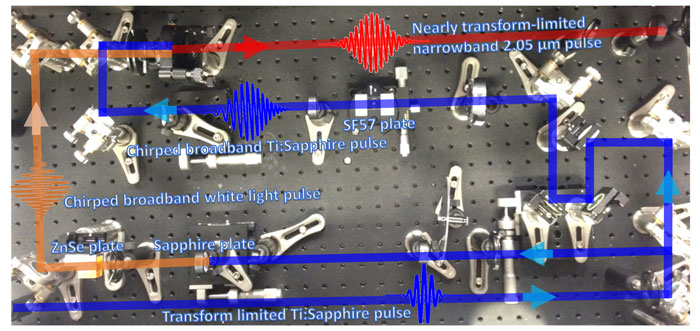
Their experiments and techniques employed entailed the use of a Ti:sapphire laser pulse energy of 1 mJ for the DC-OPA, which was split into two portions. A certain percentage of the 1 mJ beam was made to pass through a neutral density filter and an iris diaphragm and was then focused onto a 3 mm thick sapphire plate to generate a stable single-filament continuum, which was the signal for seeding the DC-OPA. The signal was positively chirped by passing through a 20.6 mm thick ZnSe plate. The remaining percentage of the 1 mJ Ti:sapphire laser was the pump, which passed through a 45 mm thick SF57 plate with the same positive dispersion. A telescope was utilized to change the pump beam size on the BBO crystal. Eventually, a silicon plate was employed to separate the signal and idler beams from the pump beam.
The research team observed that the idler center wavelength could be easily tuned around 2.05 μm in order to accommodate the gain spectrum of any Ho:YLF laser amplifier by altering the delay between the signal and the pump. In addition, the researchers noted that the bandwidth could also be tuned by varying the input chirp of pump and signal.
Yanchun Yin and colleagues in their study presented novel design of a DC-OPA that utilizes BBO crystal as the nonlinear media for generating narrowband pulses, which are pumped by broadband Ti:sapphire laser pulses. Yanchun said, “when the broadband pump and the broadband signal have an equal amount of chirp, the frequency difference of all phase-matched pump-signal pairs is a constant and thus generates a single-wavelength idler. Based on this principle, you can actually generate nearly transform-limited narrowband pulses from high-chirped broadband pulses. You need to find the right crystal to do this.” From the experimental procedure undertaken, it has been proven that 82 μJ narrowband 2.05 μm pulses can be generated with 1 mJ pump in a BBO crystal. Altogether, the high-energy narrowband 2.05 μm pulse can be an ideal source for seeding a Ho:YLF multipass amplifier due to the ease of synchronization that it can help achieve when using a Ti:sapphire laser and a Ho:YLF laser for the development of mid-infrared laser pulses.


Reference
Yanchun Yin, Xiaoming Ren, Yang Wang, Fengjiang Zhuang, Jie Li, Zenghu Chang. Generation of high-energy narrowband 2.05 μm pulses for seeding a Ho:YLF laser. Volume 6, No. 1 / January 2018 / Photonics Research.
Go To Photonics Research