Advances in Engineering Advances in Engineering features breaking research judged by Advances in Engineering advisory team to be of key importance in the Engineering field. Papers are selected from over 10,000 published each week from most peer reviewed journals.

Significance Statement
Nowadays, there is a vast interest in converting small kinetic energy into electricity for powering miniature electronics. Specifically, the conversion of mechanical forces, vibrations and sound which possess energy in the range of milli- to tens of watts into electricity has received an undivided global attention owing to the potential in powering electronic devices. However, a majority of these small energy generators can only generate power below 1 µW/cm3. In return, an energy storage device is thereby required so as to store and accumulate the generated energy until it reaches a sufficient level that can be used to power electronic devices or miniature robots. This would mean that the powered miniature robots and electronic devices would work self-sustainably without frequent recharging, which would be extremely useful for various applications in healthcare, biomedicine, industrial processing, fundamental research and environmental monitoring. Interestingly, despite the novel energy harvesting materials developed, little has been reported on the effective conversion of sound energy into electricity for power generation purposes.
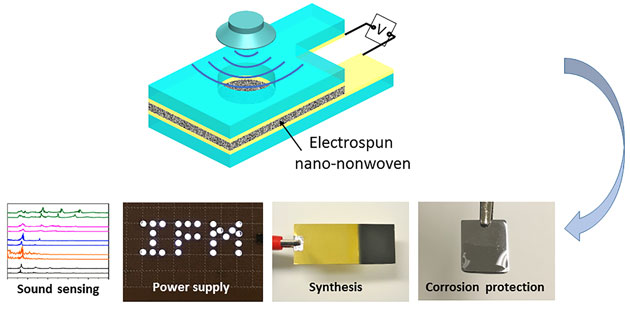
Researchers led by professor Tong Lin from Institute for Frontier Materials at Deakin University in Australia conducted a study to demonstrate that electro-spun nano-nonwovens from P(VDF-TrFE) can be used to develop acoustoelectric generator. The research team aimed at developing an exceptionally-high acoustoelectric conversion ability of randomly-orientated electro-spun P(VDF-TrFE) nanofiber nonwoven webs. They hoped that their work would help diversify conventional acoustoelectric conversion applicability which for some time has been limited to sensors and audio devices. Their research work is now published in Nano Energy.
Professor Tong Lin and colleagues commenced their empirical procedures by electrospinning, where they prepared a P(VDF-TrFE) solution which was then electro-spun into nanofiber mat. The research team then characterized the nano-fibers by observing their morphology under scanning electron microscope. Acoustic conversion tests and finite element method modeling were then carried out on the nanofiber mats respectively. Eventually, the researchers carried out application demonstrations using light emitting diodes.
The authors noticed that the devices generated higher electric outputs under a sound with pressure level above one hundred decibels. The optimized device was also seen to generate voltage and current outputs of 14.5 V and 28.5 μA with a volume power density output of 306.5 μW/cm3, which ranked much higher when compared to a smilar device made of commercial piezoelectric P(VDF-TrFE) films.
The work undertaken in their study showed incredible acoustoelectric conversion ability of randomly-oriented P(VDF-TrFE) nanofiber nonwovens, that is suitable for power supplying purposes. The devices have been seen to generate higher electric outputs under a sound with pressure levels above 100 decibels. The optimized device can generate adequate voltage which is also higher than that of commercial piezoelectric P(VDF-TrFE) films. The current generated from the fibers after rectification can be used directly to drive microelectronic devices and conduct electrochemical reactions, without using any storage unit. Such marvelous features make electro-spun nano-nonwovens particularly useful for conversion of noise, a white pollution, into usable energy.
Note: P(VDF-TrFE) – poly(vinylidenefluoride-co-trifluoroethylene)




Reference
Chenhong Lang, Jian Fang, Hao Shao, Hongxia Wang, Guilong Yan, Xin Ding, Tong Lin. High-output acoustoelectric power generators from poly(vinylidenefluoride-co-trifluoroethylene) electrospun nano-nonwovens. Nano Energy volume 35 (2017) pages 146–153.
Go To Nano Energy