Advances in Engineering Advances in Engineering features breaking research judged by Advances in Engineering advisory team to be of key importance in the Engineering field. Papers are selected from over 10,000 published each week from most peer reviewed journals.

Significance
Solar energy is the most abundant form of renewable energy available for exploitation. The most basic technique of tapping solar energy is through the use of photo-voltaic (PV) modules; colloquially termed solar panels. PV cells are manufactured from materials that possess photovoltaic properties; where in this work, halide perovskite molecules are the material of choice credit to their recently discovered exceptional photovoltaic properties. The perovskite solar cells (PSC) are typically fabricated by depositing the perovskite photo-absorber between electron-transport layer (ETL) and hole-transport layer (HTL). Unfortunately, PSCs possess some inherent drawbacks related to instability. Research has shown that these shortfalls are dependent on the material used as the electron-transport layer. For instance, titanium dioxide based PSCs show ultraviolet (UV) light instability under continuous light illumination because of presence of mobile ion species and photocatalytic activity, interfacial collapse, and charge accumulation at titanium dioxide/perovskite interface. It is also known that TiO2 exhibits low carrier mobility and difficulty in controlling the band energy levels, resulting in band offset between AL and ETL, which causes a loss in VOC. Recently, successful introduction of Al2O3 in between ETL and AL was reported for suppressing carriers recombination at interface, prevent moisture penetration, and increasing the thickness of light absorber layer. However, Al2O3 is naturally highly insulating, so it inhibits the electron transport and reduces photocurrent. Therefore, the challenge remains to improve electron transport and open-circuit voltage (a photovoltaic parameter), so as to enhance the long-term stability of PSCs which is affected by ETL and interface materials.
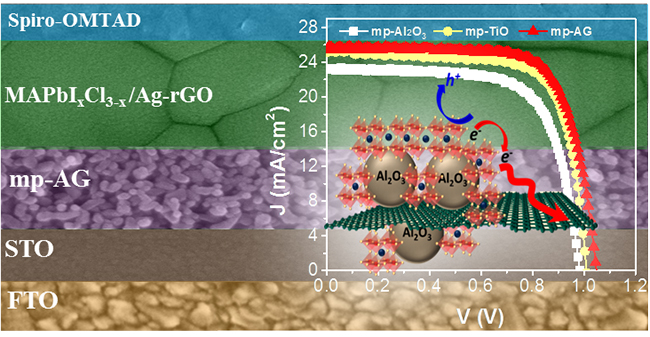
To solve such problems, a team of researchers from the Solar Energy Research Center at Jeonbuk National University in Republic of Korea: Dr. Tahmineh Mahmoudi, Dr. Y. Wang and led by Professor Yoon-Bong Hahn, proposed to improve on the device performance and long-term stability by fabricating PSCs based on MAPbI3-xClx:Ag-rGO and Al2O3-graphene (mp-AG) composites with FTO/SrTiO3/mp-AG/perovskite:Ag-rGO/Spiro-OMeTAD/Au configuration. Their work is currently published in the front cover of the research journal, Advanced Energy Materials.
Their approach started with the preparation of SrTiO3 solution where strontium acetate dissolved in a solvent of acetic acid was used. The researchers then prepared graphene and the Ag-rGO and Al2O3-Graphene Composites, following which the composites-based PSCs were fabricated. Lastly, the researchers characterized in depth the resultant devices using XRD, ultraviolet–visible spectroscopy, XPS, FTIR – among other characterization techniques.
The authors reported that SrTiO3 has a smaller band offset and a higher electron mobility than TiO2 (0.1-4.0 cm2V-1s-1), thus fast electron conduction and suppression of charge recombination at interface. They also reported that the mp-AG composite is conductive with one-order of magnitude higher mobility than mp-TiO2 because of presence of highly conductive graphene sheets, which leads to efficient charge extraction and balanced carrier transport as well as enhancing VOC. Finally, the team concluded that compared to the mp-TiO2 ETL based cells, the champion device based on perovskite/Ag-rGO and SrTiO3/mp-AG composites showed overall a best performance (i.e., open-circuit voltage = 1.057V, short-circuit current = 25.75 mA.cm−2, fill factor = 75.63%, and power conversion efficiency = 20.58%).
In summary, the study successfully reported highly efficient and stable PSCs fabricated with perovskite/Ag-rGO composite in AL and SrTiO3/mp-AG composite in ETL. Generally, compared to the mp-TiO2 ETL-based cells, the presented composites-based cells contained fewer trap states with less recombination and showed substantial improvement in thermal- and photostability. In a statement to Advances in Engineering, Professor Yoon-Bong Hahn, the corresponding author further emphasized that the champion device without encapsulation exhibited not only remarkable thermal- and photo-stability but also long-term stability, retaining 97–99% of the initial values of photovoltaic parameters and sustaining ≈93% of initial PCE over 300d under ambient conditions.



Reference
Tahmineh Mahmoudi, Yousheng Wang, Yoon-Bong Hahn. SrTiO3/Al2O3-Graphene Electron Transport Layer for Highly Stable and Efficient Composites-Based Perovskite Solar Cells with 20.6% Efficiency. Advanced Energy Materials 2020, volume 10, page 1903369.