 Advances in Engineering Advances in Engineering features breaking research judged by Advances in Engineering advisory team to be of key importance in the Engineering field. Papers are selected from over 10,000 published each week from most peer reviewed journals.

Significance Statement
Many in photovoltaic (PV) community are well aware that large area PV modules are often laterally nonuniform. The nonuniformity shows up in variations between local PV parameters in different areas of a module. It causes problems with PV performance and reliability playing the role of a hidden cost of otherwise inexpensive PV technology.
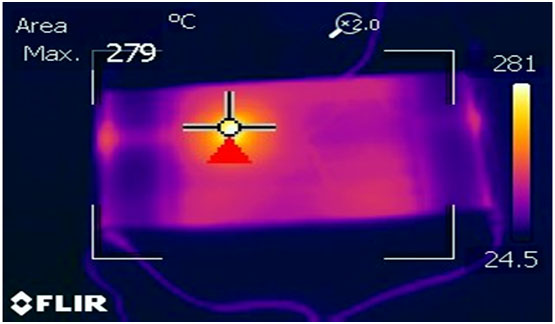
An established way of observing lateral nonuniformities in PV modules is infrared camera mapping: pictures of different parts of a module showing different temperatures as illustrated in Figure 1; these nonuniformities depend on the device current and voltage. The consensus in the PV community is that the observed lateral nonuniformities are related to material/structure imperfections or nonuniform light distribution. This understanding has matured to the level of common belief. Even the fact that the hot spots are typically close to the module bus bars is typically interpreted as an evidence of the bus bar application creating defects in the device.
Our work shifts the defect paradigm towards spontaneous hot spot formation in a perfectly uniform system. Such hot spots appear as a result of runaway instability related to the diode-like current voltage characteristics of the device: current hogging by warmer regions makes them still warmer. The phenomenon of current hogging belongs to a large class of runaway instabilities known in electrical engineering, chemistry (exothermic reactions), astrophysics (runaway nuclear fusion), where increase in temperature causes positive feedback.
The hot spot nonuniformity deteriorates device performances as different parts of it operate under different temperatures and cannot be optimized simultaneously. Furthermore, one can expect that hot spots will generate defects at exponentially higher rates compared to the surrounding cold regions. This reverses the cause and effect relation between the defects and hot spots, the latter becoming cause rather than effect. In a long run, this scenario will result in accumulation of permanent defects in certain local regions of PV modules and their corresponding degradation. It is remarkable that problems with performance and reliability related to hot spots can be fixed by properly scaling the device thickness, substrate material, and thermal insulation.
More details are presented in our forthcoming publication (currently under review in a technical journal) and in the arxiv posting http://arxiv.org/abs/1401.0056 .
Figured Legend Figure caption: Infrared mapping of a laboratory PV module manufactured by Xunlight corporation showing a hot spot with a temperature of 279 oC .
Appl. Phys. Lett. 103, 074105 (2013).
V. G. Karpov, A. Vasko, A. Vijh.
Department of Physics and Astronomy, University of Toledo, Toledo, Ohio 43606, USA and
Xunlight Corporation, 3145 Nebraska Avenue, Toledo, Ohio 43607, USA.
Abstract
We show that thin film diode structures, such as photovoltaics and light emitting arrays, can undergo zero threshold localized thermal runaway leading to thermal and electrical nonuniformities spontaneously emerging in originally uniform systems. The linear stability analysis is developed for a system of thermally and electrically coupled two discrete diodes, and for a distributed system. These results are verified with numerical modeling that is not limited to small fluctuations. The discovered instability negatively affects the device performance and reliability. It follows that these problems can be mitigated by properly designing the device geometry and thermal insulation.
© 2013 AIP Publishing LLC