 Advances in Engineering Advances in Engineering features breaking research judged by Advances in Engineering advisory team to be of key importance in the Engineering field. Papers are selected from over 10,000 published each week from most peer reviewed journals.

Significance
Evolution in technology results in complexity of various systems making them difficult to predict and control. This further trickles down to a lack of systems assurance across the supply chain, a shortfall that raises eyebrows due to the degree of uncertainty that reflects the lack of a recognized system assurance. Categorically, this problem is common with artificial systems that are subject to subsequent upgrades or are manufactured in global regions with varying technical and operational systems. Previously, various approaches outlining the methodology used to achieve the enabling conditions and engineering processes required during systems development, certification and operations have been well defined. Failure to achieve some of the measures put in place have in recent times resulted in systems malfunction and/or fatal accidents: case and point, the Mars Polar Lander malfunction and the Columbia disaster in 2003. A review of existing literature reveals that several issues which prevent the accurate prediction of system behavior are still unresolved.
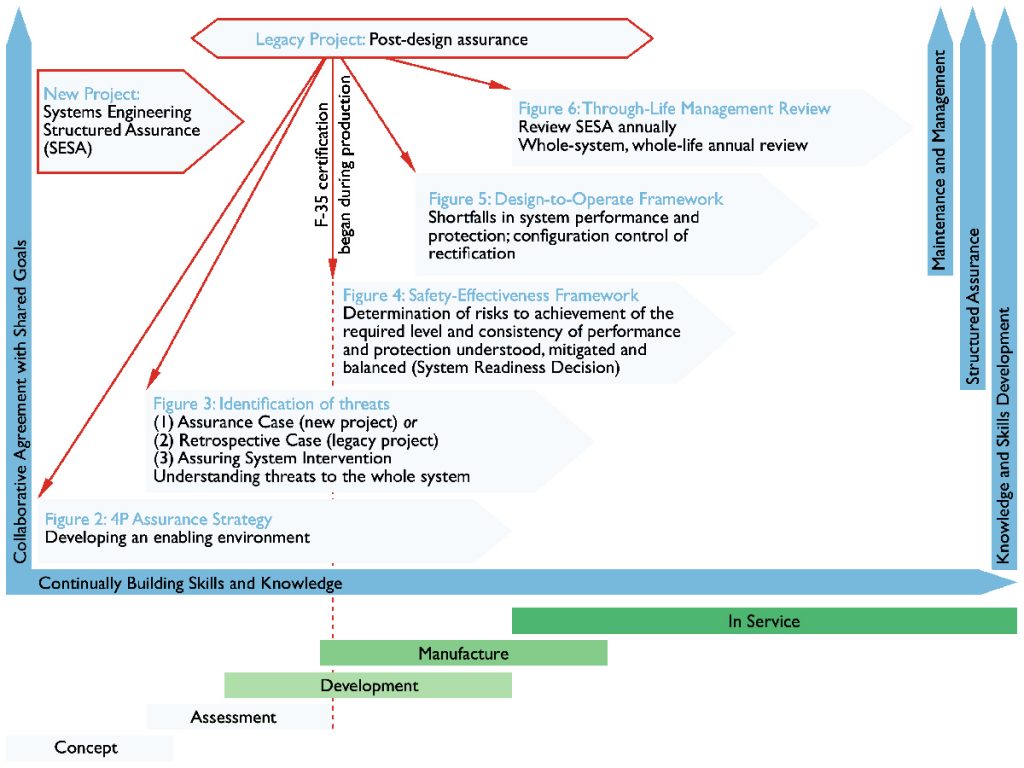
In addition, shortfalls in knowledge and practice also lead to inconsistencies in the approach adopted across the supply chain, where the supply chain is characterized as the designer, builder and user communities. In a recent publication, a group of researchers from Cranfield University at the Defence Academy of the United Kingdom: Dr Graham Farnell, Dr Alistair Saddington, and Laura Lacey proposed a novel approach based on a methodology that could address both new and legacy systems. The research team presented an enterprise approach by observing the importance of all organizational contributions to a safe working system throughout the intended project life cycle. The necessity for such a development was largely catalyzed by the need to address the certification of the F-35B stealth fighter for UK operations from 2012 onwards. Their work is currently published in the research journal, Reliability Engineering and System Safety.
The acquisition of the F-35 stealth fighter by the UK authorities provided several challenges, given inconsistencies between US and UK socio-technical policies and in the arrangements necessary to address the variations in technical standards. As such, the researchers adopted a methodical approach. This approach, in part, focused on assessing and comprehending the systems behaviour in two aspects: assurance in complex systems and the shortfalls in knowledge and practice.
The authors reported a pragmatic strategy to achieve systems control by adopting a holistic approach to systems engineering while promoting the development of an enabling environment that can determine system threats and enable appropriate controls. Moreover, the F-35 case study achieved success through a collaborative approach, where the partners added value through the joint development of a common set of objectives representing system requirements and organizational ambitions.
In summary, the study described a new methodology to achieve assurance in novel and complex systems. Remarkably, the proposed holistic approach to systems engineering and assurance was fruitful as in incorporated a systematic coordination process that helped minimize the potential for ‘organizational drift’. Cranfield University scientists highlighted that the presented methodology provided the confidence assessment for a particular product or system while remaining agnostic to regulatory constraints. They further added that the diligent completion of the methodology increases systems confidence and informs the regulatory environment.



Reference
G.P. Farnell, A.J. Saddington, L.J. Lacey. A new systems engineering structured assurance methodology for complex systems. Reliability Engineering and System Safety, volume 183 (2019) page 298–310.
Go To Reliability Engineering and System Safety