 Advances in Engineering Advances in Engineering features breaking research judged by Advances in Engineering advisory team to be of key importance in the Engineering field. Papers are selected from over 10,000 published each week from most peer reviewed journals.

Significance
The stem is known as a bright zone at the root of corona streamers, where the streamer-to-leader transition occurs in long sparks. Characteristics of stem play significant roles in the initiation and development of leader discharge. Many studies by numerical simulations have been carried out to assess the gas heating dynamics of stem. However, much less experimental results of the stem have been reported and the limited results were usually based on the static photographs. Unfortunately, it is difficult to use this approach to differentiate the stems and streamers in a situation where streamer luminosity covers the stem. Therefore, researchers have been looking for an efficient alternative for stem observations and measurements and have identified schlieren imaging as a promising solution owing to its ease of implementation and high sensitivity.
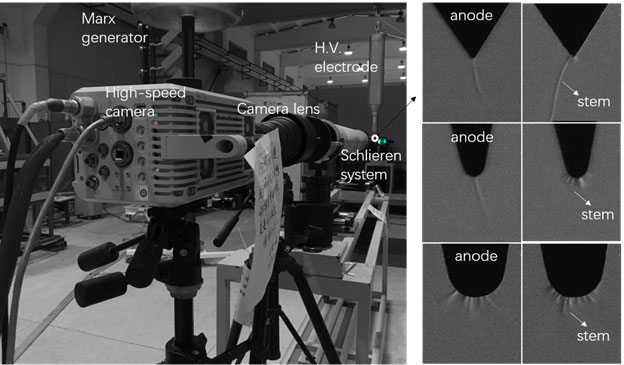
Researchers at Huazhong University of Science & Technology, Dr. Yongchao Yang, Professor Junjia He, Dr.Xiangen Zhao and Dr. Pei Xiao, developed a schlieren system for observing the number of stems around the H.V electrode at the initial corona discharge stages. The authors conducted their experimental works in a 0.74m rod-plane gap under positive impulses. Furthermore, they measured the discharge current, discharge voltages and also took the schlieren photographs during the discharge process. Eventually, the influence of the electrode radius and the crest value of applied impulse were analyzed. They aimed at correctly observing the number of stems around the H.V electrode which is a key consideration in mechanism analysis of the discharge as well as modeling of the long air gap discharge. The work is published in the journal, Physics of Plasmas.
The authors found that in most cases, the number of stems around the electrodes at the initial corona discharge exceeds one. Moreover, an increase in the electrode radius and the crest value of applied impulse results in a corresponding increase in the average number of stems. According to the authors, conditions with a small electrode radius and a low crest value under switching impulse will prefer to create only one stem.
The results suggest that the discharge current measured in the experiments is the sum total of current components flowing through the individual stems. If the measured current is used as the input of the numerical model to estimate the gas heating dynamics of a stem, the current division should be taken into consideration, or there will be large errors. What’s more, the finding may give some advices for further research on the leader branching phenomenon.




Reference
Yang, Y., He, J., Zhao, X., & Xiao, P. (2018). Number of stems around the H.V. electrode in a 0.74-m air gap under positive impulse. Physics of Plasmas, 25(10), 103513.
Go To Physics of Plasmas