 Advances in Engineering Advances in Engineering features breaking research judged by Advances in Engineering advisory team to be of key importance in the Engineering field. Papers are selected from over 10,000 published each week from most peer reviewed journals.

Significance Statement
In the human ear, sound waves propagating in air are normally transformed to sound waves in the fluid-filled cochlea, wherein, the sound energy is transformed into electrical signals that are moved to the brain. Considering that the acoustic impedance of water and air differs with 1000 factor, most of the sound energy in the ear would be reflected at the interface between the fluid and air. However, sound impinges the eardrum and it is transferred to a minuscule mechanical system composed of a chain of three ossicles. The first ossicle is normally linked to the eardrum while the third is connected to the inner ear where it vibrates generating sound pressure waves in the fluid.
The shape and orientation of the eardrum and the joints as well as the motion of the ossicles operate like a mechanical impedance transformer, which converts big motions with small forces to small motions with large forces. However, previous findings have resulted in the assumption that the middle ear operation is linear, where the output of the middle ear have been noted to grow linearly with stimulus levels of near the hearing threshold to approximately 120dB.
Laser Doppler Vibrometry is a linear measurement method owing to the linear relationship between the Doppler shift of light and the velocity of the object on which light is reflected. Electronic demodulation of the frequency modulated signal carriers can be a source of nonlinearity, however, in the current systems implementing digital processing; the frequency-modulated demodulation can be done with near perfect linearity.
University of Antwerp scientists, Kilian Gladiné, Pieter Muyshondt, Joris Dirckx used in-vitro specimens where the nonlinear role of the inner ear had ceased to exist, in a bid to investigate the nonlinear contribution of the passive middle-ear mechanics. In their work, they demonstrated how laser Doppler vibrometry made it possible to detect as well as quantify low levels of nonlinear distortions in the sound induced vibration response of the human eardrum that had not been detected before. Their work is published in Optics and Lasers in Engineering.
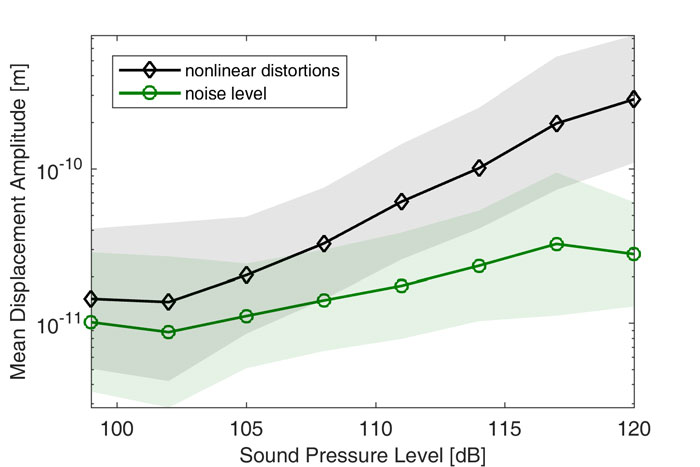
At a sound pressure level of about 120dB, the mean level of nonlinearity was recorded to be 57dB below the average linear vibration level. The low levels perhaps are the reason why nonlinearity remained uncovered using other methods. Laser Doppler vibrometry made it possible to detect and quantify nonlinearities with their levels.
It was shown that the odd multisine stimulation allowed for individual detection of even and odd degree nonlinearities. The level of the even degree appeared to be higher than the odd degree. Statistical testing however indicated that the difference was not significant owing to the large variability as well as the limited number of specimens.
The outcomes of the study indicated that odd and even distortions grew with stimulus level at a power of approximately 1.5, and this was less than expected power of two and three for quadratic and cubic distortions respectively.
In conclusion, laser Doppler Vibrometry method enabled the detection and quantification of nonlinear response in the human eardrum. Nonlinearities could be detected at 99dB and 120dB sound pressure levels the mean level of nonlinearities was more than 50dB below the average linear vibration response. It was possible to discriminate between odd and even nonlinearities, which helped to select the source of the nonlinear behavior.



Reference
Kilian Gladiné, Pieter G.G. Muyshondt, Joris J.J. Dirckx. Human middle-ear nonlinearity measurements using laser Doppler vibrometry. Optics and Lasers in Engineering. Available online 14 March 2017
Go To Optics and Lasers in Engineering