Advances in Engineering Advances in Engineering features breaking research judged by Advances in Engineering advisory team to be of key importance in the Engineering field. Papers are selected from over 10,000 published each week from most peer reviewed journals.

Significance
Epoxy resins are incredibly versatile materials and known for their strength, durability, and resistance to chemicals. This make them invaluable in countless industries from protective coatings, airplane parts, car panels, electronics, and construction materials and adhesives to advanced composites. But there’s a major downside: epoxy resins are highly flammable which makes them a significant safety risk. For years, the standard approach to making epoxy resins more fire-resistant was to add flame retardants such as halogen-based compounds and while these materials were effective at slowing down combustion, they introduced serious new problems. When burned, halogenated flame retardants release harmful and corrosive gases that pose health risks and contribute to environmental pollution. As awareness of these dangers grew, researchers began looking for alternatives that were both safer and more sustainable. Halogen-free flame retardants, especially those based on phosphorus and nitrogen, emerged as a promising option. Among these, compounds built on cyclotriphosphazene have gained attention for their ability to improve fire resistance without sacrificing too much in terms of performance or safety. However, even these newer solutions are far from perfect. Many flame retardants need to be added in large amounts to achieve meaningful fire resistance, which can weaken the overall strength and durability of the epoxy resin. Others don’t strike the right balance between improving fire safety and preserving mechanical properties, making them less practical for demanding applications. Moreover, many innovative flame-retardant materials are expensive to produce or too complex for widespread manufacturing, limiting their accessibility for large-scale use.
Recognizing these challenges, Mr. Xiao-Jie Li, Miss. Tian-Tian Huang, Prof. Zhu-Bao Shao, and led by Prof. Bin Zhao from the Qingdao University together with Mr.. Kai Ning from the North University of China, developed a better solution. Their study, recently published in Colloids and Surfaces A, described a new material designed to resolve these issues. The researchers created tiny hybrid particles called PZK (officially known as arone-containing cyclomatrix-type polyphosphazene hybrid microspheres), which combine arone-containing structures with a cyclomatrix-type polyphosphazene framework. This unique design aims to improve both the fire safety and the mechanical strength of epoxy resins. The arone structures are particularly effective at forming protective layers of char when exposed to heat, while the phosphazene framework adds robust flame-retardant properties. Together, these features offer a way to address the weaknesses of existing flame retardants, providing a safer, stronger, and more environmentally friendly solution for a material that’s critical to so many aspects of modern life.
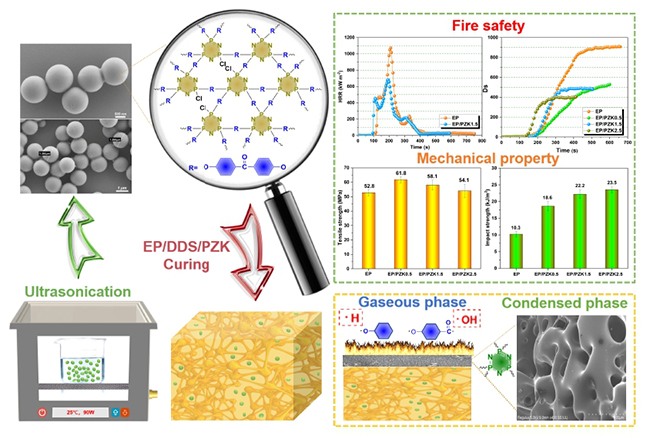
The authors created PZK using a controlled chemical process by combining two compounds—hexachlorocyclotriphosphazene and bis(4-hydroxyphenyl) ketone—and produced small, uniform microspheres with smooth surfaces. Afterward, the researchers mixed PZK into epoxy resins at three different concentrations: 0.5%, 1.5%, and 2.5% by weight. They then put the modified materials through a series of rigorous tests to evaluate how they performed under heat, stress, and fire. One of the most notable findings came from studying the thermal stability of the resins. Typically, epoxy resin starts breaking down at about 378°C, but when PZK was added, the resins were able to withstand higher temperatures before degrading. Even more impressive, the PZK helped the resin leave behind more char which is a good thing because it slows down the burning process and acts as a barrier against heat and oxygen. The team also examined how well these modified resins resisted combustion and when the authors added only 1.5% PZK, the limiting oxygen index (LOI) value jumped from 22.5%to 28.3% which indicated significantly improved fire resistance. These samples even passed the UL-94 V-1 standard, a tough benchmark for flame-retardant materials. Moreover, the researchers used a cone calorimeter to measure how the resin burned. The results showed a dramatic 36.5% reduction in the peak heat released during combustion and a 42.9% decrease in smoke production and this is way beyond fire resistance because they wanted to ensure that the mechanical properties of the resin weren’t compromised. In fact, they found the opposite—adding PZK actually made the resin stronger in some ways. For instance, the tensile strength of the resin increased by 17% when just 0.5% PZK was added. Even at higher concentrations, the resins maintained better strength than their unmodified counterparts. According to the authors, this improvement was attributed to the way the microspheres distributed stress evenly throughout the resin, preventing weak spots from forming. To understand how PZK worked so effectively, the team took a closer look at what happened when the material burned. They discovered that the microspheres released specific chemical radicals during combustion. These radicals acted as “firefighters” in the gas phase, neutralizing the highly reactive molecules that drive the spread of flames. At the same time, the unique structure of PZK promoted the formation of a dense char layer on the surface of the resin, which physically blocked heat and oxygen from fueling the fire.
In conclusion, the study by Professor Bin Zhao and colleagues took on a challenge in engineering for decades: how to make epoxy resins safer in the event of a fire while maintaining their incredible strength and durability and also environmentally sustainable. By adding just a small amount of PZK to the resin, they were able to achieve significant improvements in fire resistance. We think what makes this work so exciting is its real-world potential. Industries like aerospace, automotive, and construction are constantly looking for materials that are lightweight, high-performing, and meet strict safety standards. For example, in airplanes and cars, reducing weight is crucial, but fire safety is non-negotiable. PZK allows manufacturers to meet these fire safety requirements without adding bulk or compromising the material’s strength. It’s a smart, practical solution that addresses the very real concerns of engineers and manufacturers. We also believe the benefits go beyond fire safety. By improving the resin’s mechanical properties, the researchers have opened up new possibilities for its use in demanding environments. Imagine wind turbine blades that can withstand harsh weather and mechanical stress while also being fire-resistant, or electronic components that are both durable and safer in case of overheating.
The authors would like to acknowledge the financial support from the National Natural Science Foundation of China (Grant No. 21975226).


Reference
Xiao-Jie Li, Kai Ning, Tian-Tian Huang, Zhu-Bao Shao, Bin Zhao, Arone-containing cyclomatrix-type polyphosphazene hybrid microspheres for epoxy resin: Enhancing fire safety and mechanical properties, Colloids and Surfaces A: Physicochemical and Engineering Aspects, Volume 692, 2024, 133988,
Go to Colloids and Surfaces A: Physicochemical and Engineering Aspects