Advances in Engineering Advances in Engineering features breaking research judged by Advances in Engineering advisory team to be of key importance in the Engineering field. Papers are selected from over 10,000 published each week from most peer reviewed journals.

Significance
Intensive engineering research has led to the development of high-performance fiber-reinforced polymer composites. Owing to their excellent physical and mechanical properties, their application has tremendously increased over the past few years. More specifically, pultruded glass fiber reinforced polymers composites are widely preferred for structural and civil applications. However, recent studies have shown that exposing these materials to extreme temperature and moisture conditions result in the degradation of mechanical properties and reduction of the glass transition temperature.
To this end, understanding the effects of the environmental conditions on the behaviors and performance of glass fiber reinforced polymer composites is highly desirable.
Generally, several studies have been conducted to investigate the mechanical properties of the composites under the influence of hygrothermal environments. Despite the remarkable achievements, the effects of hygrothermal conditions on the interfacial performance between the matrix and the fiber are still missing. Alternatively, the durability of fiber reinforced polymers composites has been significantly investigated while on the other hand, little have been reported about the degradation mechanisms based on the microstructural and spectroscopic analysis.
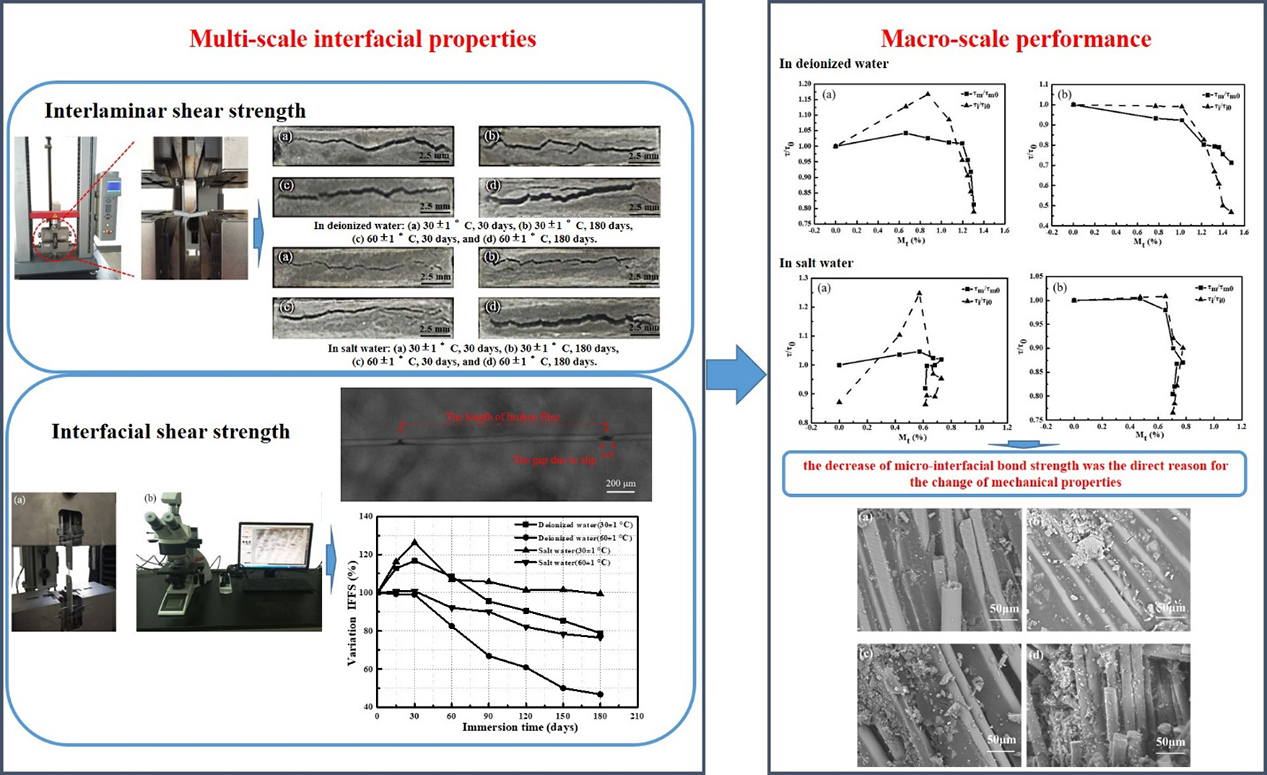
To this note, a group of researchers from College of Civil Engineering at Nanjing Tech University: Dr. Shulan Yang, Professor Weiqing Liu, A/Prof. Yuan Fang and A/Prof. Ruili Huo investigated the influence of the fiber-matrix interface of pultruded glass fiber-reinforced polymer composites under hygrothermal conditions. Specifically, they analyzed the effects of hygrothermal environments on the micro and macro mechanical properties of the polymer materials. Their work is currently published in Journal of Materials Science.
Their study involved immersing the composite in saltwater and deionized water at different temperatures. In particular, the moisture absorption kinetics of the pultruded fiber-reinforced polymer composites and its effects on the properties and interfacial strength was investigated. Next, the changes in the chemical structures and microstructures were examined through Fourier transform infrared spectroscopy and scanning electron microscope. Lastly, the Weibull distribution model was designed, taking into account the hygrothermal aging and eventually used to predict the durability and tensile performance of the pultruded fiber-reinforced polymer composites.
The authors observed that the moisture absorption increased nonlinearly with an increase in the temperature. Consequently, higher temperatures resulted in a corresponding high moisture absorption capacity and diffusion coefficient of the pultruded fiber-reinforced polymer composites immersed in both saltwater and distilled water. On the other hand, after approximately 180 days of aging, the tensile strength and modulus were recorded as 25.7% and 25% respectively for the samples immersed in distilled water and 2.15 and 18.2% for the specimen in saltwater. This was attributed to the increase in moisture absorption and tensile properties degradation.
In summary, Nanjing Tech University scientists are the first to successfully investigated the degradation mechanism of glass fiber-reinforced polymers composites in hygrothermal conditions based on the microstructural analysis. In general, the author singled out hydrolysis of resin and E-glass fibers as the main causes of the degradation of the tensile properties. The degradation trends of the composites in hygrothermal environments observed in the modeled Weibull distribution was noted to be an effective tool in describing the temperature effects. Therefore, the study will enhance the development of fiber-reinforced polymer composite suitable for numerous applications.




Reference
Yang, S., Liu, W., Fang, Y., & Huo, R. (2018). Influence of hygrothermal aging on the durability and interfacial performance of pultruded glass fiber-reinforced polymer composites. Journal of Materials Science, 54(3), 2102-2121.
Go To Journal of Materials Science