 Advances in Engineering Advances in Engineering features breaking research judged by Advances in Engineering advisory team to be of key importance in the Engineering field. Papers are selected from over 10,000 published each week from most peer reviewed journals.

Significance
The fractal theory was initially developed to characterize complex pore structures owing to the fractal nature of most materials’ surfaces at the molecular level. However, the fractural characterization of porous media has gained significant research attention in the past few decades to enable effective characterization of various materials for desirable applications. Presently, several methods for determining the fractal dimensions have been developed. Among them, the fractal dimension calculated through the box-counting method is widely preferred for investigating seepage properties, especially for porous media considering that it represents the porous volume, area size, and distribution in the space.
With the advancement in the technology, demands for high-resolution characterization of rock sample have recently increased. To this end, improvement measures for the box-counting method are highly desirable. Despite the development of high-resolution imaging techniques such as the micro X-ray computerized tomography, calculation of two-dimensional and three-dimensional fractal dimensions have remained a challenge. In a previously published literature, researchers have shown the possibility of simplifying the fractal permeability models thorough understanding of the relationship among three-dimensional, two-dimensional fractal dimension and the porosity. Alternatively, the factors influencing the different types of fractal dimensions have also been explored.
Recently, the researchers from the China University of Geosciences, Beijing (Hao Wu, Professor Yanbin Yao) and the University of Aberdeen (Dr. Yingfang Wu and Dr. Kejian Wu) cross-examined the two-dimensional and three-dimensional fractal dimension of micro-computed tomography coal images base on the improved box-counting method. They purposed to investigate the fractal characteristics of coal fracture network and the relationship among the porosity, three-dimensional fracture dimensional and two-dimensional fracture dimension. The research work is currently published in the research journal, Fuel.
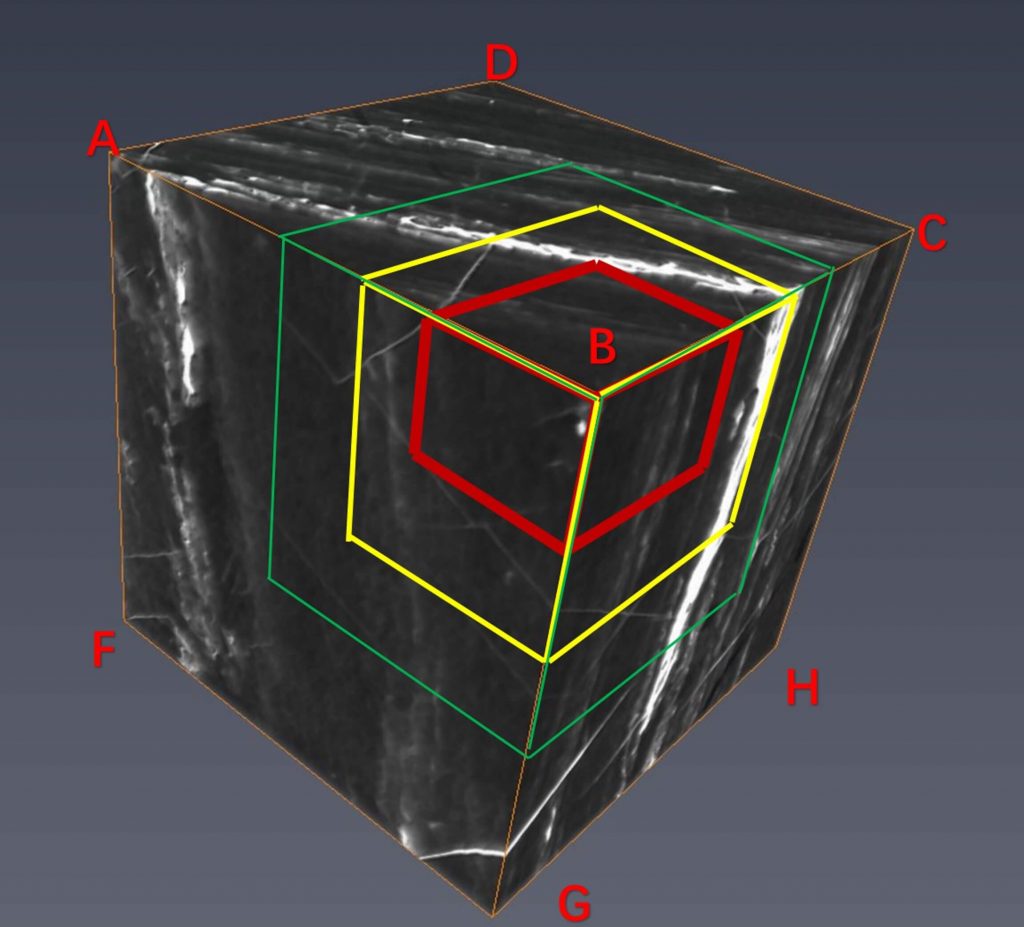
In brief, the research team started their studies by developing an image processing procedure and an algorithm for calculation of the fractal dimension. Secondly, four different coal samples with maximum vitrinite reflectance in oil ranging from 2.92% to 4.06% were imaged using the advanced micro-computed tomography imaging techniques. Next, both 2D and 3D fractal dimensions, as well as representative element volume, were calculated for the four samples, and the obtained data used to investigate the exponential relationship between porosity and fractal dimension and that between the 2D and 3D fractal dimensions.
From the experimental results, the authors confirmed the existence of fractal dimension-based representative element volume for the three-dimensional coal image and it increased with the increase in the original representative element volume image size. Generally, the fractal dimensions of the various representative element volumes were observed to positively correlate well with porosity. Unlike the previous literature, the authors proved the existence of the exponential relationship between the porosity and the fractal dimensions. Additionally, the porosity and composition of the coal were identified as the major factors influencing the exponential relationship.
In summary, the China University of Geosciences (Beijing) scientists successfully expressed the relationship between the 2D and 3D fractal dimensions using a simple equation similar to that of a line. For instance, the gradient increased with an increase in the 2D fractal dimension. Based on the exemplary results, the study will pave the way for characterization other rock and materials using the fractal theory.

Reference
Wu, H.,*Zhou, Y., *Yao, Y., & Wu, K. (2019). Imaged based fractal characterization of micro-fracture structure in coal. Fuel, 239, 53-62.
Go To Fuel