 Advances in Engineering Advances in Engineering features breaking research judged by Advances in Engineering advisory team to be of key importance in the Engineering field. Papers are selected from over 10,000 published each week from most peer reviewed journals.

Significance
The development of low carbon emission technologies has been favored by the increasing mitigation measures against the use of fossil fuels. This has also compelled serious development of renewable energy sources as an alternative to fossil fuels. Among the available renewable energy sources, hydrogen energy has particularly shown the potential of substituting fossil fuels for various applications due to its efficiency and relatively high energy density. However, storage of hydrogen has remained a challenge in the realization of its full potential. Therefore, researchers have been looking for alternative hydrogen storage methods and have identified the use of magnesium-based alloy materials as a promising candidate for effective hydrogen storage.
This can be attributed to the excellent cycling behavior and high hydrogen storage capacity of the MgH2 hydride phase. However, the high operating temperature due to the high thermodynamic stability is a great threat to its efficiency. Therefore, decreasing the stability of MgH2 is highly desirable.
Recent studies have shown that decreasing the stability of MgH2 is quite expensive and difficult. Alternatively, other considerations such as the use of dual tuned plasma materials are equally unfavorable for enhancing the equilibrium hydrogen pressure. Currently, hydrogen sorption kinetics in magnesium-based hydrogen storage materials has been considered an effective alternative solution. As such, favorable mechanisms have also been initiated to improve hydrogen sorption kinetics in magnesium.
To this note, Academy of Sciences of the Czech Republic scientists: Dr. Jiri Cermak, Dr. Lubomir Kral, and Dr. Pavla Roupcova looked at the feasibility of several chosen additives as excellent catalysts for hydrogen sorption kinetics. In particular, five different types of additives were tested and the results obtained for each individual additive compared to that in the existing literature. Their main objective was to determine a composition that could be used to improve the hydrogen storage kinetics of magnesium.
The authors commenced their research work by modifying magnesium using ten different catalysts and then investigated the hydrogen sorption characteristics of a combination of the additives together with a ball-milled blend of magnesium. Amorphous carbon was used as an anti-sticking agent to enhance the accuracy of the obtained results. The effect of every additive on the sorption kinetics was determined by setting the concentration of both the additive and the amorphous carbon at approximately 12wt %.
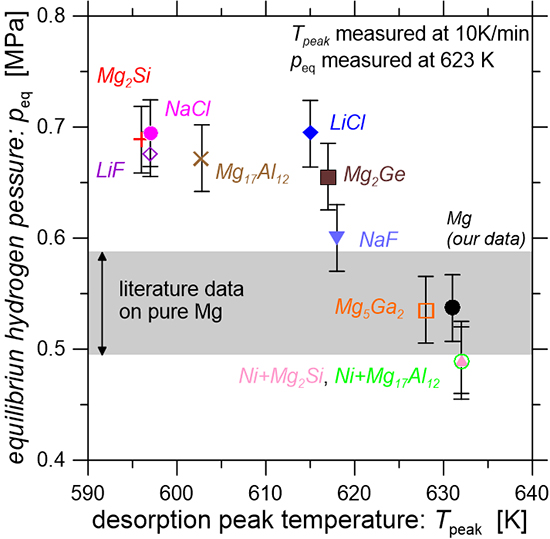
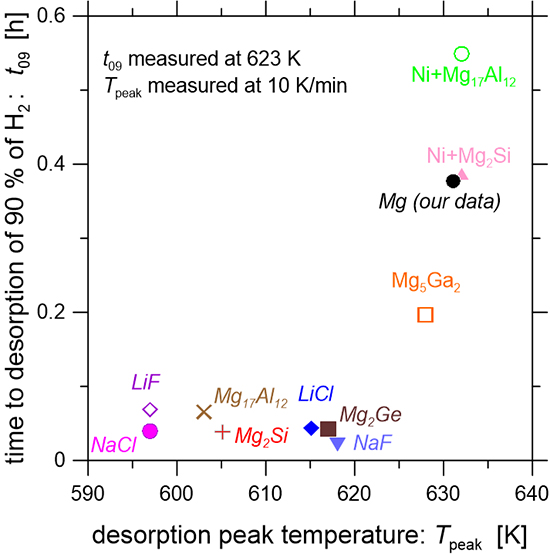
The experimental results showed that NaCl, Mg2Si and LiF mixtures increased the hydrogen equilibrium pressure and decreased desorption time. At the same time, NaCl and LiF were responsible for shifting the peak temperature to the lowest peak temperature at a temperature of 623K. In summary, Dr. Jiri Cermak and his colleagues successfully demonstrated the effective ways for improving hydrogen sorption kinetics in magnesium by using additives. This will, therefore, advance hydrogen storage for future utilization of hydrogen energy in both mobile and distributed systems as an alternative to fossil fuels. Their work is currently published in International Journal of Hydrogen Energy.




Reference
Cermak, J., Kral, L., & Roupcova, P. (2019). Improved hydrogen sorption kinetics in Mg modified by chosen catalysts. International Journal of Hydrogen Energy, 44(16), 8315-8324.
Go To International Journal of Hydrogen Energy