Advances in Engineering Advances in Engineering features breaking research judged by Advances in Engineering advisory team to be of key importance in the Engineering field. Papers are selected from over 10,000 published each week from most peer reviewed journals.

Significance
Grate biomass combustion is used for heating especially in cold countries. Numerous technological improvements have been undertaken to improve their efficiency so as to meet the customer needs as well as the policy regulations requirements. The use of computerized tools for the design, development, and simulation of grate biomass models have increased over the past decade. Bed combustion generally comprises of two zones that is fuel bed zone and freeboard zone which supports heterogeneous reactions and gaseous combustion respectively. Unfortunately, it is difficult to achieve accurate modeling of grate-fired combustion devices due to the complex nature of thermal-chemical conversion of particles found in a fuel bed.
Even though computational fluid dynamics (CFD) have been used to effectively simulate the freeboard zone, no good method has been provided for fuel bed combustion modeling. For instance, various approaches including porous medium, stand-alone bed models and empirically derived models experience numerous limitations thus producing inaccurate results. Therefore, developing a numerical tool for simulating biomass combustion in grate-fired is highly required.
Recently, Dr. Adeline Rezeau and Dr. Maryori Diaz-Ramirez at CIRCE Foundation in collaboration with Dr. Luis Diez and Dr. Javier Royo at the University of Zaragoza in Spain developed a numerical tool for simulating biomass combustion in grate-fired biomass boilers based on a simplified computational fluid dynamics. They achieved sufficient results accuracy and computing demand for enhancing the operation and improvements of the biomass devices. Their research work is currently published in the research journal, Fuel Processing Technology.
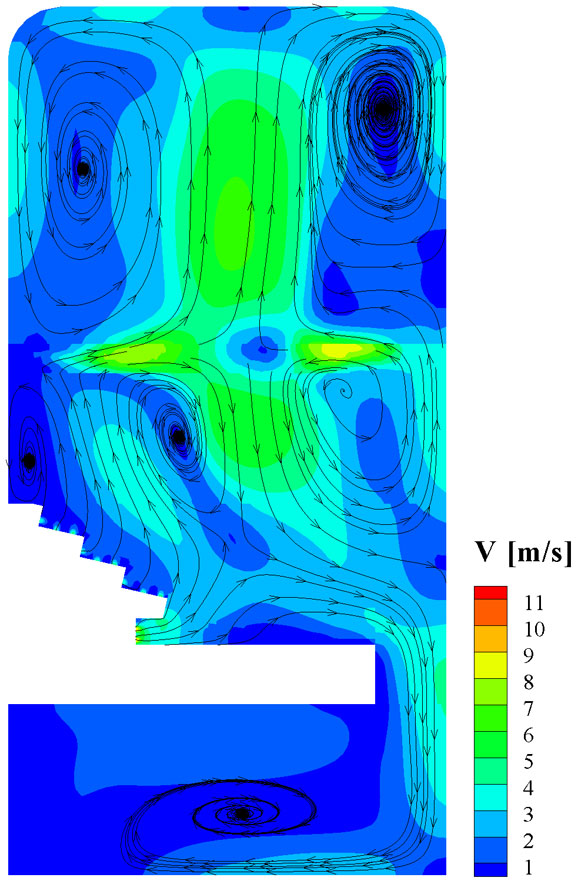
Briefly, the team of authors simplified the coupling between the freeboard zone and bed zone by integrating them on the same three-dimensional grid. Consequently, they assumed the combustion bed as a porous medium and utilized the modified laminar rate model to simulate the heterogeneous reactions because it allows simulating drying, pyrolysis and char reactions. The introduced site species effectively reacted on the surface of the porous medium thus producing and consuming the gas species. Furthermore, they carried out an experimental test in a 250 kWth grate boiler to validate the numerical tool. Eventually, they used the computational fluid dynamics-based tool to characterize the flow patterns and temperature in a combustion chamber.
The authors observed the similarities between the experimental results and the numerical results. This confirmed the capability of the developed modeling approach to predict the performance of the boiler. Also, the method was capable of detecting some of the operation and design deficiencies hindering the operation of biomass boilers that could not be detected by other experimental tests. For instance, several dead zones were produced by the secondary air inlets forcing the flames to expand in the direction of the combustion wall chambers thus affecting combustion above the grate.
The authors have successfully developed a new modeling method for enhancing the operation and improving the design of grate-fired biomass boilers. As such, it has created a platform for future research and hence will advance the design, development, and operation of efficient biomass boilers.




Reference
Rezeau, A., Díez, L., Royo, J., & Díaz-Ramírez, M. (2018). Efficient diagnosis of grate-fired biomass boilers by a simplified CFD-based approach. . Fuel Processing Technology, 171, 318-329.
Go To Fuel Processing Technology