 Advances in Engineering Advances in Engineering features breaking research judged by Advances in Engineering advisory team to be of key importance in the Engineering field. Papers are selected from over 10,000 published each week from most peer reviewed journals.

Significance
Variable geometry turbines help aircraft engines adapt to different flight conditions and unlike conventional turbines with fixed blade arrangements, they can adjust the angle of their stationary guide vanes to regulate gas flow. This flexibility is valuable in variable cycle engines, which must deliver high thrust during takeoff and high-speed flight but also reduce fuel consumption during cruise. Rotating the guide vanes changes the narrowest passage between adjacent blades, known as the throat area. This adjustment also affects the pressure and velocity of the gas, altering the aerodynamic conditions within the turbine.
Maintaining proper matching between the stationary guide vanes, or stator, and the rotating blades, or rotor requires careful consideration. When the stator closes, the gas enters the rotor at a different angle from its intended inlet direction. This difference, known as the incidence angle, can produce unfavorable pressure distributions and cause flow separation along the blade surfaces, increasing aerodynamic losses.
Conventional turbine design methods typically optimize aerodynamic parameters for a single operating condition before evaluating performance elsewhere. A configuration that works efficiently at one point may be less effective at another, making it necessary to consider competing requirements during the design process.
Accurately predicting the effects of stator rotation requires accounting for several factors. The direction of gas leaving the guide vanes depends on their orientation, throat geometry, flow deviation, and whether choking occurs. Once the flow becomes choked, further reductions in downstream pressure do not increase the mass flow through the affected passage under otherwise unchanged inlet conditions.
In a recent research paper published in Aerospace Science and Technology, Professor Zhengping Zou, Dr. Zihao Wang, and Dr. Lichao Yao from Beihang University, together with Dr. Weipeng Xue and Dr. Hongchuan Tan from AECC Sichuan Gas Turbine Establishment, developed an optimization method that accounts for multiple operating conditions during preliminary turbine design.
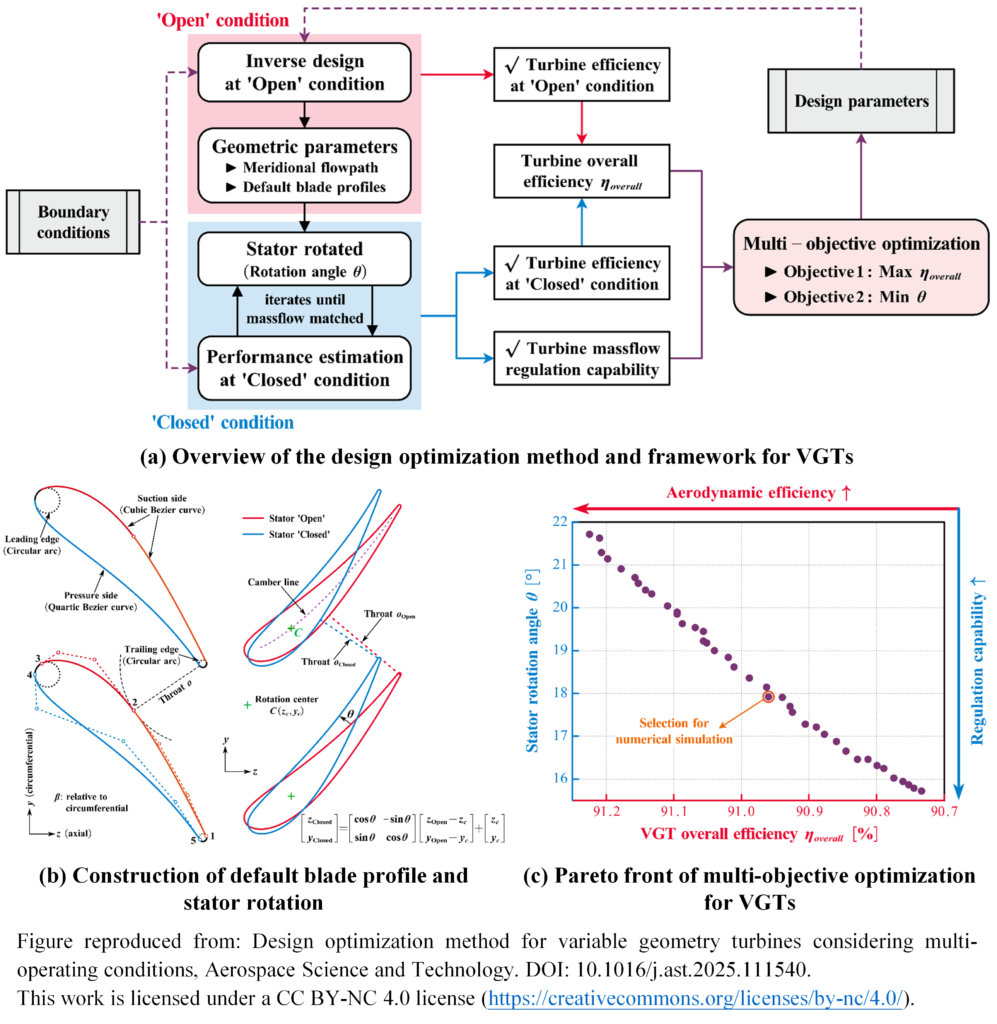
The process begins with the high-flow, or open, operating condition. Using an inverse design approach, the researchers calculate the gas velocities, blade angles, and passage dimensions needed to meet the specified performance requirements. These parameters provide the starting point for estimating turbine behavior at reduced flow rates.
To represent stator rotation, the team constructed a guide vane profile and calculated how its movement changes the throat area. The model accounts for flow deviation and determines whether choking occurs in the stator or rotor. The vane angle is then adjusted until the required mass flow and pressure ratio are achieved at the low-flow, or closed, condition.
The authors assessed the accuracy of these predictions using previously published experimental measurements from a variable geometry turbine. The calculated flow rates differed from the measurements by approximately 1.0% in the open condition and 2.5% in the closed condition. Differences in efficiency were within 0.5 percentage points, indicating close agreement between the model and experimental data.
The team then investigated how aerodynamic parameters influence turbine performance. One of the key variables was the reaction degree, which describes the proportion of the stage’s expansion occurring in the rotor. Lower values allowed the required reduction in flow rate to be achieved with less stator rotation. Increasing the reaction degree generally improved efficiency, although the benefit became smaller at higher values.
The loading coefficient, which relates the work extracted by the turbine to the square of the blade peripheral velocity, also affected efficiency. Lower values increased the stator outlet flow angle and reduced the turning required in the rotor, helping to limit aerodynamic losses. The influence of the flow coefficient, which relates axial gas velocity to blade peripheral velocity, depended on the operating point. Higher values favored the closed condition under the investigated conditions, whereas lower values were more beneficial at full flow.
To identify suitable parameter combinations, the researchers applied a multi-objective genetic optimization algorithm. It evaluated candidate designs according to their efficiency and the stator rotation needed to achieve the desired reduction in flow. The resulting solutions indicated that intermediate reaction degrees offered a favorable balance between these requirements.
Subsequently, the researchers focused on rotor blade geometry. The team combined a Kriging surrogate model with a genetic optimization algorithm to identify profiles capable of accommodating changes in inlet flow angle. By estimating aerodynamic losses for candidate shapes, the surrogate model reduced the number of detailed computational fluid dynamics simulations required.
Blade stagger angle, which describes the orientation of a blade relative to the turbine axis, was an important factor. They found larger stagger angles, together with lower inlet metal angles, helped the rotor accommodate the positive incidence encountered at reduced flow rates. At the open condition, excessively large stagger angles could lead to pressure-side flow separation under negative incidence. The researchers therefore selected a blade profile that provided a favorable compromise between the two operating conditions.
The researchers extended the analysis to a wider regulation range, reducing the mass flow from its full value to approximately two-thirds. Three-dimensional numerical simulations showed that the optimized turbine achieved efficiency improvements of 0.75 percentage points at full flow and 2.49 percentage points at reduced flow compared with the original prototype. They studied the rotor flow field to explain the larger improvement at the closed condition. In the original turbine, a region of low total pressure recovery extended from the rotor hub toward the middle of the blade span, indicating considerable aerodynamic losses. The optimized configuration reduced the extent and intensity of this region, producing a more favorable flow distribution.
The research by Dr. Lichao Yao and colleagues provides a way to assess the competing requirements of variable geometry turbines before their detailed blade profiles are finalized. By evaluating multiple operating conditions during preliminary design, engineers can select aerodynamic parameters that better accommodate the intended regulation range. The relationship between reaction degree and turbine performance offers guidance for distributing gas expansion between the stator and rotor. Choosing this parameter involves balancing the vane movement needed to control flow against the aerodynamic losses associated with each configuration.
The researchers also considered rotor incidence during preliminary design and, by accounting for changes in the direction of gas entering the rotor, optimized the blade geometry for different operating conditions rather than focusing on a single design point. Accurate treatment of throat geometry and choking behavior strengthens the connection between vane rotation and the resulting mass flow. Combined with the aerodynamic optimization procedure, these calculations provide a systematic basis for developing turbines that maintain efficient operation across a broad range of flow requirements.





Reference
Zhengping Zou, Zihao Wang, Lichao Yao, Weipeng Xue, Hongchuan Tan, Design optimization method for variable geometry turbines considering multi-operating conditions, Aerospace Science and Technology, Volume 170, 2026, 111540,