 Advances in Engineering Advances in Engineering features breaking research judged by Advances in Engineering advisory team to be of key importance in the Engineering field. Papers are selected from over 10,000 published each week from most peer reviewed journals.

Significance
Reaction rates and their associated effects vary depending on several factors, reaction conditions, and substances reacting. To understand the critical role of charge transport and the importance of chemical and biological reactions, it has become imperative to explore reaction kinetics at the individual-molecule level. Various mechanical and optical approaches have been developed to probe the reaction dynamics of biomacromolecules with great success. Unfortunately, these approaches have several drawbacks that limit their application in studying the dynamics of single-molecule chemical reactions.
Recently, in-situ label-free methods with stable long-term monitoring capabilities have been identified as promising alternatives. This can be achieved using electrical approaches based on the relationship between molecular conformation information and molecular electrical characteristic parameters. Among them, molecular break-junction have attracted significant attention owing to their outstanding properties, including ultrahigh sensitivity, stable electrical detection capability, and high reliability. This technique has shown great potential for monitoring the dynamics of single-molecule chemical reactions with various conditions. Nevertheless, despite the remarkable progress, it is still challenging to directly monitor chemical reactions under thermal control at a single-molecule scale.
On this account, Dr. Xia Long, Professor Juexian Cao, and Dr. Yong Hu from Xiangtan University in collaboration with Dr. Jin Li from Shenzhen Research Institute of Xiamen University reported an in-situ label-free technique for direct analysis and detection of the dynamics of a thermal reversible Diels-Alder (DA) reactions. In order to achieve this objective, they employed a scanning tunneling microscopy break junction (STM-BJ) technique coupled with a thermocouple with feedback control. Their research work is currently published in the journal, Chemical Engineering Journal.
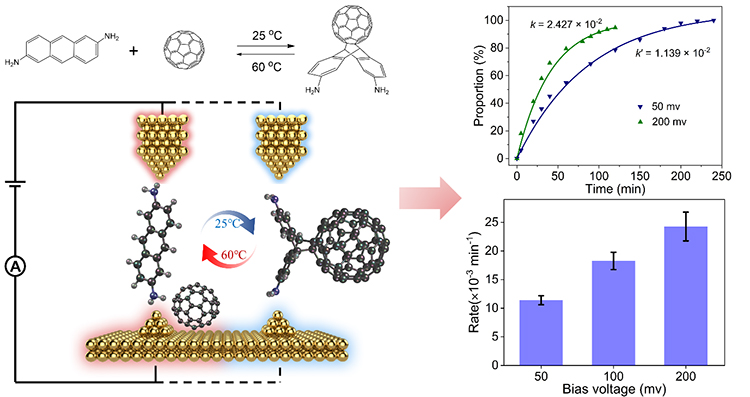
In their approach, the thermal-reversible DA reactions were carried out using fullerene C60 as the dienophile and anthracene-2,6-diamine (AnAm) as the dienes because they are known to undergo thermoreversible even at low temperatures. The STM-BJ equipped with a feedback-controlled thermocouple was used to trap single molecules. A Peltier heater was used for accurate temperature control for the DA reactions. AnAm molecules, especially with two NH2 moieties, were used to build efficient molecular junctions and to serve as single-molecule conductance indicators. Furthermore, by repeated forming and breaking of the molecular junctions, the corresponding conductance was measured for further quantitative kinetic analysis of the single-molecule reaction dynamics.
The authors showed that the initial and final conductance states in single-molecule junctions based on the reaction could be reversibly switched in situ between two different temperature levels. Quantitative analysis revealed the role of oriented external electric fields in electro-static catalysis of thermal-reversible DA reactions. Under external electric fields, the rate of forward reaction was more than three times faster than in the bulk phase. Interestingly, the significantly accelerated forward reaction did not impact the reverse reaction, whose reaction kinetics remained similar to those characterized via in-situ UV–vis measurements. Furthermore, the applied electric field reduced the energy barrier of the forward reaction by stabilizing the transition state dipole.
In summary, this is the first study to apply the STM-BJ technique for label-free single-molecule dynamic monitoring of thermal-reversible chemical reactions. The results demonstrated the great potential of electric fields in achieving selective manipulation of single-molecule dynamics of thermal-reversible reactions with remarkable results. Moreover, integrating reversible reactions into nanocircuits provided an efficient approach for manipulating chemical reactions, thereby offering new opportunities for the robust design of functional molecular-scale devices. In a statement to Advances in Engineering, Dr. Yong Hu stated that the proposed strategy would be extended for single-molecule direct dynamic monitoring of more sophisticated reactions.

Reference
Li, J., Long, X., Cao, J., & Hu, Y. (2023). In-situ label-free single-molecule dynamic detection of thermal-reversible reactions. Chemical Engineering Journal, 451, 138779.
