Advances in Engineering Advances in Engineering features breaking research judged by Advances in Engineering advisory team to be of key importance in the Engineering field. Papers are selected from over 10,000 published each week from most peer reviewed journals.

Significance Statement
Fossils fuels have the capacity to generate huge amounts of electricity and are being used to power everything from cars to lights in home. But the disadvantage of fossil fuel is that combustion of fossil fuels releases large amount of CO2 resulting in a global climate change. Hence alternative to fossil fuels such as renewable fuels e.g. biomass (from organic material, plant or waste) is needed.
Biomass used as a fuel reduces use of fossil fuels for the production heat, steam and electricity for residential, industrial and agricultural purposes. Combustion of waste and Biomass produces sustainable amount of heat and electricity. During combustion, flue gas is released which forms deposits on superheater tubes and water walls of the boilers leading to corrosion problems. This corrosion is mainly due to the presence of alkali chlorides present in the deposits.
Associate Professor Jesper Liske and colleagues from Chalmers University of Technology in Sweden have conducted laboratory studies with small amounts of KCl (potassium chloride) on stainless steels and have found out that it was chromate formation that initiated the corrosion attack. There is also formation of hydrochloric acid during the reaction between KCl and chromium rich oxide leading to further corrosion of metals. They investigated how initial corrosion on 304L is effected on varying amounts of potassium chloride with and without sulfur dioxide at 600 degree Celsius. The research is published in the peer-review journal, Energy & Fuels.
The aim of this laboratory study was to investigate, in a well-controlled way, the decrease of the corrosion rate of superheaters when sulfur containing fuel additives or by co-combustion of sulfur rich fuel are introduced to biomass and waste combustion. When SOx (sulfur oxides) content is increased, the alkali chlorides gets converted to alkali sulfates, which are less corrosive. By combusting the corrosive fuel with e.g. high dosage sewage sludge, most of the alkali chlorides are sulfated thereby making it less corrosive. The corrosive attack of stainless steels are considerably less in the presence of potassium sulfate compared to potassium chloride.
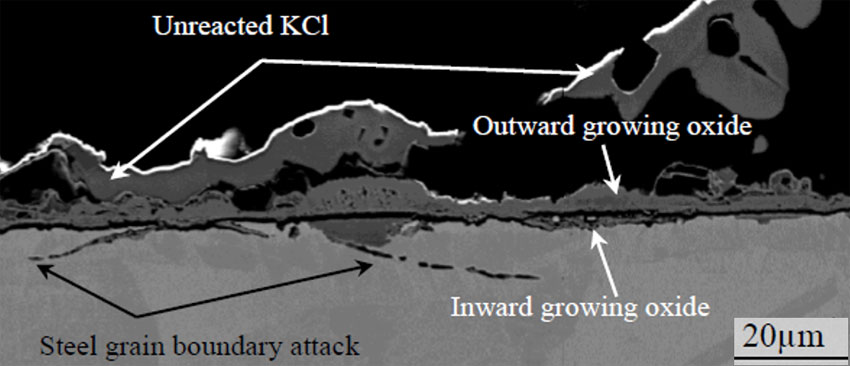
The results achieved were giving a clear picture on the corrosion effects on the stainless steel which is under study. The results showed that in the absence of SO2 KCl accelerates the rate of corrosion by means of two types of corrosion attack: a general attack and a steel grain boundary attack. The general attack was initiated by K2CrO4 formation. The steel grain boundary attack was suggested by the authors to be accelerated by HCl released due to the chromate formation which increased with higher amounts of KCl. They identified that after 24 hours of exposure in the absence SO2 20 % of the applied potassium ions was detected as K2CrO4. In contrast, only less than 2% of the potassium was detected as KCl. Hence, most of the applied KCl has left the surface (about 78%). The authors argues that most of the KCl has vaporized. In the presence of sulfur-dioxide, most of the potassium remains on the surface, about 91%, as potassium sulfate.
The corrosiveness of potassium chloride in absence and presence of sulfur-dioxide at 600 degree Celsius are investigated. The results show that initially the general corrosion is due to chromium depletion on the protective oxide on the stainless steel by chromate formation. They also observed that with larger amount of salt, the formation of chromate was increased and attack on the steel boundary was introduced. This was due to the increased chlorine release from the chromate formation. Furthermore, the study showed in the presence of sulfur dioxide that the corrosion was accelerated at the steel grain boundaries. The authors suggested that the grain boundary attack was accelerated by HCl released from the sulphation reaction and by sulphation of the steel grain boundaries.

Journal Reference
Sofia Karlsson, Erik Larsson, Torbjörn Jonsson, Jan-Erik Svensson, Jesper Liske, A Laboratory Study of the in Situ Sulfation of Alkali Chloride Rich Deposits: Corrosion Perspective, Energy Fuels 2016, 30, 7256−7267.
Department of Chemistry and Chemical Engineering, Energy and Materials Chalmers University of Technology, S-412 96 Göteborg, Sweden.
Go To Energy Fuels