Advances in Engineering Advances in Engineering features breaking research judged by Advances in Engineering advisory team to be of key importance in the Engineering field. Papers are selected from over 10,000 published each week from most peer reviewed journals.

Significance Statement
Natural gas is commonly transported from producing regions to demand centers by buried steel pipelines. Actually it is estimated that the total length of the carbon steel pipe network that crisscrosses all over our planet is larger than 1 million kilometers, a length equivalent to 25 turns around the Earth. Though pipelines are the safest, most environmentally-friendly and most reliable mode of transporting natural gas, it is clear that protection, maintenance, monitoring and survey of the buried steel pipes is of tremendous importance. The main risk arises from the external corrosion of the pipes that is the corrosion of the metal in contact with soil. Two methods are combined to prevent the pipelines against this degradation. First, an organic coating is used to physically shelter the steel surface from the soil. Secondly, as it cannot be expected that the coating is totally free of defects, a cathodic protection (CP) is applied to limit the corrosion rate of the uncoated parts of the pipes. The basic principle of this electrochemical method is to provide electrons, using an electrical device, to the oxidizing species responsible for the corrosion phenomenon (mainly dissolved oxygen). These electrons are consumed preferentially to those otherwise given by the corroding metal and the corrosion rate is decreased. The efficiency of the method is assessed by the measurement of the potential of the metal. Schematically, the lower is this potential the smaller is the corrosion rate. In practice, it is considered that the steel pipes are correctly protected if the potential of the metal is lower than the “protection potential”. The value of this “protection potential” is recommended by international standards taking into account various physical and chemical properties of the soil to guarantee a residual corrosion rate lower than 10 µm/yr. With such a rate, a steel thickness loss of 1 mm would require a hundred years. However, the accurate relationship between the “protection potential” and the residual corrosion rate is questionable. Moreover, in some cases, it is practically impossible to reach the “protection potential” value.
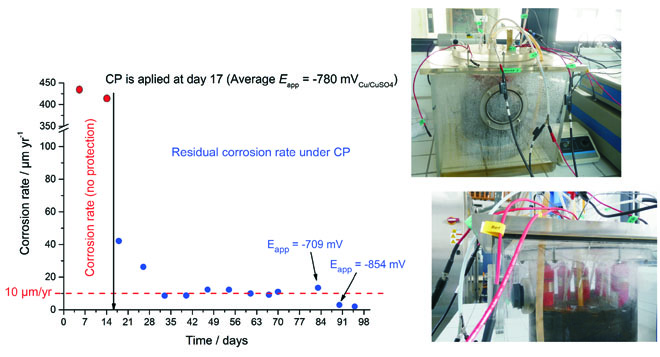
And then was the scientific blockage: Cathodic protection was well known to be efficient, but to what extent? The criterion base on potential is an indirect proof of cathodic protection efficiency; the direct proof is the residual corrosion rate. This rate is proportional to the anodic current density, a very minor part of the overall current flowing through the steel surface. How could we determine this residual anodic current density, generally considered to be negligible so that its existence was sometimes forgotten (or denied)? The article highlighted here demonstrated that the combination of experimental results and mathematical modelling using electrochemical kinetic laws could provide a reliable determination of the residual anodic current density or, in other words, of the residual corrosion rate of steel under cathodic protection. The polarization curve of the metal, that is the variation of the overall current with the potential, could be modelled from the applied “protection potential” up to the corrosion potential (that is the potential of the metal when it corrodes spontaneously without applied protection). The kinetic parameters of both anodic and cathodic components of the current were adjusted so that the theoretical computed curve corresponded to the experimental polarization curve. The residual corrosion rate can then be computed from kinetic parameters obtained for the anodic current density. The method was applied in various soil moistures conditions, at various applied potentials, and its results validated by comparison with weight loss measurements (the weight of the steel sample is measured at the beginning and at the end of the experiment so that the metal loss due to corrosion can be determined and the average corrosion rate deduced). As the method gives the residual corrosion rate at a given time it allowed us to follow the evolution of the residual corrosion rate over time and its variation with the applied potential. In any case, the residual corrosion rates were observed to decrease over time. They did reach (and even get lower) the aimed value of 10 µm/yr after about three weeks of cathodic protection. Moreover, the information given by this new methodology provided new insight on the variations of the steel/soil interface induced by cathodic protection.
Applied to steel in the field, this new method could quantify the residual corrosion rates and provides a more direct evidence of the efficiency level of the cathodic protection applied to the buried pipelines.
Figure Legend: Graph showing the evolution over time of the residual corrosion rate of a steel sample (5 cm2) under cathodic protection in an aerated saturated sand soil. The oscillations of the residual corrosion rate are due to variations of the applied protection potential. The photographs show the experimental Plexiglas cell containing the soil and the various buried steel coupons and electrodes.
Journal Reference
Electrochimica Acta, Volume 176, 2015, Pages 1410-1419.
D. Nguyen Dang1, L. Lanarde2, M. Jeannin1, R. Sabot1, Ph. Refait1
[expand title=”Show Affiliations”]- Laboratoire des Sciences de l’Ingénieur pour l’Environnement (LaSIE), UMR 7356 CNRS-Univ. La Rochelle, Bât. Marie Curie, Av. Michel Crépeau, F-17042 La Rochelle cedex 01, France
- GDF SUEZ–CRIGEN, 361, Av. du Président Wilson, BP 33, 93210 Saint-Denis La Plaine, France
Abstract
Carbon steel coupons buried in a sand soil with various moisture conditions were left at open circuit potential during 14-17 days before to be subjected to cathodic protection for 78–90 days. Voltammetry was used to follow the corrosion rate with time. The residual corrosion rate under cathodic protection was estimated via a mathematical adjustment of the polarization curves with a theoretical kinetic law, which allows the determination of the anodic part of the current. The ohmic drop was corrected after measurement of soil resistance with electrochemical impedance spectroscopy. At open circuit potential, a link between soil resistance and corrosion rate revealed that these two parameters were mainly influenced by the active area of the coupon. Thus, the various measured corrosion rates (from 40 to 400 μm yr−1) mainly reflect variations of the active area. Under cathodic protection, the active area increases and the residual corrosion rates tend to a unique value for all coupons. Average corrosion rates deduced from voltammetry were consistent with weight loss measurements. Analysis of the products formed on the coupons illustrated the influence of aeration and water content. The predominant compound was α-FeOOH in the 25%/saturation soil, carbonate green rust in the saturated soil.
Go To Electrochimica Acta