Advances in Engineering Advances in Engineering features breaking research judged by Advances in Engineering advisory team to be of key importance in the Engineering field. Papers are selected from over 10,000 published each week from most peer reviewed journals.

Significance
3D printing is one of the latest exciting and revolutionary technologies in the manufacturing industries. It enables the fabrication of complex three-dimensional parts from their computer-aided design drawings. Owing to its flexibility and efficiency, its use has been extended to several other applications for printing structures such as advanced electronic components. The fusion at the droplet/droplet interface is very significant for the printing of 3D metal structures. Therefore, extensive research is being done to improve on the existing 3D printers for the manufacturing of high-quality products for a wide range of materials such as aluminum.
Generally, molten aluminum alloys exhibit large surface tension and high-temperature gradient that hinder printing of high-quality structures from the molten aluminum droplets. This results in defects such as cold lap pores due to poor remelting conditions between the droplets. Recently, determination of the critical remelting conditions has attracted significant attention of many researchers. Despite a number of proposed theoretical and experimental models, cold cap pores remain a serious defect thus lowering their performance. This has led to consideration of other potential factors during the remelting process.
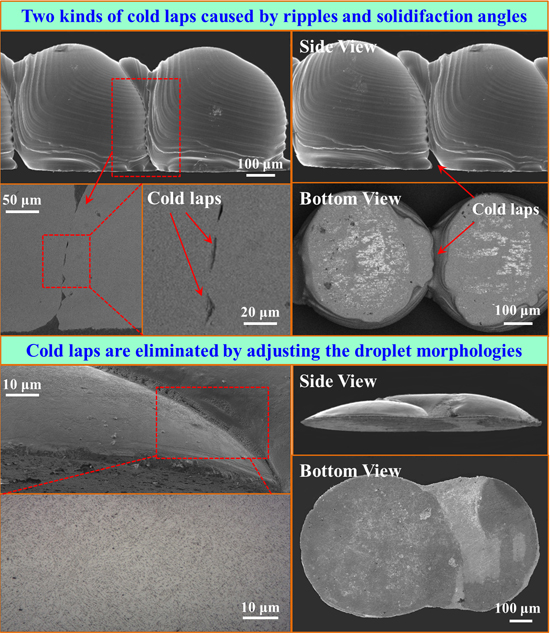
Recently, Northwestern Polytechnical University researchers Dr. Hao Yi, Professor Lehua Qi, Professor Jun Luo, Dr. Daicong Zhang and Professor Hejun Li in collaboration with Professor Xianghui Hou at the University of Nottingham observed that the surface morphologies of solidified droplets are potential and significant influencers of the remelting between droplets during 3D printing for the first time. They investigated the effects of surface morphologies in the remelting process between neighboring droplets by considering the ripples and the solidification angles. Their work is published in International Journal of Machine Tools and Manufacture, and this investigation successfully updates the understanding of metal droplet-based 3D printing.
The authors divided the remelting process between the neighboring droplets into two stages. In the first stage, they observed that the internal defects like cold laps can occur even though the remelting conditions are theoretically satisfied. This is because the surface of the previously deposited droplet contains ripples that tend to block the contact with another droplet. Consequently, in the second stage, solidification angles greater than 900 results in the incomplete filling of the liquid phase that produces cold laps on the bottom surface.
The study is the first to experimentally investigate the effects of the solidification angles and the blocking effects of the ripples on the fusion between the droplets. Furthermore, an effective method for promoting the remelting process of the droplets by decreasing solidification angles and eliminating the ripples by using a lower thermal conductivity substrate is also verified. The research forms the basis for minimizing internal defects and thus improving the metallurgical bonding during droplet-based 3D printing. Therefore, it will advance the use of 3D printers in the various field for manufacturing of complex parts especially metal structures.



Reference
Yi, H., Qi, L., Luo, J., Zhang, D., Li, H., & Hou, X. (2018). Effect of the surface morphology of solidified droplet on remelting between neighboring aluminum droplets. International Journal of Machine Tools and Manufacture, 130-131, 1-11.
Go To International Journal of Machine Tools and Manufacture