Advances in Engineering Advances in Engineering features breaking research judged by Advances in Engineering advisory team to be of key importance in the Engineering field. Papers are selected from over 10,000 published each week from most peer reviewed journals.

Significance Statement
CO2 is a major greenhouse gas that causes global climate change. Carbon capture and storage (CCS) is increasingly receiving attention as a measure to mitigate greenhouse gas emissions. Within post combustion CO2 capture, scrubbing with aqueous amine based solvents is the most mature and widely used technology. Monoethanolamine (MEA) is still considered a base case, but other amines as well as different blended systems have been suggested and partially commercialized.
Minimizing the energy consumption and the parasitic load of the capture process has been the number one priority within research and development of CO2 capture processes. Increased maturity of the technology and the establishment of the first full scale plants, has led to increased focus on other process factors, such as solvent degradation, emissions to air and process waste handling. Accumulation of solvent degradation products in the process makes reclaiming necessary for efficient operation. This reclaimer waste has to be disposed of properly. Compared to disposal as hazardous waste landfill or by incineration, biological waste water treatment is a sustainable and economically feasible option that needs further studies.
In amine based CO2 capture plants, the aqueous amine solution is subject to oxidative and thermal degradation as well as side reactions with flue gas impurities. The reclaimer unit separates the high molecular weight degradation products and heat stable salts from the amine solvent. In addition to these, the amine solvent itself is often the main constituent of the reclaimer waste. The exact composition varies with amine type regarding composition, quantity and toxicity. Generally, such wastes will contain undegraded amines as well as their degradation products, including ammonia as a dominant factor.
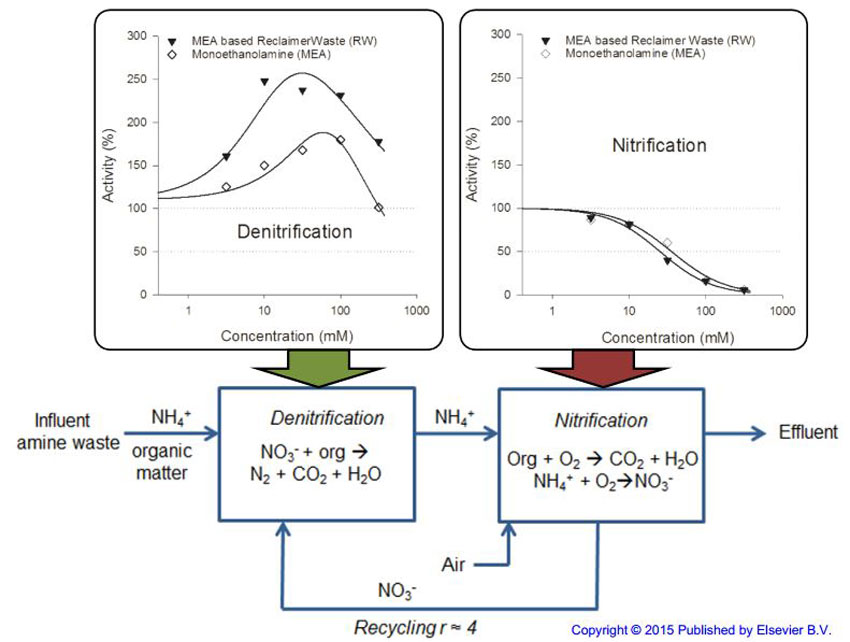
We have previously shown that two-step biological nitrogen removal by pre-denitrification is a feasible approach for MEA based reclaimer waste.. So called moving bed biofilm (MBBR) systems have proven to be robust and highly efficient both for the nitrifying and the denitrifying step. However, in order to design a successful full scale process, limiting factors at high loading must be identified first. This is the goal of our current paper.
Initially, total organic loading was tested in the form of added acetate while monitoring population dynamics in the biofilms by pyrosequencing. Our results show that the long-term abundance of heterotrophic bacteria is an essential factor in inhibition of nitrifying efficiency. Secondly, the inhibition potential of the commonly applied amines monoethanolamine (MEA), 2-amino-2-methyl-1-propanol (AMP), diethanolamine (DEA), methyldiethanolamine (MDEA), piperazine (Pip), as well as MEA based reclaimer waste (RW) were tested on separate nitrifying and denitrifying MBBRs. Results show that nitrification was inhibited by 50% at EC50 concentrations from 9 to 120 mM, whereas denitrification was stimulated by all compounds at concentrations up to 100 mM.
Nitrifying biofilms, long-term adapted to organic loadings, were in both cases 5–20 times more sensitive towards inhibition than those maintained without organic feeding. The crucial factor for the total process is therefore maintaining nitrification by avoiding overloading of amines or other organics in the second reactor. Computer models suitable for design as well as for operation are being developed, including simulated inhibition based on the data presented here.





Journal Reference
International Journal of Greenhouse Gas Control, Volume 45, 2016, Pages 200-206.
Ingrid A. Henry1, Aslak Einbu2, Hallvard F. Svendsen3, Ingrid Bakke1, Kjetill Østgaard1
[expand title=”Show Affiliations”]- Department of Biotechnology, Norwegian University of Science and Technology, Sem Sælands vei 6/8, 7491 Trondheim, Norway
- SINTEF Material and Chemistry, Sem Sælands vei 2 A, 7491 Trondheim, Norway
- Department of Chemical Engineering, Norwegian University of Science and Technology, Sem Sælands vei 6, 7491 Trondheim, Norway [/expand]
Abstract
We have previously shown that biological nitrogen removal by pre-denitrification as illustrated may be a feasible approach for treating wastes generated by amine based CO2 capture. In order to identify limiting factors for successful up-scaling, we first compared the nitrifying activity of moving bed biofilm reactors (MBBR) with or without chronic exposure to organic loading in the form of acetate while monitoring population dynamics in the biofilms by pyro-sequencing. Our results show that the long-term abundance of heterotrophic bacteria is an essential factor in inhibition of nitrification efficiency. Secondly, the inhibition potential of the commonly applied amines monoethanolamine (MEA), 2-amino-2-methyl-1-propanol (AMP), diethanolamine (DEA), methyldiethanolamine (MDEA), piperazine (Pip), as well as MEA based reclaimer waste (RW) were tested on separate nitrifying and denitrifying MBBRs.
Results show that nitrification was inhibited by 50% at EC50 concentrations from 9 to 120 mM, whereas denitrification was stimulated by all compounds at concentrations up to 100 mM. Nitrifying biofilms long-term adapted to organic loadings were 5–20 times more sensitive towards inhibition than those maintained without organic feeding, by both MEA and by organic loading. The crucial factor for the total process is therefore maintaining nitrification by avoiding overloading of amines or other organics in the second reactor.
Go To International Journal of Greenhouse Gas Control