Advances in Engineering Advances in Engineering features breaking research judged by Advances in Engineering advisory team to be of key importance in the Engineering field. Papers are selected from over 10,000 published each week from most peer reviewed journals.

Significance
Composite laminates are made up of a combination of fibrous composite materials bonded together layer by layer to obtain the required engineering properties, such as bending stiffness, strength, and in-plane stiffness. Modern fabrication technologies have enabled the development of advanced composite laminates that have better properties. Nonetheless, such advanced composite laminates have been plagued by a critical weakness in that they are highly susceptible to delamination due to their low interlaminar shear and tensile strengths. Consequently, numerous studies have been undertaken where the focus has been to investigate the required energy to induce fracture, known as the critical strain energy release rate (SERR) or fracture toughness, to characterize the initiation of delamination within composite laminates. Technically, most studies utilize standard tests,such as the double cantilever beam (DCB) or end-notch flexural (ENF). Contemporary research has revealed that due to the significant variation in the critical SERR and the considerable influence of ply orientation and specimen width, it is necessary to obtain accurate internal measurements to simulate delamination accurately.
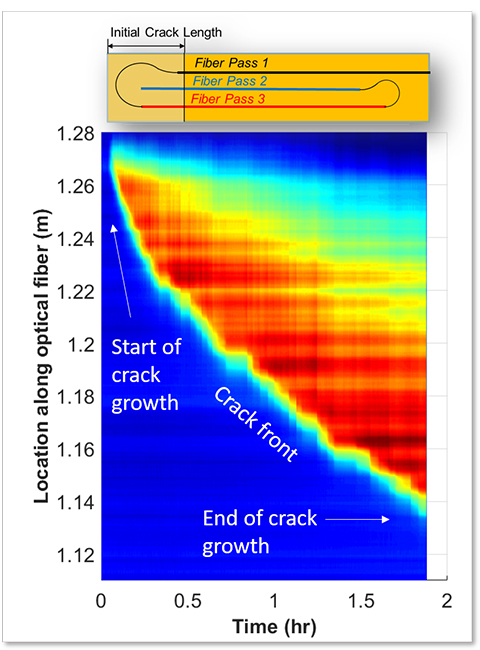
Ideally, significant variations of the fracture toughness can occur across the width of a DCB test article due to the anticlastic curvature of composite laminates in bending. Therefore, for one to obtain more accurate fracture toughness values, further research is necessitated. To address this shortfall, scientists from Mississippi State University: Daniel Drake (PhD candidate) and Professor Rani Sullivan used a Lagrangian cross-correlation approach for estimating the delamination front without influencing crack growth behavior, and successfully determined the critical SERR variation experimentally using high-spatial resolution unmodified optical fibers. Their new numerical approach is capable of using strain measurements directly from the delamination site to obtain accurate crack growth predictions. Their work is currently published in the research journal, Composites Part A.
In their study, cross correlation was used to identify the crack front to measure the internal delamination in situ within DCB composite specimens. In addition, strain data from multiple passes of embedded OF in DCB specimens were used to demonstrate the cross correlation numerical approach and its efficacy. In the end, a comparison of crack lengths, fracture toughness, and flexural moduli between the numerical approach and visual edge measurements were presented.
The authors reported excellent agreement between SERR surface measurements and OF predictions. Additionally, they highlighted that measuring the fracture toughness across the specimen width revealed a concave curvature that was associated with the anticlastic behavior of laminates undergoing bending. Using their approach, the flexural moduli before the initiation of delamination can be estimated.
In summary, strain distributions were obtained from OF sensors embedded in DCB test articles and correlated to the propagation of delamination. In the presented approach, the sensors were woven through the local preform stitching before resin infusion. The hallmark of their work was the fact that the measurements of internal delamination propagation in composite laminates of unique ply configurations could be achieved by using embedded optical fiber sensors. In a statement to Advances in Engineering, Drake mentioned that their approach alleviated the requirement of unidirectional plies near the midplane of composite laminates when determining the SERR of angle-ply laminates.
Overall, the presented methodology offers improved predictive and design capability for composites from a crack progression perspective by using internal SERR measurements. Professor Sullivan related that since this method can be used for obtaining in situ crack growth measurements , a more condition-based maintenance procedure can be implemented for improved structural health monitoring.


Reference
D. Drake, R. Sullivan. Prediction of delamination propagation in polymer composites. Composites Part A, volume 124 (2019) page 105467.