Advances in Engineering Advances in Engineering features breaking research judged by Advances in Engineering advisory team to be of key importance in the Engineering field. Papers are selected from over 10,000 published each week from most peer reviewed journals.

Significance
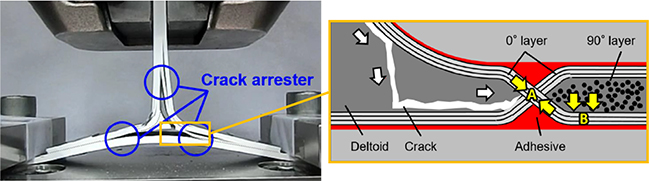
Composite materials have gained significant research attention due to their unique properties desirable for various applications, including aerospace and automobile. Unfortunately, joining composite structures have remained a great challenge in their applications. In the aerospace industry, T-joints are commonly used to transfer loads between horizontal and vertical panels. However, achieving these T-joints, especially the ones made of composite structures such as carbon fibers is difficult. Typically, a T-joint consists of a skin laminate, L-shaped structures and a deltoid. And the main design concern is the prevalent cracks in the deltoid and their propagation in the flange-skin interface, resulting in overall failure. The premature cracking in the deltoid region can be attributed to the cure-induced effects and low through-thickness material properties. Therefore, using crack arresters at the interface is a promising method for enhancing damage tolerance of T-joints made of composite structures.
The reinforcement of flange-skin interface of composite T-joints has been extensively studied in the literature. Methods such as stitching and z-pinning, which involves reinforcing the bonded interface using metals or fibers inserted in the out-of-plane direction, have proved effective for improving the damage tolerance of the joints. Unfortunately, these methods also have the undesirable effect of reducing initial failure strength and stiffness. Therefore, developing alternative and efficient methods for suppressing the crack development and propagations at the T-joints is highly desirable.
On this account, researchers from The University of Tokyo: Dr. Shinsaku Hisada (currently at Japan Aerospace Exploration Agency), Professor Shu Minakuchi and Professor Nobuo Takeda, investigated the crack propagation at the flange-skin interface of composite T-joints based on finite element analysis (FEA). The aim was to obtain the most appropriate crack arrester for enhancing the damage tolerance of the composite T-joints under pull-up conditions. Their research work is currently published in the journal, Composite Structures.
In their approach, the authors commenced their study by detailed finite element analysis of the crack propagating mode in the flange-skin interface. From the FEA analysis, an appropriate crack arresting mechanism with interlocking feature was proposed. Next, a series of pull-up tests were performed to evaluate the feasibility of the proposed crack arrester mechanism. The authors also investigated the efficient configuration and arrangement of the crack arresters. Finally, to validate the results further, the energy absorption ability as well as the failure progress of the specimen with crack arresters were compared to those without arresters.
Results demonstrated that an interlocking-fiber based crack arrester was very effective for improving the damage tolerance of composite T-joints subjected to pull-up conditions. Generally, the crack arresters were capable of suppressing the crack propagation, thereby remarkably enhancing the composite T-joints damage tolerance. Specimens without crack arresters exhibited lower energy absorption capacity and totally different failure progress compared to those with crack arresters. And the differences were attributed to the configurations of the interlocking fibers of the arresters. Furthermore, a better arrester arrangement was deemed to be that placed at the deltoid and the flange-skin interfaces.
In summary, the authors studied the crack propagation and the resulting failure mode at the flange-skin interface. They introduced a crack arrester feature based on interlocking fiber to suppress the cracks and improve the damage tolerance of the composite T-joints. The feasibility of the crack arresters, including their configurations and arrangements, were discussed in detail. Notably, the authors noted that there is an optimal configuration and arrangement of the crack arrester for the overall design requirements. It is important that the initial failure load is almost the same regardless of the configuration and arrangement of the crack arrester. According to the authors, the next step is to verify the effectiveness of the crack arresters in suppressing the bending and fatigue induced damages.



Reference
Hisada, S., Minakuchi, S., & Takeda, N. (2020). Damage tolerance improvement of composite T-joint under pull-up conditions using an interlocking-fiber-based crack arrester. Composite Structures, 253, 112792.