Advances in Engineering Advances in Engineering features breaking research judged by Advances in Engineering advisory team to be of key importance in the Engineering field. Papers are selected from over 10,000 published each week from most peer reviewed journals.

Significance Statement
The corrosion history influences the present corrosion rate and type of corrosion attack in a boiler
Renewable fuels such as biomass and waste are used as a promising alternative in production of electricity.However, the combustion of these fuels often generates deposits rich in alkali chlorides which accelerate the corrosion rate of the alloys used in heat-exchangers. These less expensive fuels are generally more corrosive, but the corrosion rate may be affected by a former fuel mix causing a memory effect .
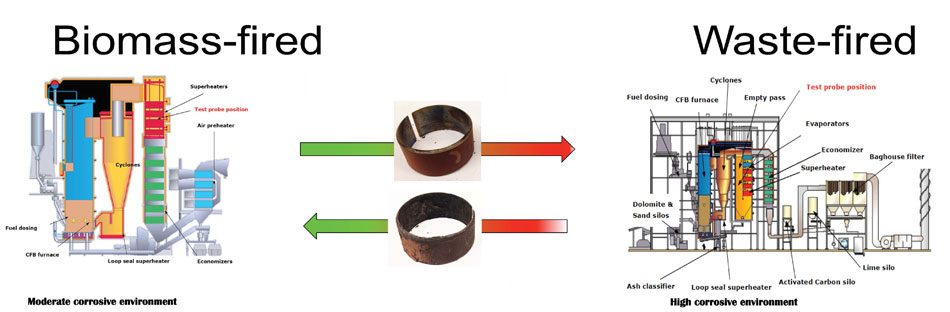
Dr. Paz and colleagues from High Temperature Corrosion Centre at Chalmers University of Technology in Sweden have investigated the effects of variations of fuel mix in a boiler and corrosion history on corrosion of heat exchange surfaces. They have achieved this study by introducing a novel scheme that utilizes probe exposures in two different boilers in order to simulate the fuel exchange. The study is published in Fuel Processing Technology.
A three-step exposure was carried out using two identical probes in two different boilers with temperature set at 600. For the first step, both probes were exposed for 313 h in a biomass-fired boiler which results in a non-corrosive deposit and eventually 3 out of 9 samples of both probes were changed. During the second step, one of the probes (Probe 2) was exposed in a waste-fired boiler while the other (Probe 1) was exposed again in the biomass-fired boiler during 236 h. In the third step, both probes were exposed in the biomass-fired boiler for 162 h.
In the first exposure, it was observed that a thin deposit with some spallation was generated. In the second exposure, Probe 1 (biomass) generated deposits similar to first exposure while Probe 2 (waste) generated a large amount of deposit which was spalled off during the handling of the samples.
The analyses of the deposit and corrosion products formed on samples on Probe 1 after the first step was given as backscattered scanning electron microscopy images. They showed an approximately 100 μm thick deposit covering a very thin oxide (about 5 μm) on the sample.
Analytical results on Probe 1 after three exposures in biomass-fired boiler (711 h) showed that the deposit is about three times thicker than the corresponding sample exposed for only one step. The oxide scale has grown to about 10-15 μm in some regions and still thin in others. The oxide scale consisted of outer iron-rich oxide and inner FeCrNi oxide with no chlorine or metallic chloride detected in any of the analyses. The material loss was negligible at about <0.13μm/h after one and three exposures.
For Probe 2 in waste-fired boiler, the samples suffered from spallation and only the inner part of the corrosion products was preserved. This 100 μm thick layer of corrosion products can be divided into three layers. Scanning electron microscopy/energy dispersive x-ray analysis showed an inner iron and nickel rich layer of approximately 20 μm closest to the alloy, containing about 32% atomic chlorine. Above this inner layer, backscattered scanning electron microscopy images confirmed the presence of a second layer of iron chloride. The third layer consist of metal chlorides with embedded chromium-rich oxides . The material loss measurement was found to be about 2 μm/h, 15 times larger than the samples exposed in moderately corrosive environment for three times longer.
The memory effect was analyzed in Probe 2. The oxide scale was composed by an outer 25 μm thick chromium rich oxide and an approximately 50 μm thick inner part composed mostly of nickel and iron oxide. Negligible amounts of chlorine were observed in the remaining deposit, corrosion products or metal oxide interface. The material loss measurement showed a loss of approximately 0.5 μm/h, which is 4 times lower than the one found in the samples exposed only in the high corrosive environment..
The findings show that the oxide scale formed on samples exposed first in a biomass-fired boiler has a mitigating effect on corrosion attack when exposed in a waste fired boiler afterwards. The corrosion history was seen to affect the future corrosion rate.

Journal Reference
Paz, M.D. Zhao, D. Karlsson, S. Liske, J. Jonsson, T. Investigating Corrosion Memory: The Influence of Previous Boiler Operation on Current Corrosion Rate. Fuel Processing Technology, Volume 156, 2017, Pages 348–356.
Environmental Inorganic Chemistry, Department of Chemistry and Chemical Engineering, Chalmers University of Technology, S-412 96 Gothenburg, Sweden.
Go To Fuel Processing Technology