 Advances in Engineering Advances in Engineering features breaking research judged by Advances in Engineering advisory team to be of key importance in the Engineering field. Papers are selected from over 10,000 published each week from most peer reviewed journals.

Significance
The use of optical products fabricated using ultra-precision cutting processes have been widely utilized in optics, photonics and in biomedical engineering. This technique mainly utilizes potassium dihydrogen phosphate (KDP) crystal optical switch for harmonic frequency conversion in laser systems. The performances of the optical components made from the KDP crystals depend on their surface quality. Recent studies have already established that the texture features have a great impact on the quality of KDP crystal surface. Furthermore, an experimental study on surface roughness in rotary ultrasonic machining process of KDP crystal has indicated that the surface quality is usually affected by different machining variables. To this note, several techniques have been advanced in a bid to analyze the performance of texture features of machined surface. Unfortunately, the performance of prediction based on the popular bidimensional empirical mode decomposition (BEMD) method that is closely related to the surface quality, and the surface profile analysis by denosing embedded BEMD method is yet to be reported.
Recently, a team of researchers at Harbin Institute of Technology: Dr. Lei Lu, Professor Jihong Yan, Dr. Wanqun Chen, Prof. Shi An developed a novel spatial-frequency analysis method based on improved bidimensional empirical mode decomposition to identify and evaluate the KDP surface profile. For this purpose, the team aimed at embedding a denoising technique in the sifting iteration process to remove redundant information in decomposed sub-surfaces. Their work is currently published in the journal, Applied Surface Science.
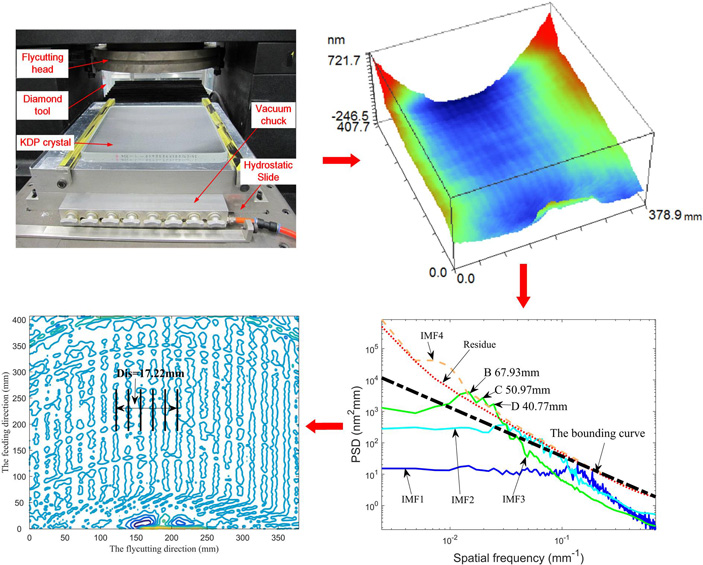
The research method employed commenced with the processing of KDP crystal by use of an ultra-precision fly-cutting machine. Next, the researchers undertook a series of fly-cutting tests on the ultra-precision machine tool. The influence of the surface characteristics on power spectral density were then determined. Later, the improved BEMD based texture features detecting was then incorporated in to the system and analyzed. Eventually, a comparative study with the Two-dimensional wavelet transform method on surface texture analysis was undertaken.
The authors mainly observed that by embedding a two-dimensional denoising technique in the sifting process, the end effect and iteration errors were removed to improve the decomposed intrinsic mode functions by the BEMD method. Additionally, they noted that from the comparative study with power spectral density method, traditional BEMD method, and Two-dimensional wavelet transform technique of the machined surface demonstrated that, the cutting path was clearly identified at a specific frequency, and the feeding texture feature was detected at another frequency.
The Jihong Yan and colleagues’ study presented the development of an enhanced and improved BEMD method for texture feature investigation of machined KDP crystal surface in spatial frequency domain. They observed that the two high amplitude areas were successfully separated and the gradient analysis revealed the development of gradient information of machined surface. Moreover, the improved IBEMD was seen to evade shortcomings of selecting model parameters. Altogether, the proposed method is a promising tool for the application of online monitoring and optimal control of precision machining process.



Reference
Lei Lu, Jihong Yan, Wanqun Chen, Shi An. Investigation of KDP crystal surface based on an improved bidimensional empirical mode decomposition method. Applied Surface Science , volume 433 (2018) page 680–688
Go To Applied Surface Science