Advances in Engineering Advances in Engineering features breaking research judged by Advances in Engineering advisory team to be of key importance in the Engineering field. Papers are selected from over 10,000 published each week from most peer reviewed journals.

Significance Statement
A recent article by Schulz et al. and published in Electrochimica Acta, investigated the effect of anions such as chloride and sulphate on the stabilization of given Rh-Ag nanostructures.
Pt, Pd and Rh are among the most expensive metals used as a catalyst for electrochemical reactions (Petri and Tsirlina, Electrochimica Acta 39 (1994) 1739 – 1747). However, nanoparticle catalysts have been encouraged due to their high electroactive surface area and relatively low cost when compared to bulk materials. This also aids in the construction of bimetallic structures with new catalytical properties.
Taking a brief look at the deposition of Rh on Ag in uhv under room temperature, the thermal diffusion of Ag is negligibly slow and the growing film is rough, however having some layer-by-layer quality especially for first 2-3 monolayers (Schmitz et al, Physical Review B 40 (1989) 11477 – 11487). This is due to bad miscibility hence disregarding any alloy formation.
Kibler et al. (Journal of Electroanalytical Chemistry 467 (1999) 249–257) investigated the electrochemical deposition of Rh on Au (III) in sulphuric acid and the results showed that at first a Rh bilayer growth behavior similar to a well-ordered Rh (III) surface is observed, while the second Rh monolayer forms small three-dimensional clusters. Similarities in the results are expected since Au and Ag share similar physical and structural properties.
Further investigations on the electrodeposition of Rh on Au have shown that Rh proceeds through a nucleation and growth mechanism (Stranski-Krasnatov) predicting the nucleation and growth of 3D Rh clusters on top of preformed 2D Rh phase. It’s also known that Rh deposition occurs with a substantial overpotential on vitreous carbon and copper in sulphate and chloride anions which strongly depends on the surface preparation (Pletcher and Urbina, Journal of Electroanalytical Chemistry 421(1997) 137 – 144).
In order to carry out these experiments, all chemicals are of ultra-pure quality and the solutions were prepared with milli-Q water and purged with N2 prior to each experiment. Measurements were carried out at room temperature of 298K and employing a computer controlled Autolab, model AUT 84233 using NOVA 1.6 software.
From the results obtained, the electrochemical response in sulphate-containing electrolytes were shown in a cyclic Voltammogram. Three peaks in the negative scan at the potential values: –0.155V (I), -0.330V (II), -0.500 (III) and two peaks in positive scan at -0.185 (III) and -0.375 (IIII) vs. SCE, were observed. At peak I, a nucleation loop appears, showing a similar behaviour to that found by Pletcher and Urbina (Journal of Electroanalytical Chemistry 421(1997) 137 – 144), indicating a 3D nucleation and growth process for new Rh deposits. When the scan limit was set below peak II, peak II’ was not observed showing that there is an under-potential adsorption of hydrogen (HUPD) on the newly formed Rh phase and peak II’ can be due to desorption of HUDD. This shows some irreversibility for the under potential adsorption/desorption of hydrogen on Rh monocrystalline electrodes which may be due to partial passivation of Rh at higher pH. There is a linear dependency of the peak current with the square root of scan rate at peaks III and III’. This behaviour shows characteristics of a mass transfer controlled process. Chronoamperometric response at different levels of each peak shows the same characteristics observed in a cyclic voltammogram response.
In the electrochemical response of chloride-containing electrolytes, the voltammetric response on first negative scan shows a feature at a potential E=-0.105V vs. SCE, which correspond to two different processes that can be attributed to rhodium deposition. The peak denoted as II at E=-0.300V shows the characteristic shape of a 3D nucleation mechanism followed by a rapid growth of the new phase under diffusional control, also confirmed by the chronoamperometric experiments. After the rhodium deposition process takes place, hydrogen evolution proceeds in two distinct steps; the first being represented by peak III at E=-0.450V and second step at E=-0.900V.
Density Functional Theory (DFT) studies on the effect of chloride on the deposition of Rh showed that the adsorption of chloride is favored at more positive potentials while the electrodeposition of Rh is favored at more negative potentials. However, the interplay between these two factors also determines the effect of the presence of Cl in the stabilization of electrodeposited Rh apart from the DFT calculated adsorption energy. The presence of Cl on the formation of one monolayer of Rh on Ag shifts its potential to a slightly more positive value, from –O.2V to about -0.18V. Also, a 2D-growth mechanism has been identified at a potential range where the free energy becomes negative. Larger coverages of chloride of more than 0.25 increase the free energy values. This can be due to the repulsion between neighboring chloride atoms..
Schulz et al, hereby concluded that the presence of chloride stabilizes the formation of Rh layers of monoatomic height on the surface of a Ag substrate, which then evolves to bilayers. The modelling of the chronampometric experiments has identified a clear transition from a 2D to a 3D growth mechanism, giving fundamental importance for understanding the effect of anions in the design of new nano-structured electrocatalysts.
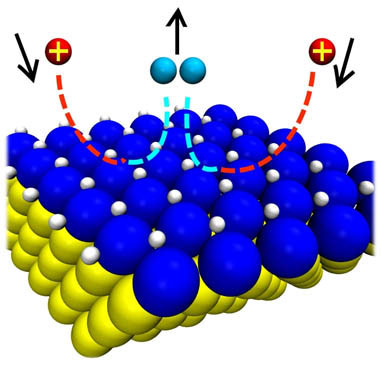
Figure Legend: Rh monolayer over a Au(111) substrate while two protons approach the surface to react and form a hydrogen molecule. Grey atoms represent HUPD. Credits for the image go to Dr. Germán José Soldano from CONICET Argentina, co-author of the present article.

Journal Reference
Eduardo. N. Schulz1,2, Andrés Ruderman2,3, Germán J. Soldano2,4, Silvana G. García1, Elizabeth Santos2,3 . Key Role of Anions in the 2D-3D Electrochemical Deposition of Rh on Ag Electrodes. Electrochimica Acta, Volume 178, 1 October 2015, Pages 813–822.
[expand title=”Show Affiliations”]- Instituto de Ingeniería Electroquímica y Corrosión, (INIEC)—Universidad Nacional del Sur, Bahía Blanca, Argentina
- Institute of Theoretical Chemistry, Ulm University, Ulm, Germany
- Instituto de Física Enrique Gaviola (IFEG-CONICET)—Universidad Nacional de Córdoba, Córdoba, Argentina
- INFIQC—Departamento de Matemática y Física Facultad de Ciencias Químicas—Universidad Nacional de Córdoba, Argentina
Go To Electrochimica Acta