Advances in Engineering Advances in Engineering features breaking research judged by Advances in Engineering advisory team to be of key importance in the Engineering field. Papers are selected from over 10,000 published each week from most peer reviewed journals.

Significance
More often than not, materials of dissimilar properties have to be joined in order to meet various technical obligations, financial considerations or environmental limitations. Specifically, recent advances in the automotive industry, aerospace, biomedical industries and microelectronics, call for joinery of dissimilar metals. Studies investigating the joining of dissimilar metals have revealed that brittle intermetallics are easily formed during welding of dissimilar metals in many alloy systems. Consequently, the formation of intermetallics in dissimilar metals joints usually result in poor mechanical performance and potential brittle fracture at the interface. To circumvent this shortfall, alternative approaches have been proposed. For instance, laser welding-brazing, explosive welding, magnetic pulse welding and laser impact welding (LIW). The first two have great potential; nonetheless, some underlying parameters yet to be resolved still impinge their large-scale adoption. On the other hand, LIW, developed for low temperature spot impact welding, utilizes the surface of a flyer plate to absorb the energy of the laser when the plasma is formed. A review of recent publications reveals that in such a setup, the velocity of this flyer is a critical parameter.
Generally, laser impact welding has been proved through the joining of aluminum and brass in recent studies. In these studies, however, the experimental setups were the same with flat target, in which the impact angle effect on the weld was not studied in order to increase the weld area along the collision interface. On this account, researchers from The Ohio State University: Dr. Huimin Wang, Dr. Dejian Liu, Professor John Lippold and Professor Glenn Daehn, conducted a series on experiments for joining of Ni-Ni, Al-Cu, Al-Ni and Al-Ti similar and dissimilar metal combinations with various experimental setups. Their goal was to assess the influence of LIW parameters. Their work is currently published in the Journal of Materials Processing Technology.
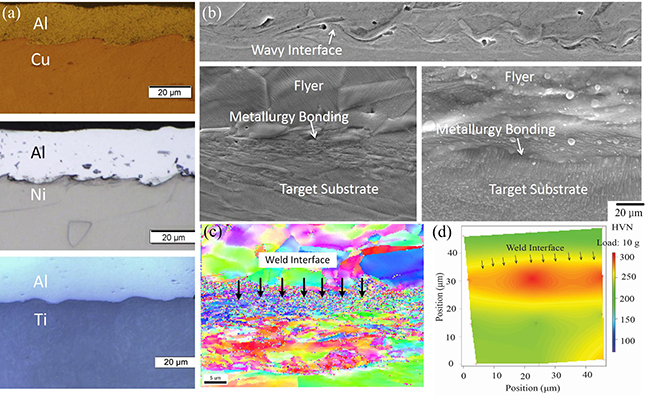
In their approach, used a 3-Joule pulsed laser to study the influence of LIW parameters on the launch of the flyer component as well as the bonding between the flyer and target. Metallurgical bonds between Ni-Ni, Al-Cu, Al-Ni and Al-Ti combinations were successfully produced. The bonding area was significantly increased (up to 30% of the impact region) when an appropriate impact angle was applied (nominally 7.5 degrees). In addition, Photon Doppler Velocimetry (PDV) was used to measure the impact velocity of the flyer during the LIW process.
The research team found that a wavy interface in all three dissimilar metal combinations. This helped prove that the yield stress of the target material has important influence on the morphology of the wavy interface. Further, a wavy interface with relatively long wave length and high amplitude was formed in Al-Cu LIW samples due to the low yield stress of Cu110 target plate.
In summary, the study demonstrated laser impact welding as an effective method for joining dissimilar metals. Interestingly, a characteristic wavy interface was observed in all LIW samples. In addition, the researchers demonstrated that the impact angle also plays a key role in the bonding process. In a statement to Advances in Engineering, the authors said that their work laid the foundation for future studies that will help advance the techniques of joining dissimilar metals.




Reference
Huimin Wang, Dejian Liu, John C. Lippold, Glenn S. Daehn. Laser impact welding for joining similar and dissimilar metal combinations with various target configurations. Journal of Materials Processing Technology, volume 278 (2020) 116498.