 Advances in Engineering Advances in Engineering features breaking research judged by Advances in Engineering advisory team to be of key importance in the Engineering field. Papers are selected from over 10,000 published each week from most peer reviewed journals.

Significance
Despite the increasing strict mitigation measures imposed on the use of fossil fuels, the petroleum industry will remain the main global source of energy for some time in the future. This is due to the underdeveloped alternative sources of energy which cannot meet the current global energy demand. Generally, light crude forms the cornerstone to the fossil fuels owing to their excellent properties such as low impurity contents and low viscosity. Unfortunately, the rapid reduction in the levels of the light crude oils has raised concern in the oil and gas industry. To this end, developing an alternative to substitute light crude oil is highly desirable. Recently, the focus has shifted to processing of heavy and extra heavy crude oils despite their high impurity content. However, more efficient processing method needs to be put in place considering their high carbon emission nature and the need for environmental protection.
Presently, several techniques have been developed for the processing of heavy crude oils. Among them, catalytic hydrotreating is widely preferred due to its ability to improve the quality of the final product through catalytic reactions. Recently, studies have shown that NiMo- and CoMo-based catalysts are highly favorable for catalytic hydrotreating processes. However, to ensure processing of complex feedstock and high-quality products, appropriate catalysts design criteria have been adopted. For instance, NiMo catalytic hydrotreating utilizes high availability and cost-effective γ-Al2O3. However, the catalytic activities are affected by the strong interaction between the alumina and metal surfaces. Therefore, researchers have been looking for alternative methods for reducing the interaction between the metals and alumina surface and have identified modification of the alumina with silicon as s promising solution.
To this note, Instituto Mexicano del Petróleo researchers: Patricia Rayo, Pablo Torres-Mancera, Guillermo Centeno, Fernando Alonso, José Antonio Muñoz and Jorge Ancheyta investigated the effects of silicon modifications on NiMo-based catalysts for hydrotreating reactions. Fundamentally, preparation of the NiMo catalysts supported on the Al-Si was based on: first incorporating the Si in alumina surface through drying and calcination and secondly structurally modifying the alumina. Additionally, Maya crude oil with high impurity content was used to prepare the feedstock to enable testing of the catalysis in the various reaction such as hydrodesulfurization and hydrodemetallization. Furthermore, various techniques including X-ray diffraction and nitrogen physisorption were used to analyze the supports and catalysts. The work is currently published in the journal, Fuel.
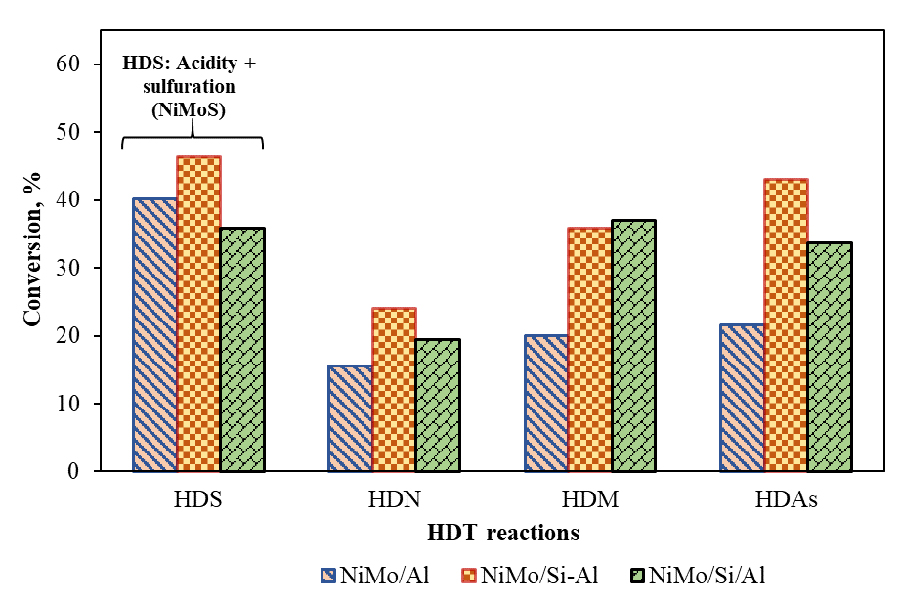
The authors observed higher conversion rates in the hydrotreating reactions due to the effects on the support surface properties that varied depending on the type of the preparation method. Consequently, incorporation of the silicon into Al2O3 support exhibited significant effects on the final properties of the catalysts including changes in the acidity and porosity. This was attributed to the weakening of the metal-surface interaction.
In summary, the research team demonstrated the effect of the Si-modified catalysts in the catalytic hydrotreating feedstock compound. The silicon incorporation method proved feasible for use in the catalytic hydrotreating of compounds with heavy crude oil fractions. The study will, therefore, ensure less-pollutant production of more energy for market demand.






Reference
Rayo, P., Torres-Mancera, P., Centeno, G., Alonso, F., Muñoz, J., & Ancheyta, J. (2019). Effect of silicon incorporation method in the supports of NiMo catalysts for hydrotreating reactions. Fuel, 239, 1293-1303.
Go To Fuel