Advances in Engineering Advances in Engineering features breaking research judged by Advances in Engineering advisory team to be of key importance in the Engineering field. Papers are selected from over 10,000 published each week from most peer reviewed journals.

Significance
Concentrated solar power plants provide a substantial amount of energy to the national grid in a more efficient way with low emission of greenhouse gases. The deployment of concentrated solar power technologies follows efforts to minimize the expenses as well as improving the efficiency of electricity production.
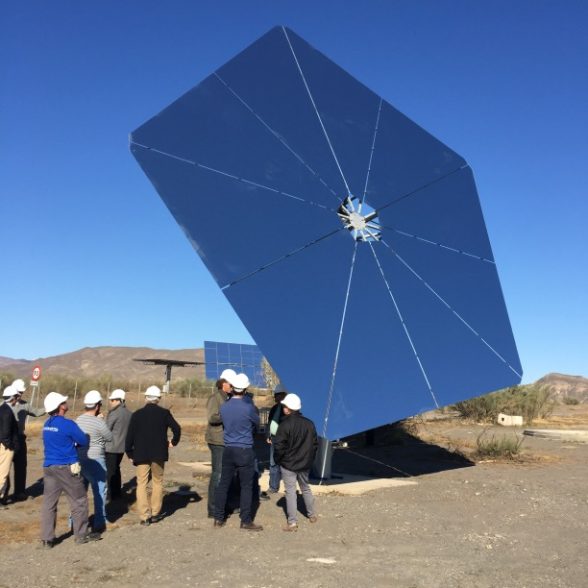
Thomas Telsnig (currently an energy analyst at Joint Research Centre of the European Commission), Gerhard Weinrebe, Jonathan Finkbeiner, and Dr. Ludger Eltrop at University of Stuttgart in Germany studied for the first time the ecological implication of autonomous heliostat applications for a solar power plant and compared them with other conventional systems of electrical energy production. This innovative idea targets improving the future solar field design of a concentrated solar power plant which consequently would reduce the cost implications of the system as well as lowering the adverse effects on the environment. Further, the paper assesses alternative technological concepts on heliostat propulsion application and their environmental life cycle impacts. Additionally, the potential for global warming of the solar power system which is dependent on co-firing using fossil fuel was assessed as one of the environmental effects. Their research work is published in journal Solar Energy.
The authors found that one of the main components of the solar power plant that can offer improved efficiency and a reduction in cost is the collector field. When used with autonomous heliostats, this concept can lead to a significant improvement in the supply of solar electricity. The environmental parameter is also seen to improve with higher yields of renewable energy. The amount of energy output is dependent on the heliostats’ number and positioning on the field where the solar power system has been implemented. The solar power plant life cycle emissions are seen to escalate as the amount of co-firing fossil fuel increases. With respect to the indirect emissions (without fossil fuel co-firing) of the solar power plant, the solar collector field was identified the highest contributor to the global warming potential. Compared to the conventional solar field concept, the global warming potential decreased by 10% through the implementing of one of the autonomously driven solar field concepts.
The study by Thomas Telsnig and colleagues successfully assessed the environmental implications and technical design of a future concentrated solar power plant with autonomously operated heliostats. The presented autonomous solar field concepts use a combined PV-battery energy supply system for the propulsion of the heliostats. The results are compared with a conventional solar field design with grid electricity supply of the heliostats. The effects of the concentrated solar power on the environment are seen to be relatively low with the most negligible global warming potential as compared to other conventional systems which in this case are considered to yield emissions which are ten times that of the proposed solar power system. Moreover, the study shows that both proposed autonomous heliostat concepts would cause a 10% reduction in overall emissions of greenhouse gases compared to the solar field with conventional heliostats, a significant decrease in detrimental implication to human health. This is true because the conventional electricity mix with high shares of fossil energy is substituted by photovoltaic solar energy and the wiring necessary in the conventional solar collector field can be avoided in the case of the autonomous energy supply concepts.
There is no doubt that this study will help improve future concentrated solar power systems through introduction of more advanced technologies that cut down on cost while at the same time promoting environment free of global warming gases.



Reference
Thomas Telsnig, Gerhard Weinrebe, Jonathan Finkbeiner, Ludger Eltrop, Life cycle assessment of a future central receiver solar power plant and autonomous operated heliostat concepts. Journal of Solar Energy (2017), Volume 157, Pages 187-200
Go To Solar Energy