Advances in Engineering Advances in Engineering features breaking research judged by Advances in Engineering advisory team to be of key importance in the Engineering field. Papers are selected from over 10,000 published each week from most peer reviewed journals.

Significance
Hydrogen believed to be the cornerstone of a sustainable energy future, a fuel that could power vehicles, supply industry, and stabilize electric grids without releasing greenhouse gases. However, its promise has been consistently hampered by one central dilemma: how to store and transport such a light, reactive molecule safely and affordably. Compressed gas cylinders and cryogenic tanks offer partial solutions, but they are costly, technically demanding, and difficult to integrate into existing fuel infrastructures. This gap has prompted scientists to look toward liquid organic hydrogen carriers (LOHCs), which allow hydrogen to be chemically bound to stable liquids and later released through controlled dehydrogenation. In principle, LOHCs combine the safety and convenience of liquid fuels with the versatility of hydrogen, but the search for carriers that are renewable, scalable, and efficient has proven more elusive than expected.
To this account, new research work published in International Journal of Hydrogen Energy and led by Dr. Andrew Lipton, Dr. Terak Ibrahim, Dr. William Schwartz, Dr. Rafal Gieleciak, Dr. Dequan Xiao, and Professor Bin Yang from the Pacific Northwest National Laboratory and Washington State University, the researchers developed a novel LOHC derived from lignin-based jet fuel (LJF), termed LJF-HyC. By using platinum nanoparticles supported on zeolite, they demonstrated that the cycloalkane-rich LJF can be catalytically dehydrogenated in situ to yield unsaturated and aromatic compounds capable of storing and releasing hydrogen. Advanced spectroscopic and chromatographic analyses confirmed the formation of distinct hydrogen-carrying species and mapped their reaction pathways. This work establishes a renewable aviation fuel that simultaneously functions as a practical hydrogen storage medium. The challenge, however, is formidable. Jet fuels derived from lignin are dominated by cycloalkanes—saturated hydrocarbons that must be dehydrogenated to form the unsaturated or aromatic compounds capable of storing and releasing hydrogen. Achieving this transformation efficiently requires robust catalysts that can activate C–H bonds under conditions mild enough to preserve carrier stability. Traditional LOHC candidates are fossil-derived aromatics, which offer excellent hydrogen capacity but raise sustainability concerns and often rely on infrastructure not designed for bio-based systems. The question the researchers sought to answer was whether LJF, already compatible with jet engines and renewable in origin, could be engineered through in-situ dehydrogenation into a viable LOHC. To investigate this possibility, the team employed platinum nanoparticles supported on zeolite and monitored the chemical transformations in real time using advanced nuclear magnetic resonance and chromatographic techniques. Their motivation was not purely academic; it stemmed from the urgent need for energy solutions that are both technically feasible and environmentally sound. If successful, their approach would bridge two pressing goals at once—decarbonizing aviation and enabling practical hydrogen storage—thereby offering a rare synergy in the pursuit of a sustainable energy economy.
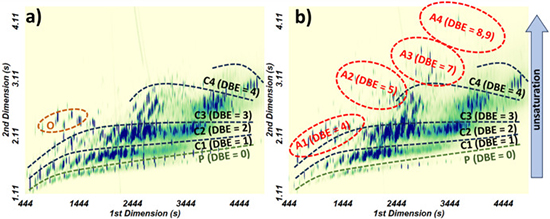
In more detail, the researchers began by preparing platinum nanoparticles on a zeolite support, knowing that platinum is one of the most reliable metals for breaking C–H bonds, yet expensive enough that it had to be used with precision. Transmission electron microscopy confirmed that the nanoparticles were within the optimal 5–10 nanometer range, evenly dispersed on the porous support. Once the catalyst was ready, lignin-based jet fuel, a mixture dominated by cycloalkanes, was introduced into a carefully sealed reactor. What set this work apart was the decision to track molecular changes in real time using in-situ solid-state NMR spectroscopy, a method that allowed them to follow the rise of aromatic carbons as the reaction temperature increased. As the system was gradually heated from ambient conditions to 250 °C, the spectra revealed the moment when dehydrogenation truly began: aromatic resonances, absent at the start, appeared at chemical shifts between 120 and 140 ppm once the temperature surpassed 230 °C. These signals grew stronger with time, evidence that hydrogen atoms were being pulled away from cyclohexyl rings and replaced by stable aromatic structures. The researchers also noticed fluctuations, as the population of aromatics rose and then dipped, suggesting that in the closed reactor, the released hydrogen was not lost but lingered, occasionally driving rehydrogenation back into the system. This delicate push and pull between hydrogen release and reabsorption underscored both the promise and complexity of using LJF as a carrier. To capture the chemical diversity beyond what NMR alone could reveal, the authors employed comprehensive two-dimensional gas chromatography coupled with time-of-flight mass spectrometry and vacuum ultraviolet detection. These tools revealed that roughly 18.5% of the fuel composition had shifted toward unsaturated compounds after dehydrogenation. Peaks corresponding to alkylbenzenes, tetralins, and naphthalenes emerged in the chromatograms, molecules that embody the hydrogen-storage potential of the system. By examining mass fragmentation patterns and absorption fingerprints, the researchers confirmed the presence of five main classes of products, each distinguished by increasing double bond equivalence. This analysis also illuminated reaction pathways, with monocyclohexanes converting into monoaromatics and dicyclohexylalkanes producing a series of partially unsaturated intermediates before stabilizing as naphthalenes.
In conclusion, Dr. Andrew Lipton and colleagues successfully demonstrated that lignin-based jet fuel can undergo in-situ dehydrogenation to yield aromatic-rich compounds, the researchers revealed that a single biomass-derived fuel could function both as a drop-in replacement for petroleum jet fuel and as a liquid organic hydrogen carrier. This dual purpose is remarkable because it not only offers a renewable alternative for aviation, a sector notoriously difficult to decarbonize, but also provides a pathway for safe, high-density hydrogen storage without the infrastructure burdens of compression or liquefaction. The implications extend well beyond chemistry: they point to an integrated energy system where the same molecule could support long-distance flights and later act as a reservoir of clean hydrogen for power generation or mobility. We believe what makes this study especially impactful is that it demonstrates feasibility at the molecular level with rigorous experimental evidence. The detection of nearly one-fifth of the fuel shifting toward unsaturated carriers under platinum catalysis validates the concept that lignin-derived fuels can be engineered for reversibility. Such a transformation is not trivial, as most renewable fuels are valued solely for their combustion properties, not their potential to interact with hydrogen chemistry. Here, the possibility of cycling between hydrogen-rich and hydrogen-lean states changes how we might think about the value of lignocellulosic byproducts. It elevates lignin from a marginal feedstock into a central player in the hydrogen economy. On a broader scale, the authors’ findings suggest new routes for coupling biofuel production with hydrogen supply chains. Biorefineries that already generate lignin-derived jet fuels could, in principle, extend their scope by integrating catalytic units for hydrogen release. This could enable a distributed model where sustainable fuels are not only burned in turbines but also used as mobile hydrogen reservoirs, bridging gaps in renewable energy storage and transport. Moreover, the detailed mapping of reaction pathways provides a framework for catalyst optimization, guiding future studies to enhance efficiency and stability. If these improvements succeed, the economic and environmental benefits could be substantial: reduced reliance on fossil aromatics for LOHCs, lower aviation emissions, and a practical step toward hydrogen integration without entirely new distribution networks.


Reference
Andrew S. Lipton, Terak Ibrahim, William Schwartz, Rafal Gieleciak, Dequan Xiao, Bin Yang, In-situ dehydrogenation of lignin-based jet fuel: A novel and sustainable liquid organic hydrogen carrier, International Journal of Hydrogen Energy, Volume 98, 2025, Pages 1275-1282,