Advances in Engineering Advances in Engineering features breaking research judged by Advances in Engineering advisory team to be of key importance in the Engineering field. Papers are selected from over 10,000 published each week from most peer reviewed journals.

Significance
Recent advancement in technology has led to the development of numerous machining techniques for fabrication of different materials. For instance, in electrical and conductor devices, precision machines are required to enable fabrication of three-dimensional structures at both micro and nanoscale levels. Unfortunately, most of these machining technologies are susceptible to various failures caused by factors such as wear and tear thus hindering their functionality.
Among the commonly available micromachining technologies, micro-electro-discharge machining can be used to create microstructures in numerous applications owing to its high-precision nature. Also, it can be efficiently used for both soft and fragile materials. Generally, it is based on thermal erosion of the material due to the generated electrical discharge between the workpiece and the electrode to remove the materials from the surface. Unfortunately, the machining process is associated with several limitations like electrode wear and poor surface quality.
However, the significance of the machining electrode in determining the precision of micro-electro-discharge machining have attracted the interest of many researchers. For example, wire electro-discharge grinding is capable of achieving precise shaping of microcylindrical electrodes. On the other hand, variation in the diameter accompanied during the process reduces the quality and precision of the process. The gradual change of the electrode shape during the machining process also results in erosion which further leads to loss of part geometry and accuracy. To this mote, significant effort has been directed towards investigating, predicting and compensating electrode wear in the micro-electro-discharge machining process.
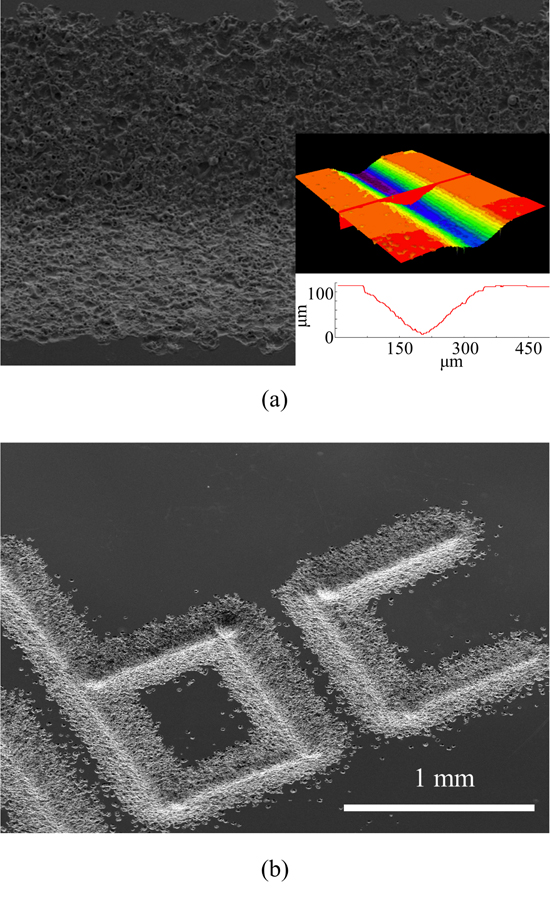
Recently, Dr. Ruining Huang and Dr. Wenbin Yu from Harbin Institute of Technology in collaboration with University of British Columbia scientists: Dr. Ying Yi and Professor Kenichi Takahata investigated the use of liquid alloy as a machining electrode in micro-electro-discharge machining process to overcome the factors influencing the electrodes wear during machining. The process was based on supplying the liquid electrode to a metallic microcapillary nozzle to eliminate electrode wear. Furthermore, scanning mode patterning and controlled discharge generation were demonstrated using microfluidic Galinstan electrodes. Their main aim was to address the electrode wear problem so as to advance the micro-electro-discharge machining technology. The work is published in Journal of Materials Processing Technology.
The authors observed the capability of using Galinstan as an electrode material for the micro-electro-discharge machining to create discharge pulses for microscale removal of materials from the sample surfaces because it is a non-toxic liquid alloy. Consequently, they successfully demonstrated arbitrary patterning on the silicon substrates due to the minimized contamination of the processed workpiece. Furthermore, the patterned linewidth generally depended on the discharge conditions. Therefore, it could be tuned without having to replace the nozzle.
The study successfully developed a microfluidic electrode for micro-electro-discharge machining based on the liquid-phase alloy. Owing to its efficiency and effectiveness, the developed method can be used to rapidly produce micropatterns at relatively low cost. Therefore, the authors are optimistic that it will help advance future development aimed at improving the micro-electro-discharge machining resolution, control and accuracy. This will ensure the production of high-quality structures for various applications.




Reference
Huang, R., Yi, Y., Yu, W., & Takahata, K. (2018). Liquid-phase alloy as a microfluidic electrode for micro-electro-discharge patterning. Journal of Materials Processing Technology, 258, 1-8.
Go To Journal of Materials Processing Technology