Advances in Engineering Advances in Engineering features breaking research judged by Advances in Engineering advisory team to be of key importance in the Engineering field. Papers are selected from over 10,000 published each week from most peer reviewed journals.

Significance
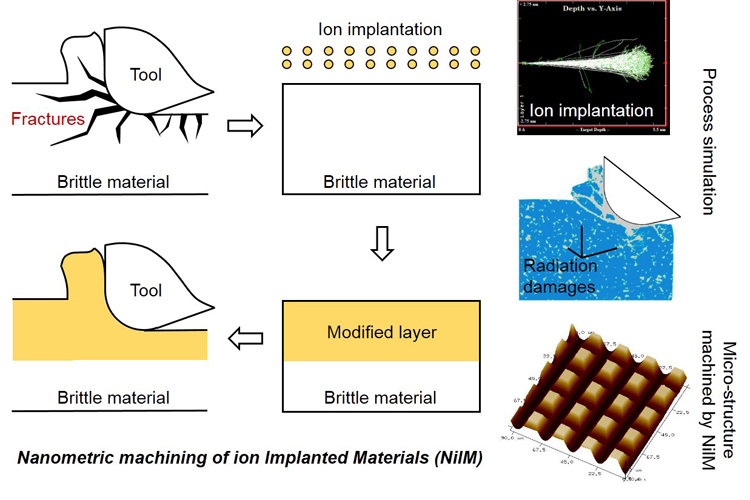
Machining of hard and brittle materials has for a long time been a challenge owing to the unpredictability of the resultant product. Abrasive grinding followed by fine polishing has since been the safest technique of carrying out this task. In the recent past, diamond turning technique has been developed for ultra-precision machining. Awkwardly, even with this technique, it has still been difficult to maintain high efficiency and low surface damage simultaneously. Severe tool damage is also inescapable when using this diamond technique. On the other hand, recently undertaken studies have shown that ion implantation can be used to improve the machinability. Just the other day, researchers realized surface modification by nuclear collision cascade that induces phase transition during the implantation. Additionally, electronic interaction between the incident particles and the target material, such as ionization, also occurs particularly during a high-energy ion implantation. Unfortunately, the influence of ionization on the machinability has not been exhaustively studied.
Researchers led by professor Fengzhou Fang from the State Key Laboratory of Precision Measuring Technology & Instruments, Centre of MicroNano Manufacturing Technology, at Tianjin University in China, conducted a study to cross examine the modification on the nanocutting of silicon by high-energy oxygen ions. They performed Molecular dynamics simulation in order to reveal the nanocutting process on silicon with irradiation damages. Their work is currently published in the research journal, Precision Engineering.
The research method utilized commenced by conducting high energy irradiation using a tandem electrostatic accelerator to implant oxygen dose into the surface of the high resistivity monocrystalline silicon at room temperature. Next, the researchers employed Raman spectroscopy to investigate the modification on the material lattice. The team then conducted molecular dynamics and Monte Carlo method simulations so as to deeply study the material processes at nanoscale level where the Open Visualization Tool software was used for molecular dynamics data visualization.
The authors observed that the images of the depth profiles of ionization and vacancies for the O ion implantation showed the regions with intensive electronic process and nuclear collision to be well separated. The researchers also noted that the data obtained from molecular dynamics simulation revealed the nanocutting process on silicon with irradiation damages. Conclusively, the results obtained indicated that an enhancement in the critical underformed chip thickness, which is crucial in machining of brittle materials.
The Fengzhou Fang and his research team study successfully presented the utilization of high-energy ion irradiation on silicon in studying the modification on the machinability by ionization. It has been seen that during ion implantation, local amorphous pockets occur. Furthermore, molecular dynamics analysis has pointed out that the lattice damages absorb the shear strain energy in nanocutting. As a consequence, more shear bands are generated and plastic yielding becomes easier in the stress field of the machine tool. Altogether, this new technique offers improved machinability that yields high efficiency and low surface damage.
Reference
Jinshi Wang, Rongtai Chen, Xiaodong Zhang, Fengzhou Fang. Study on machinability of silicon irradiated by swift ions. Precision Engineering, volume 51 (2018) pages 577–581.
Go To Precision Engineering