 Advances in Engineering Advances in Engineering features breaking research judged by Advances in Engineering advisory team to be of key importance in the Engineering field. Papers are selected from over 10,000 published each week from most peer reviewed journals.

Significance
Polyanionic compounds have been extensively used in rechargeable batteries as high-density cathodes owing to their unique electrochemical properties. Having a broad structural diversity, these materials are comprised of tetrahedron anion units (or their derivatives) and transition metal-oxide polyhedra, and possess a strong polyanionic inductive effect suitable for designing high-performance devices. Unfortunately, little emphasis has been given to their other potential properties. For instance, the unique magnetic properties of three-dimensional polyanionic compounds can result in magnetoelectricity and multiferroicity due to the complex magnetic structures induced by competing exchange interactions. The possibility to reveal this magnetoelectic effect has attracted significant interest among many researchers.
Among the available polyanionic compounds, sodium iron phosphate and lithium iron phosphate are mostly preferred, especially in rechargeable batteries. They are readily available, environment-friendly, and cost-effective. Generally, sodium iron phosphate crystalizes in either triphlyte or maricite polymorphic forms.
Recently, Dr. Oier Arcelus and Dr. Jarvier Carrasco from CIC Energigune in Spain in collaboration with Dr. Sergey Nikolaev and Dr. Igor Solovyev at International Center for Materials Nanoarchitectonics, National Institute for Materials Science in Japan investigated the magnetic properties of sodium iron phosphate (NaFePO4) polymorphs by using the model Hamiltonian approach. Starting from first-principles electronic structure calculations, the authors constructed the effective Hubbard-type models including the effects of electronic correlations in the basis of Wannier functions for the magnetically active iron states. Furthermore, they performed a comparative study numerically implementing realistic modeling within two approaches including the pseudopotential method and linear muffin-tin orbital technique. Finally, they used the meanfield-Hartree-Fock approximation to study the magnetic ground-state properties and applied the theory of superexchange interactions to determine the corresponding interatomic exchange parameters. Their work is published in the journal, Physical Chemistry Chemical Physics.
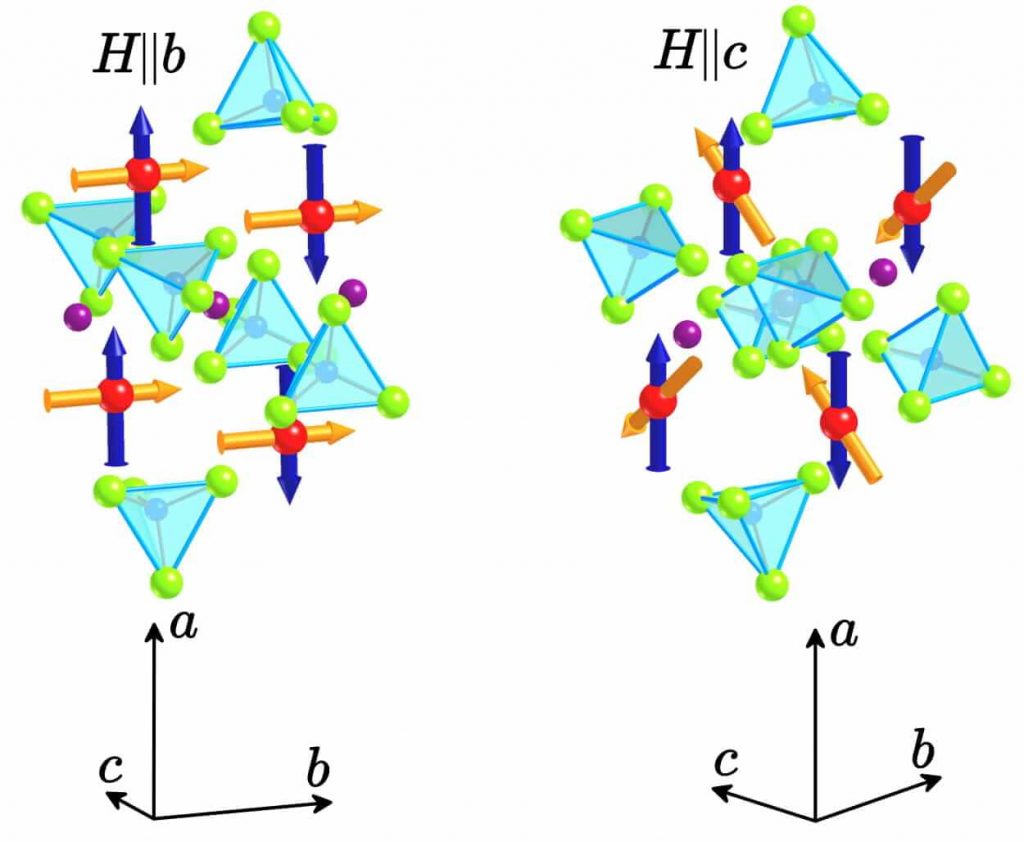
The authors observed that the two different methods produced similar results describing the magnetic properties of sodium iron phosphate in good agreement with the obtained experimental data. For example, triphlyte sodium iron phosphate (t-NaFePO4) was shown to exhibit the magnetoelectric effect due to the antiferromagnetic arrangement across the inversion symmetry centers which can be destroyed by applying electric or magnetic fields. However, it was challenging to reproduce experimental results for maricite sodium iron phosphate (m-NaFePO4), whose significantly large frustration index leads to the noticeable complexity of the interatomic exchange interactions as compared to t-NaFePO4. According to the authors, the magnetic superstructure observed along the shortest orthorhombic axis of m-NaFePO4 can be attributed to the competing exchange interactions, just like in the case of multiferroic manganites. Finally, they studied the effect of chemical pressure on the magnetic properties of polyanionic compounds by substituting the sodium ions with lithium to examine the contribution of an external magnetic field to the magnetoelectric effect in transition metal phosphates.
The developed model successfully provided a deep understating on the microscopic origin of exchange interactions in polyanionic compounds, which is a key consideration in determining their magnetic properties. Moreover, this study may give a further boost for future theoretical and experimental studies, especially needed to clarify the origin of the propagation vector observed in m-NaFePO4. It will also increase the investigation of other potential properties of polyanionic compounds thus leading to their numerous applications in various fields.




Reference
Arcelus, O., Nikolaev, S., Carrasco, J., & Solovyev, I. (2018). Magnetism of NaFePO4 and related polyanionic compounds. Physical Chemistry Chemical Physics, 20(19), 13497-13507.
Go To Physical Chemistry Chemical Physics