Advances in Engineering Advances in Engineering features breaking research judged by Advances in Engineering advisory team to be of key importance in the Engineering field. Papers are selected from over 10,000 published each week from most peer reviewed journals.

Significance Statement
More industrial interest in control systems has led to the spread of the actuator as well as sensor fields. Therefore, magnetostrictive materials are of importance with regards to torque and force sensors by determining the change in the magnetization caused by an applied stress. Various materials have been selected for several magnetic sensors demand. However, monolithic materials suffer from eddy current losses at high frequencies. For this reason, magnetostrictive composite materials synthesized by blending magnetostrictive particles in a non-metallic matrix possess high electrical resistivity and therefore do not suffer the eddy current losses. Such materials are excellent building blocks for magnetostrictive sensors operating at high frequencies.
Fe100-x Alx ribbons obtained through melt spinning exhibit high magnetostriction for a value of x about 19. This method can be adopted to make powder cheaply and consequently produce magnetostrictive composites.
Spanish researchers Graciela Riesgo García and colleagues studied the magnetostriction in Fe81Al19 composite powder randomly distributed and oriented in silicone and polyester matrixes. They obtained nanocrystalline powder of Fe81Al19 through mechanical milling from ribbons with the same composition synthesized through rapid solidification process. This enabled them to shorten the milling time, consequently reducing oxidation of the constituent powders. Their work is published in Materials Science and Engineering B.
The authors used high purity aluminum and iron metals to prepare alloy ingots of Fe81Al19 by induction melting. They produced ribbons from these ingots via flow casting and determined their chemical composition. The ribbons were cropped before milling, which was done in a water-cooled steel vessel. A 4wt% benzene was adopted as the process control agent in the milling. This allowed the particles to downsize easily without welding on each other.
The authors analyzed the X-ray diffraction patterns of the Fe-Al alloy powder at varying milling times and determined lattice strain as well as crystalline size of the powder. They used powders milled for 100 h to synthesize two composites. In one of the composites, they used polyester matrix and silicone in the other. In the polyester composite, the researchers cured one sample without applied magnetic field and two with applied magnetic field. This was in a bid to configure the composite particles in the longitudinal and transverse directions. For the case of silicone, two samples were cured with an applied magnetic field.
The authors observed that the crystallite size was less than 7 nm after milling for 10 h, which indicated rapid nanocrystallization. After milling for 10 hours there was an increase in the crystallite size and this was attributed to grain growth as well as recrystallization. Lattice strain was observed to increase with the milling time.
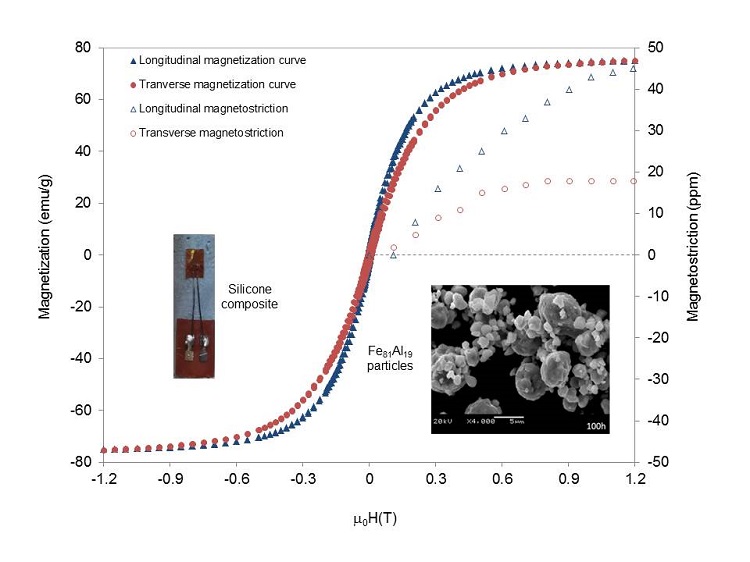
Milling produced particle size reduction and cold welding. For milling time until 10 h, grinding produced material refinement with a decrease in the particle size, but when the milling time increased, cold welding was responsible for the particle size increase. It was also observed that silicone composites cured in an applied magnetic field in the longitudinal direction reached a saturation magnetostriction of 45 ppm.






Reference
G. Riesgo1, J. Carrizo2, L. Elbaile2, R.D. Crespo2, R. Sepúlveda3, J.A. García2. Magnetostrictive properties of FeAl/polyester and FeAl/silicone composites. Materials Science and Engineering B, volume 215 (2017), pages 56–63.
[expand title=”Show Affiliations”]- Dpto. de Ciencias y Técnicas de la Navegación, Universidad de Oviedo, Campus universitario de Gijón, 33203 Gijón, Spain
- Dpto. de Física de la Universidad de Oviedo, c/ Calvo Sotelo s/n, 33007 Oviedo, Spain
- Dpto. de Ingeniería Mecánica y de los Materiales, Universidad de Sevilla, Isla Cartuja, 41092 Sevilla, Spain
Go To Materials Science and Engineering B