 Advances in Engineering Advances in Engineering features breaking research judged by Advances in Engineering advisory team to be of key importance in the Engineering field. Papers are selected from over 10,000 published each week from most peer reviewed journals.

Significance
The emergence of strongly correlated complex oxides characterized by microscopic electronic phase separation (EPS) has attracted significant interests amongst researches in the past decades. This is due to the increasing need to develop highly efficient multifunctional devices by controlling the EPS strength. For the complex oxides, the EPS strength can be controlled using the external stimuli like strain, magnetic field, current among others. For instance, perovskite manganite exhibits large EPS in its various phases including paramagnetic insulating phase and ferromagnetic metallic phase. External stimuli change their physical properties by tipping the stability of the coexisting phases.
Generally, light or electric field is used to manipulate the physical properties of manganite films. However, combination of light and electric-field control of EPS has not been fully explored. Investigation of multifield tuning of EPS will lead to a clear understanding of the coupling effects of the light and electric field in perovskite manganites. An example of a magnetoresistive material with high strain-sensitive EPS is Nd0.7Sr0.3MnO3 (NSMO) thin film. It utilizes a substrate-induced in-plane tensile strain to observe a phase transition from ferromagnetic metallic phase to charge-ordering insulating phase.
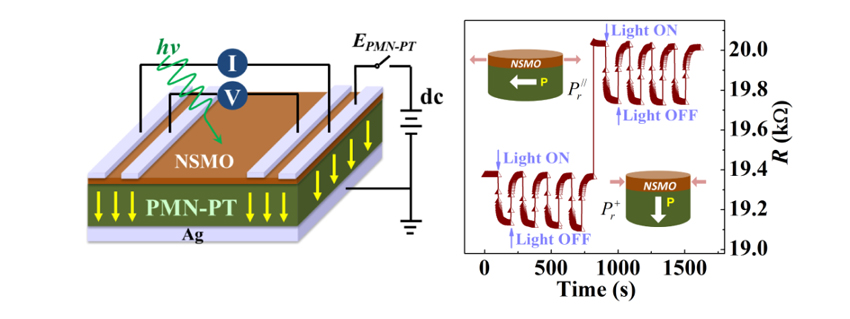
Dr. Ming Zheng from The Hong Kong Polytechnic University, Dr. Hao Ni from China University of Petroleum (East China) and colleagues investigated the light and electric field control of the phase separation in resistive switching using multiferroic heterostructure. The authors commenced their work by growing the phase-separated NSMO films on single-crystal substrates of ferroelectric Pb(Mg1/3Nb2/3)O3-PbTiO3 (PMN-PT). They employed reversible ferroelastic switching domain to induce nonvolatile electroresistance response at room temperature. Furthermore, they modified the resistance state and phase separation of the NSMO films by both the light-induced delocalization effect and electric-field-induced ferroelastic strain effect. Their work is currently published in the research journal, Physical Review Applied.
The research team observed that the electric-field-induced ferroelastic strain had the potential of improving the visible-light-induced photoresistance effect up to 22.6%. On the other hand, the photoexcited delocalization carriers resulted in a decrease in the film resistance. Both of the effects resulted in adjustable photoresponse as well as a multilevel resistive switching memory. They also noted the strong similarities in the light-induced effects, as well as the electric-filed effects and they too depended on the EPS.
According to the authors, the experimental result in conjunction to the response of the optically controlled electroresistance can be interpreted using a phase separation model and it presents an in-depth understanding of the coupling between the light-induce effects and the electric-field effects. Therefore, it will advance multifield tuning of electron phase separation and more so in complex oxide heterostructures. The properties of such multiferroic heterostructures are similar to nonvolatile storage devices, and thus can be employed in the design and development of multifunctional memory devices with high energy efficiency by adding light as another control parameter.


Reference
Zheng, M., Ni, H., Xu, X., Qi, Y., Li, X., & Gao, J. (2018). Optically Tunable Resistive-Switching Memory in Multiferroic Heterostructures. Physical Review Applied, 9(4).
Go To Physical Review Applied