Advances in Engineering Advances in Engineering features breaking research judged by Advances in Engineering advisory team to be of key importance in the Engineering field. Papers are selected from over 10,000 published each week from most peer reviewed journals.

Significance
Improving the efficiency with which we harness solar energy is no longer just a technical goal—it’s a global necessity in the context of climate change and the shift toward carbon neutrality. As single-junction solar cells approach their theoretical efficiency limits, the research community has turned its attention to more advanced photovoltaic architectures. Two strategies that have gained significant traction are tandem solar cells and bifacial solar cells. Tandem designs stack materials with different bandgaps to absorb a broader portion of the solar spectrum, while bifacial cells capture light from both the front and rear by taking advantage of reflected radiation from surrounding surfaces. Individually, both approaches have shown impressive results, but their combined potential remains underexplored—an oversight that this study directly addresses. Although tandem solar cells, particularly perovskite/silicon and all-perovskite systems, have achieved record-breaking efficiencies in lab settings, one issue remains: most designs are tailored for idealized test conditions and not the variability of real-world environments. Important factors such as albedo—the reflectivity of the ground—along with the sun’s angle and fluctuations in local weather are either oversimplified or entirely excluded in many simulation studies. Similarly, the development of bifacial cells has largely progressed in parallel to tandem systems, with little attention paid to how these technologies might be integrated or optimized together. Parameters like sub-cell bandgap alignment, absorber layer thickness, and the spectral content of light hitting the rear surface all play a role in determining the device’s overall power output. Two-terminal (2T) devices, where sub-cells are connected in series, are particularly vulnerable to current mismatches, while four-terminal (4T) configurations, though electrically decoupled, present their own challenges, such as increased optical losses from intermediate layers. Quantifying and optimizing these trade-offs is difficult, especially with conventional modeling tools that are often constrained by limited variable input and computational load.
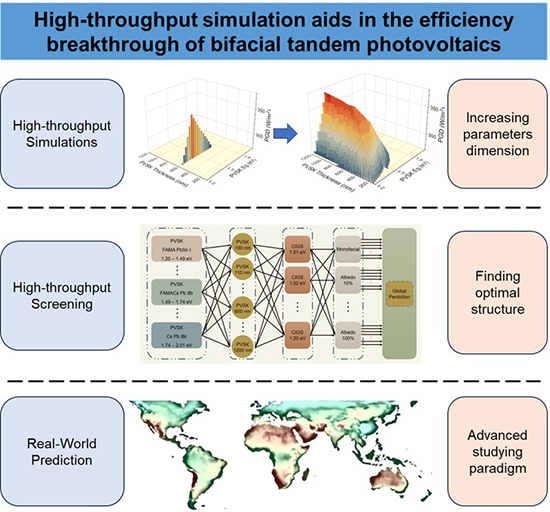
Recognizing these limitations, a research team led by Professors Yan Jiang and Qi Chen at the School of Materials Science and Engineering, Beijing Institute of Technology, initiated the rethink how bifacial tandem solar cells are designed. Alongside Dr. Jiahong Tang et al., they developed a high-throughput optoelectrical modeling platform capable of handling vast, multidimensional simulations. They built a modeling framework that can evaluate hundreds of thousands of device configurations under real-world conditions. The researchers managed to simulate over 621,000 unique device configurations spanning both 2T and 4T designs. Moreover, the authors found that under a moderate albedo of 30%, which is roughly what you’d get from reflective surfaces like concrete or grass, the simulations showed that 2T bifacial tandem cells could increase their power generation density by about 13.44% compared to monofacial versions. That’s a significant increase, but things got even more interesting with the 4T configuration. In high-reflectivity conditions—think snow-covered ground, where albedo can reach 80%—these cells were projected to deliver over 495 watts per square meter. That’s nearly 50% of the incoming solar energy being converted into usable electricity and pushed the boundaries of what’s currently possible with photovoltaic technology. It is also interesting to mention that the authors found that tuning the perovskite top cell’s bandgap showed that narrower values—around 1.32 to 1.44 eV—performed better under higher albedo. This finding runs counter to traditional preferences for wider bandgap materials and instead supports the use of mixed tin-lead (Sn–Pb) perovskites over more conventional lead-only compositions. Insights like these wouldn’t have emerged through standard modeling methods; it was only through the scale and flexibility of the simulations that such patterns became clear. Afterward, the authors went a step further and incorporated real solar spectra from cities like Miami and Beijing. When these real-world lighting profiles were used in the model, the optimal bandgap for the top cell shifted—by as much as 0.09 eV, depending on the location. While that might seem like a small change, in solar cell design, it can have a meaningful impact on energy yield. This highlighted a crucial point: universal designs are unlikely to perform optimally across all settings. Tailoring devices to specific climates or regions will be necessary to unlock their full efficiency in practice.
Another important takeaway involved the role of perovskite thickness. In monofacial tandems, getting the thickness just right was critical. Small deviations could lead to noticeable performance losses. Bifacial designs, on the other hand, proved to be more forgiving. Because they also collect light from the rear side, the impact of slight variations in thickness was less severe. This not only improves light absorption but also relaxes the strict manufacturing tolerances, which could reduce production costs and make these devices more scalable. Additionally, the 4T configuration, in particular, stood out for its robustness. Unlike the 2T setup, where the sub-cells are electrically linked and current matching is a strict requirement, the 4T cells operate independently. That means even if the spectral distribution shifts throughout the day—or due to seasonal changes or cloud cover—the system remains stable and efficient. This flexibility makes the 4T design especially appealing for real-world deployment, even though it comes with some added complexity in terms of fabrication.
In conclusion, the work of Professor Yan Jiang and Professor Qi Chen and their colleagues truly redefined the evaluation of energy yield. Traditionally, solar cells are assessed using the AM1.5G reference spectrum under fixed test conditions. But in practice, no rooftop, open field, or urban façade receives sunlight in such a uniform or predictable way. This study accounts for variations in local spectral content, ground reflectivity (albedo), and changing light angles over time—factors that can dramatically shift the actual performance of a solar device. The ability to model all of these influences in a systematic and data-rich way represents a significant step forward. It enables designers and engineers to tailor devices not just for ideal conditions, but for specific geographic regions and installation types, from snowy cities to sun-drenched deserts.
The results also highlight the unique advantages of bifacial tandem cells—particularly the 4T configurations. These devices show a remarkable ability to maintain high performance across different and sometimes unpredictable conditions. In an era of increasing climate variability, that kind of robustness is more than a bonus; it’s essential. Whether panels are installed in cloud-prone regions, on sloped terrain, or in places with dramatic seasonal shifts in sunlight, the adaptability demonstrated here makes these designs especially appealing for long-term deployment.
Importantly, the findings extend beyond just performance metrics. There are real manufacturing and economic implications as well. The simulations show that bifacial tandem cells are more tolerant of variations in parameters like absorber thickness and bandgap, which translates into greater flexibility during production. This relaxed sensitivity can help lower manufacturing costs, simplify quality control processes, and make it easier for manufacturers to scale up without being constrained by ultra-precise fabrication requirements. Looking ahead, perhaps the most exciting implication is how this modeling approach could be generalized. While this study focused on PVSK/CIGS tandems, the same framework could be used to optimize other multi-junction configurations or novel material pairings. It could even be extended to applications beyond conventional panels—like building-integrated photovoltaics, flexible solar modules, or space-based energy systems where environmental conditions vary even more dramatically. In that sense, the study does more than refine a single device; it offers a roadmap for the design of solar technologies that are smarter, more adaptive, and ready for the complex realities of global deployment.
Reference
Tang, Jiahong & Xue, Junfeng & Xu, Huaiwang & Li, Yujing & Lin, Shuping & Li, Boyan & Zhong, Dalong & Li, Gang & Jiang, Yan & Chen, Qi. (2024). Power generation density boost of bifacial tandem solar cells revealed by high throughput optoelectrical modelling. Energy & Environmental Science. 17. 10.1039/D4EE01173B.