 Advances in Engineering Advances in Engineering features breaking research judged by Advances in Engineering advisory team to be of key importance in the Engineering field. Papers are selected from over 10,000 published each week from most peer reviewed journals.

Significance
Global acknowledgement of the excessive emission of greenhouse gases and their devastating far-fetched repercussions recently led to countries committing to the Paris Agreement 2016. Our daily activities directly or in directly contribute to greenhouse gas emission; partly knowingly and partly unknowingly. For instance, research on electricity consumption has recently revealed that the refrigeration sector requires approximately 20% of the global electricity consumption. Much of this electricity may be produced using green energy sources; however, a major part of it is still produced by burning fossil fuels. As such, making refrigeration systems more efficient would have considerable influence on the reduction of the anthropogenic greenhouse effect and thereby help to meet the Paris Agreement from 2016. From a technical perspective, most domestic refrigeration systems use fixed speed hermetic reciprocating compressors to drive the refrigeration cycle. One way to improve the efficiency of such refrigeration systems is by varying the speed of operation. Unfortunately, it is associated with challenges concerning the reed valve dynamics. To this end, numerous studies based on experimental or numerical methods have been carried out to investigate and improve the behavior of reed valves in reciprocating compressors; yet, there is need for further improvement.
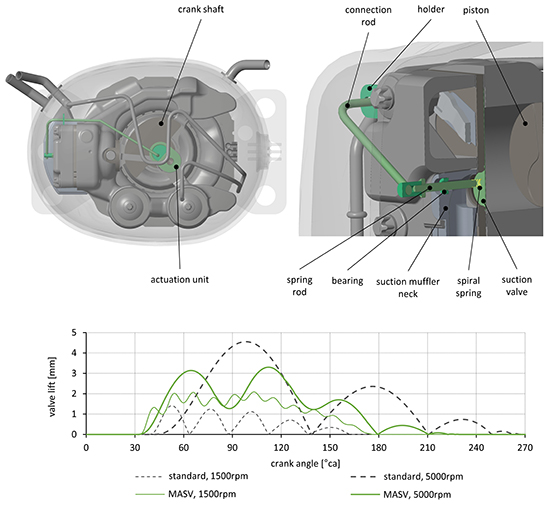
In essence, reed valves are widely used in hermetic reciprocating compressors for domestic refrigeration. They are crucial components in terms of efficiency, cooling performance and reliability of the compressor. While reed valves already cause a significant proportion of the thermodynamic losses in fixed speed compressors, they cause even more challenges in variable speed compressors. Especially in variable speed compressors, a further improvement of the reed valve dynamics requires the consideration of a new valve concept. In light of this, Graz University of Technology researchers: Andreas Egger, Raimund Almbauer, Lukas Dür, Johann Hopfgartner and Michael Lang introduced a novel and cost-effective concept of a mechanically assisted suction reed valve. Their work is currently published in the International Journal of Refrigeration.
Their concept comprised of a simple valve support mechanism and a conventional reed valve. Following an initial proof of concept, the researchers optimized several design variants based on a multi response optimization approach. Their objective was to simultaneously improve coefficient of performance, cooling capacity and reliability of the compressor.
The authors found that their concept was very robust in reducing suction work. In fact, simulations between 1500 rpm and 5000 rpm of initial design and optimized design variants showed suction work reductions of similar magnitude. Moreover, the researchers reported that when the compressor speed was low, there was a higher reduction of the percentage of the suction work. Overall, all mechanically assisted suction reed valve (MASV) variants showed significantly lower maximum suction valve impact velocities than the standard valve.
In summary, the study demonstrated a novel, cost effective concept of a mechanically assisted suction reed valve. The researchers employed a simulation-based response modelling and a multi-response optimization approach to systematically optimize the design. Remarkably, simulations between 1500 rpm and 5000 rpm indicated the strengths and weaknesses of individual optimized design variants over a wide compressor speed range. In a statement to Advances in Engineering, Andreas Egger, first author, explained that calorimeter and valve dynamics measurements showed considerable improvements of the coefficient of performance and the valve impact velocity.





Reference
Andreas Egger, Raimund Almbauer, Lukas Dür, Johann Hopfgartner, Michael Lang. Multi-Response optimization applied to a mechanically assisted reed valve of a hermetic reciprocating compressor. International Journal of Refrigeration: volume 119 (2020) page 119–130.