Advances in Engineering Advances in Engineering features breaking research judged by Advances in Engineering advisory team to be of key importance in the Engineering field. Papers are selected from over 10,000 published each week from most peer reviewed journals.

Significance
The studies on hydrogen permeation using different techniques have arrived at the conclusion that hydrogen migration in metals is generally enhanced along the grain boundaries. This non-trivial result was in a clear contradiction with the experimental and theoretical data that only diffusion of substitutional atoms can be enhanced along the grain boundaries or dislocations, whereas the both of these lengthy crystal lattice defects are the traps for interstitial atoms decreasing thereby their diffusivity. Substantial experimental evidence for non-diffusional character of the enhanced grain boundary flux of interstitial atoms is still lacking.
The group of scientists led by Professor Valentin Gavriljuk and including Dr. George Mogilny, Dr. Vladyslav Shyvaniuk, Dr. Sergey Teus from G.V. Kurdyumov Institute for Metal Physics and Dr. Ljubomyr Ivaskevych from G.V. Karpenko Physical-Mechanical Institute of National Academy of Sciences of Ukraine investigated the occurrence of plastic deformation during cathodic charging in metals and its role in the enhanced hydrogen flux along the grain boundaries of metals. Their work is currently published in the research journal, Acta Materialia.
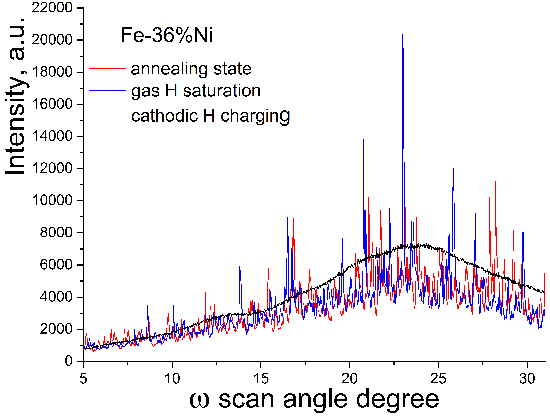
In their approach, the research team utilized a Fe-36Ni alloy because of its high hydrogen solubility and diffusivity properties. Using the omega scan X-ray diffraction technique, the effects of the electrolytic hydrogen charging on the crystalline structure of the annealed polycrystalline material was investigated and compared to that of gaseous hydrogenation. By analyzing the experimental data and the available literature data, they also discussed in detail whether enhanced hydrogen flux along the grain boundaries might be due to the hydrogen transportation by moving dislocations.
The authors observed that the electrolytic hydrogen charging leads to plastic deformation which increases density of dislocations and causes crystallographic texture. In contrast, the crystal structure remained unchanged during gaseous hydrogen charging due to the absence of plastic deformation, see Fig. 1.
As such, gaseous charging appeared to be the most suitable method for uncovering the grain boundary hydrogen diffusivity in polycrystalline metals. Notably, the stresses induced by the hydrogen concentration gradient were considered to be the only reason for plastic deformation. By analyzing and comparing the experimental data with the available literature information on hydrogen diffusion, the authors confirmed hydrogen transport by moving dislocations to be the underlying mechanism of enhanced hydrogen flux along the grain boundaries.
In summary, the study explored the effects of both gaseous hydrogenation and electrolytic hydrogen charging on the crystalline structure of Fe-36Ni alloy. Results provided evidence that plastic deformation is caused by electrolytic hydrogen charging. Moreover, hydrogen transport by sliding dislocations was identified as the primary mechanism for enhanced hydrogen flux at the grain boundary. In a statement to Advances in Engineering, by Professor Valentin Gavriljuk said their investigation provided useful insights that would benefit future studies on different metals.



Reference
Mogilny, G., Shyvaniuk, V., Teus, S., Ivaskevich, L., & Gavriljuk, V. (2020). On a mechanism for enhanced hydrogen flux along grain boundaries in metals. Acta Materialia, 194, 516-521.