 Advances in Engineering Advances in Engineering features breaking research judged by Advances in Engineering advisory team to be of key importance in the Engineering field. Papers are selected from over 10,000 published each week from most peer reviewed journals.

Significance
Increasing strict regulation measures on carbon emissions have motivated to develop power-generating systems based on renewable energy such as solar and wind. However, the electricity produced from the renewable sources is not constant and stable due to the dependence on the precarious weather conditions. To level out the variance in energy generation, the electrical energy storage (EES) systems are required, and redox-flow batteries have attracted attention as promising candidates due to their excellent benefit of independently controllable power and energy. However, their full application has not been achieved due to the issue of high system cost.
Ion-exchange membrane is known to be the most expensive cell component which dominates 40% of total cell cost. Extensive research efforts have been reported to remove the membrane from the cell, but most of them were applicable in small lab-scale cell due to the intrinsic issue of intermix of reactants from both sides of the cell, requiring in-depth research to resolve the intermixing problem.
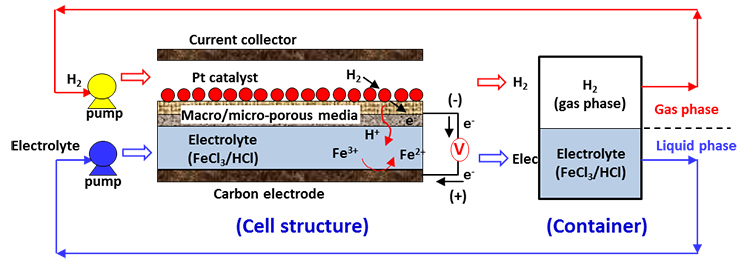
To this note, researchers in Electro-Chemical Thermal Energy Lab (ECTEL) at Northern Illinois University: Kyamra Marma, Jayanth Kolli and Professor Kyu Taek Cho conducted systematic research combined with cell-based test and physic-based mathematical model to resolve the aforementioned challenge through a new system called membrane-less hydrogen iron redox flow battery. First, the authors defined the key design parameters to enable this new environmentally friendly membrane-less system to work in optimal conditions. Secondly, immiscible electrolytes in different phases were applied to completely resolve the intermixing issue.
Furthermore, three-dimensional structure of porous carbon electrode was modified by Teflon impregnation to control the reactivity at the electrode. Therefore, challenging issue of the conventional membrane-less systems such as intermixing, crossover, separation of reaction, safety, cost, and durability could be resolved through this new flow battery system.
It was observed for the first time in this research that the membrane-less system exhibited significantly enhanced durability and stability as compared to the conventional membrane-based system. This behavior is attributed to the constant and stable ohmic properties for the membrane-less system, whereas contamination or fouling by cation was found serious in the membrane-based system, causing unstable ohmic properties. Moreover, the cell-based performance of the membrane-less system was equivalent to that of the membrane-based system.
In summary, Northern Illinois University scientists were the first to develop membrane-less hydrogen iron redox flow battery for solving the challenges in conventional systems. To understand underlying physics, they developed a physics-based mathematical model to investigate the electrochemical behavior of the reactants during the system operation. Interestingly, the system proved effective for solving the challenging issues. It is expected that results of this research will provide essential information to advance knowledge and technology for future flow battery systems. Their research work is currently published in Journal of Electrochemical Energy Conversion and Storage.

Reference
Marma, K., Kolli, J., & Cho, K. (2018). Membrane-Less Hydrogen Iron Redox Flow Battery. Journal of Electrochemical Energy Conversion and Storage, 16(1), 011005.
Go To Journal of Electrochemical Energy Conversion and Storage