Advances in Engineering Advances in Engineering features breaking research judged by Advances in Engineering advisory team to be of key importance in the Engineering field. Papers are selected from over 10,000 published each week from most peer reviewed journals.

Significance Statement
Block copolymers have attracted considerable attention for many decades because they can yield ordered structures in a wide range of morphologies, including spheres, cylinders, bicontinuous structures, lamellae, vesicles, and many other complex or hierarchical assemblies. In the block copolymers each molecule consist of at least two chemically different repeat units, A and B, whose immiscibility drives the system to form structures so as to minimize contacts between the unlike monomers.
The prediction of properties is fundamental in materials science and engineering. For this purpose, it is essential to develop theoretical and computational approaches sufficiently fast and accurate that the structure and property of the materials can be predicted for various conditions.
A particular advantage of molecular simulation techniques is that the properties of new materials can be predicted in advance of experiments. This allows the system to be adjusted and refined (or designed) so as to obtain the optimal properties before the arduous experimental task of synthesis and characterization
In this work we present calculations of the Flory-Huggins interaction parameter c for (N-isopropyl acrylamide)-water and (ethylene oxide)-water and compare with available experimental results and values from other theoretical calculations. By means of dissipative particles dynamics (DPD) we then simulate the coil-globule transition for PNIPAM chains in water.
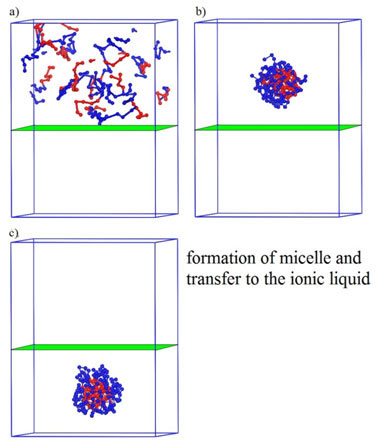
Besides, by considering the system micelle-water/anionic liquid (1-butyl-3-methylimidazolium hexafluorophosphate [BMIM][PF6]) it is shown that at T = 345 K there is a transfer of the micelle from water to the ionic liquid phase and this is due to the change in relative affinity of PEO to water and ionic liquid.

Journal Reference
Modelling and Simulation in Materials Science and Engineering, Volume 24, Number 4.
Rubén Bautista-Reyes1, César Soto-Figueroa2 , Luis Vicente1
[expand title=”Show Affiliations”]- Departamento de Física y Química Teórica, Facultad de Química, Universidad Nacional Autónoma de México, 04510, México D.F., México
- Facultad de Ciencias Químicas, Universidad Autónoma de Chihuahua, 31125 Chihuahua, México
Abstract
In this article we studied the micellar formation of poly(N-isopropyl acrylamide)-b-polyethylene oxide (PNIPAM-b-PEO) copolymers in an aqueous system. From molecular simulations the dependence on temperature of the Flory–Huggins interaction parameter χ for PNIPAM and PEO in water is obtained and compared with available experimental results and values from other theoretical calculations. By means of dissipative particle dynamics (DPD) we then simulated the coil–globule transition for PNIPAM chains in water with a transition temperature of around 305 K. The simulations for PNIPAM-b-PEO copolymers showed that at room temperature the chains are miscible in an aqueous phase but with a temperature increase the system turns into micelles at T = 305 K. The change in micelle anisotropy due to a different ratio PNIPAM/PEO of chains is also analyzed. What is observed is that for large PEO the large number of dissolved PEO chains gives a large corona size and the micelle is not spherical but obloide and as the number of PNIPAM is increased the micelle acquires a spherical shape. As an important application we considered the system micelle-water/anionic liquid (1-butyl-3-methylimidazolium hexafluorophosphate [BMIM]+[PF6]−). By increasing the temperature of the system from 306 K it is shown that at T = 345 K there is a transfer of the micelle from water to the ionic liquid phase and this was due to the change in the relative affinity of PEO to water and ionic liquid expressed by the change in χ. All the simulation outcomes are qualitatively consistent with experimental results and thus to our knowledge we give the first set of χ values for the interaction between PNIPAM and water in a wide range of temperature values.
Go To Modelling and Simulation in Materials Science and Engineering