Significance Statement
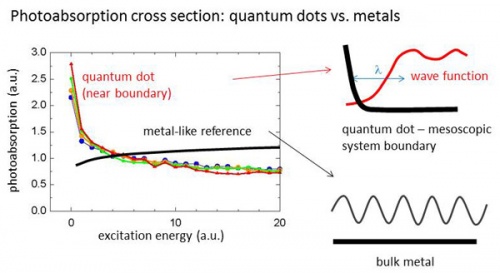
Nano- or mesoscopic systems, such as nanoparticles or quantum dots, may differ significantly in their properties from that of macroscopic samples, such as metallic probes: In the featured article we focus on the absorption properties for X-rays, i.e., the photoabsorption cross section at the so-called K-edge. We find it to characteristically differ in quantum dots, where the signal is peaked, from the rounded photoabsorption signal at the Fermi edge that has been long known for bulk metals. The origin of this difference lies in the existence of a system boundary – that is, if you will, exactly the property that makes a sample to be in the nano-/mesoscopic rather than in a macroscopic regime: Other than metallic Bloch waves, the electronic wave function drops to zero at mesoscopic system boundaries (see figure below). The wave function derivative has to take, as a direct consequence, relatively large values at the same time. These enter the photoabsorption cross section via the dipole matrix element, dominate the overall photoabsorption signal, and eventually explain the large absorption values of mesoscopic samples in contrast to metallic probes. Moreover, we had previously seen characteristic boundary effects in the photoabsorption signal for graphene (Röder et al., Europhys.Lett. 2011). These examples illustrate the application potential as well at the importance of edge and boundary effects in the continuing miniaturization of devices.

Journal Reference
The European Physical Journal B, January 2014, 87:12.
Martina Hentschel, Georg Röder
Institut für Physik, Technische Universität Ilmenau, Weimarer Str. 25, 98693, Ilmenau, Germany and
Max-Planck-Institut für Physik komplexer Systeme, Nöthnitzer Str. 38, 01187, Dresden, Germany
Abstract
We investigate the X-ray edge problem and photoabsorption spectra of mesoscopic quantum dot systems, in particular those of rectangular shape. We find strong signatures of Fermi-edge singularities in the photoabsorption cross section that characteristically differ from the well-studied metallic behaviour. The averaged photoabsorption at K-edge, typically rounded in the metallic case, develops a peaked characteristics, comparable to the metallic and mesoscopic L-edge signature, in quantum dots. It stems from the contribution of the system boundary region to the photoabsorption signal and has its origin in the correlation between the single-particle wave functions and their derivatives near a system boundary.
Go to Journal
 Advances in Engineering Advances in Engineering features breaking research judged by Advances in Engineering advisory team to be of key importance in the Engineering field. Papers are selected from over 10,000 published each week from most peer reviewed journals.