Advances in Engineering Advances in Engineering features breaking research judged by Advances in Engineering advisory team to be of key importance in the Engineering field. Papers are selected from over 10,000 published each week from most peer reviewed journals.

Significance
Copper as well as its alloys have seen modern world applications in the form of building elements for applications in micro-electronics. Copper (Cu) is quite resistant to corrosion in neutral environments as well as sulfur dioxide and chloride free environments, protected by a layer of copper dioxide, also known as patina. Unfortunately, Cu is susceptible to corrosion when exposed to aggressive media, when the patina is converted to other corrosion products.
A number of methods have been implemented to mitigate metallic corrosion. The use of organic and inorganic inhibitors is one of them. Organic inhibitors are compounds that are normally applied in small concentrations and have the potential to efficiently minimize the rate of corrosion. Compounds belonging to the azoles group contain sulfur and/or nitrogen heteroatoms that have great affinity to Cu and its alloys, serving as the anchoring point between these organic molecules and copper surface. Because of this attraction, the azoles are considered as effective corrosion inhibitors for Cu in an array of aggressive environments.
Inhibitor selection is based usually on gravimetric determination of metal dissolution rate, but unfortunately this method provides insufficient information about the complex interactions between the inhibitor, metal surface, and the corrosive media. Therefore, in order to optimize inhibition efficiency, the mechanism of interaction with the metal system must be adequately understood. However, this approach calls for the application of electrochemical methods, as well as surface analysis.
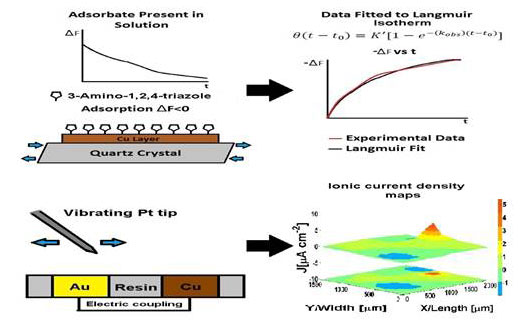
Electrochemical quartz crystal microbalance (EQCM) is an electrochemical method that allows for the acquisition of the relevant data about the adsorption of molecules on metallic surfaces with microscale resolution, therefore, enabling the characterization of their adsorption kinetics. The method works by applying an oscillatory electrical field to a quartz resonator placed between two electrodes.
Prof. Dr. Lucien Veleva and Dr. J.A. Ramírez-Cano at CINVESTAV-Merida, Mexico in collaboration with Dr. Bibiana M. Fernández-Pérez and Prof. Ricardo M. Souto at University of La Laguna in Spain, characterized the electrochemistry of metal-inhibitor interaction of 3-amino-1,2,4-triazole (ATA) using open circuit potential measurements (OCP, free corrosion potential), scanning vibrating electrode technique (SVET), and electrochemical quartz crystal microbalance technique (EQCM). Their research work is published in peer-reviewed journal, Materials and Corrosion.
The authors treated the surfaces of gold (Au) and copper micro-electrodes, separately and electrically connected in a bid to form a galvanic Au-Cu pair with ATA, considered as a corrosion inhibitor. The basis for selecting this galvanic pair was based on the current trends in microelectronics, where Cu and Au made components are in close proximity. They tested the surface reactivity of the inhibitor-modified metals in diluted chloride solution (1 mM NaCl).
The presence of the azole inhibitor ATA on Au and Cu surfaces was observed to modify the open circuit potentials of both metals. The inhibitor shifted the free corrosion potential (OCP) of gold to a more positive value, while that of copper became slightly more negative. In view of these facts, the authors concluded that the inhibitor ATA was not copper corrosion inhibitor.
The free adsorption energy computations, based on the recorded frequency response performed with the electrochemical quartz crystal microbalance, indicated that the inhibitor ATA was physisorbed on both metal surfaces. Considering that the main protection mechanism related to this organic inhibitor is the development of a physical barrier between the metal surface and the aggressive media, the efficiency of a physisorbed film was lower-ranking. As the inhibitor ATA (3-amino-1,2,4-triazole) was not chemisorbed, its adhesion forces to the metal surface wasn’t strong, compromising its ability to act as an effective barrier between the metal and the aggressive environment.



Reference
J. A. Ramírez-Cano, L. Veleva, R. M. Souto, and B. M. Fernández-Pérez. Investigating metal-inhibitor interaction with EQCM and SVET: 3-amino-1,2,4-triazole on Au, Cu and Au–Cu galvanic coupling. Materials and Corrosion issue 69 (2018), pages 115–124.
Go To Materials and Corrosion