Advances in Engineering Advances in Engineering features breaking research judged by Advances in Engineering advisory team to be of key importance in the Engineering field. Papers are selected from over 10,000 published each week from most peer reviewed journals.

Significance
Optically and thermally excited states have exhibited similar and different chemical reactions and physical properties that have recently attracted significant research attention in an attempt to understand the purely optical processes. The variance in the relationship between thermal and optical excitations depend on several factors including observation time-scales and excitation materials. Taking photoconduction, for example, heat can be produced in various ways through photocarriers or many-body effects during successive or parallel processes. However, it cannot give a good description and understanding of the optical and thermal effects. Therefore, despite the difficulty in separation, researchers have recently identified that the underlying photoexcited conduction properties can be best realized by separating them from the thermally excited carriers. This requires the development of efficient analysis approaches for such separation techniques.
Herein, scientists at Ehime University: Professor Toshio Naito, Tomoaki Karasudani, Ryoma Yamamoto, Ming Yang Zhang, and Professor Takashi Yamamoto presented an optically excited state with high chances of exhibiting high conduction like metals based on the tentative analysis. The main objective was to observe an optically excited and possible highly conducting state in the molecular crystal. Their research work is currently published in the research journal, Journal of Materials Chemistry C.
In brief, the research team started by exploring the unique electronic state and properties of the molecular charge-transfer salts that have recently caught researchers’ attention. In particular, they investigated a new molecular charge-transfer salt with a peculiar interest in its semiconducting properties governed by its radical anions. Eventually, structural, theoretical and spectroscopic examinations were conducted to determine the factors influencing high conductance of the salt.
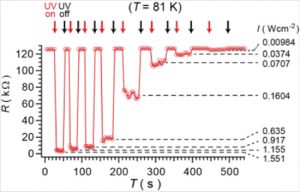
Despite being an insulator, the salt exhibited high conductance similar to metallic substances around room temperature even under the dark condition, though the temperature-dependence of the electrical resistivity was clearly non-metallic. This was attributed to the fluctuations in the charge distribution of the anions which are closely and isotropically packed in a two-dimensional sheet. Unlike other organic charge-transfer salts, the qualitative conduction behavior of this salt is highly unlikely to be affected by changes in temperature and pressure. However, based on the proposed analysis model, UV irradiation corresponding to a charge transfer between the anions induces the charge distribution required to achieve a highly conducting state. Under the UV-radiation, not only the conducting properties but also the magnetic properties exhibited characteristic temperature-dependences unique to metallic substances, which are qualitatively different from those of non-metallic substances. It is worthy of note that well-known photoconduction does not produce metallic conduction, i.e. the temperature-dependence of electrical resistivity unique to metallic substances, even if it could produce high conduction like metallic substances at a particular temperature. This means that the mechanism of photoconduction discovered herein should be different from what has been known for nearly fifty years. In addition, it should be emphasized that such physical properties or the state of matter in this material are not realized in thermodynamic ways such as the control of temperature and pressure, let alone chemical syntheses. This fact suggests that the newly found state, which was separated from thermally excited and the ground states, could be a new unknown state being even different from metallic states we are familiar with and could be exclusively achieved by appropriate optical excitations.
The fluctuation exhibited a unique tendency not to order the charge but to maintain a homogenous charge distribution. Whereas the tendency was also not affected by the variation in temperature and pressure, it was enhanced by the photoexcitation of charge transfer transition between the anions. Due to this characteristic, the authors successfully observed an optically excited and possible highly conducting state in the molecular crystal.
Based on the results, the study indicated the possibility of the existence of unique, unknown electronic state and physical properties in the photoexcited states. Therefore, Professor Naito, the lead author in a statement to Advances in Engineering expressed his confidence that the research will pave the way for developing rich chemistry in the high energy world of matter.

Reference
Naito, T., Karasudani, T., Yamamoto, R., Zhang, M., & Yamamoto, T. (2019). A possibly highly conducting state in an optically excited molecular crystal. Journal of Materials Chemistry C, 7(30), 9175-9183.