Advances in Engineering Advances in Engineering features breaking research judged by Advances in Engineering advisory team to be of key importance in the Engineering field. Papers are selected from over 10,000 published each week from most peer reviewed journals.

Significance
In recent years, the world’s curiosity and interest in medium Mn (4-7%) steels have grown exponentially, especially due to their specific strain hardening behavior. This property enables the steels to possess an extremely desirable strength-ductility balance. What makes medium Mn steels unique relative to other advanced high strength steels, is that these characteristics are achieved with the minimal addition of alloys. For instance, high Mn twinning-induced plasticity (TWIP) steels in spite of having similar properties with the steel above require a significant addition of alloys to achieve their properties. Pohang University of Science and Technology researchers in South Korea in collaboration with Javad Mola at Technische Universitat Bergakademie Freiberg in Germany investigated the deformation mechanisms of a medium Mn austenitic steel and explored its potential benefits regarding micro-plasticity. Their research work is published in Acta Materialia.
To realize their objectives, the researchers conducted an experimental procedure involving hot‑rolled steel with a composition of Fe-1.2%C-7.0%Mn (in wt. %). Electron backscatter diffraction technique was used to select grains with specific orientations. Nano-indention tests and in situ micro-pillar compression tests were conducted using Hysitron PI 85 SEM Pico-Indenter. The researchers then used transmission electron microscopy to investigate dislocation interactions and the evolution of the deformation microstructure after nano-indentation and micro-pillar compression tests.
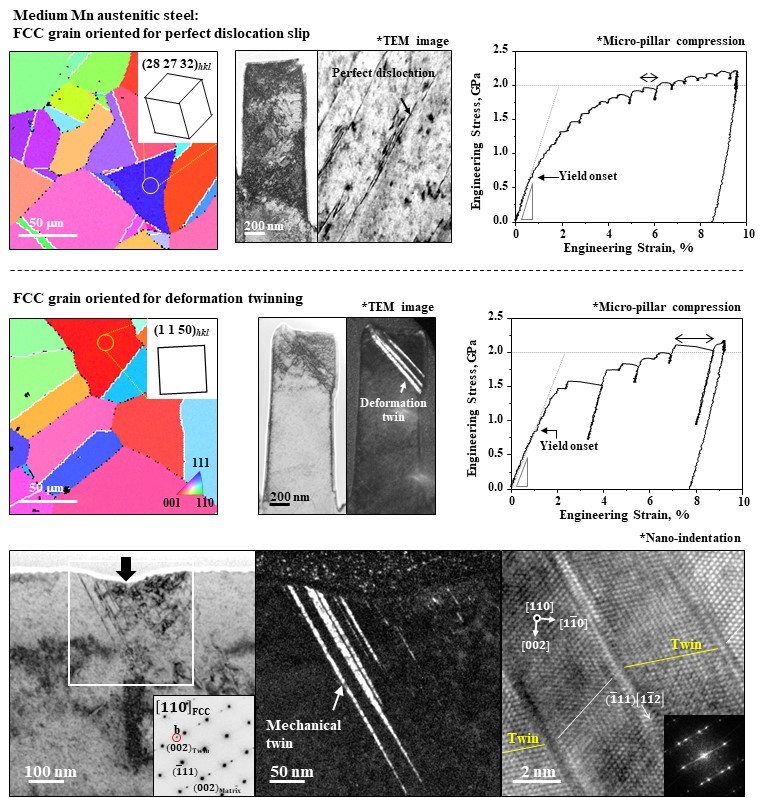
Coarse austenite grains (> 50 µm) with the surface normal oriented close to the [001] and [111] directions were selected for the nano-indention and micro-pillar compression tests. The results showed that deformation twinning was favored in the crystals that had a [001] orientation, whereas perfect dislocation glide was more pronounced in [111]-oriented crystals.
The researchers reported that the stacking fault energy (SFE) of the medium Mn austenitic steel was estimated to be in the range of 28-34 mJ·m-2. Within this specified SFE range, only twinning and dislocation gliding could be observed during deformation.
They also revealed the steel grain orientation-dependence of the deformation mechanism during nano-indention and micro-pillar compression. The analysis based on Schmid’s law was further used to explain the deformation behaviors that had been observed during the experimental procedure. On the basis of the Schmid factor analysis, when the loading was along the [111] direction, the deformation twinning was suppressed. On the other hand, when the orientation for compressive loading is in the [001] direction, the Schmid factor for leading partial dislocation is larger than that for the trailing one, hence resulting in creation of wide stacking and twin formation. Therefore, during the compression of the [001]-oriented micro-pillar, the rapid twin growth led to large strain bursts. The observations offer strong support for the hypothesis that deformation twinning is a plasticity enhancing mechanism activated during the deformation of medium Mn steel.





Reference
Eun Jung Seo, Jin Kyung Kim, Lawrence Cho, Javad Mola, Chang Yeol Oh, Bruno C. De Cooman. Micro-plasticity of medium Mn austenitic steel: Perfect dislocation plasticity and deformation twinning. Acta Materialia, Volume 135, 15 August 2017, Pages 112-123.
Go To Acta Materialia